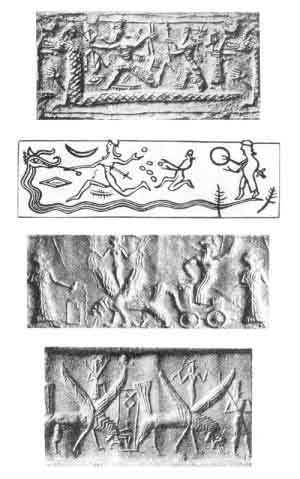
One of the most difficult groups of concepts to identify and interpret is that represented by the Sumerian word
kur.
That one of its primary meanings is "mountain" is attested by the fact
that the sign used for it is actually a pictograph representing a
mountain. From the meaning "mountain" developed that of "foreign land,"
since the mountainous countries bordering Sumer were a constant menace
to its people.
Kur also came to mean "land" in general; Sumer itself is described as
kur-gal, "great land."
But in addition the Sumerian word
kur represented a cosmic concept. Thus it seems to be identical to a certain extent with the Sumerian
ki-gal, "great below." Like
ki-gal,
therefore, it has the meaning "nether world"; indeed in such poems as
"Inanna's Descent to the Nether World" and "Gilgamesh, Enkidu, and the
Nether World," the word regularly used for "nether world" is
kur.
Kur
thus cosmically conceived is the empty space between the earth's crust
and the primeval sea. Moreover, it is not improbable that the monstrous
creature that lived at the bottom of the "great below" immediately over
the primeval waters is also called Kur; if so, this monster Kur would
correspond to a certain extent to the Babylonian Tiamat. In three of
four "Myths of Kur," it is one or the other of these cosmic aspects of
the word
kur which is involved.
THE DESTRUCTION OF KUR: THE SLAYING OF THE DRAGON
It is now more than half a century since the Babylonian "Epic of
Creation," which centers largely about the slaying of the goddess Tiamat
and her host of dragons, has been available to scholar and layman.
Inscribed in Accadian, a Semitic language, on tablets dating from the
first millennium B. C.--tablets that are therefore later by more than a
p. 77
millennium than our Sumerian literary inscriptions--it is quoted and
cited in the major works concerned with mythology and religion as an
example of Semitic myth-making. But even a surface examination of its
contents clearly reveals Sumerian origin and influence. The very names
of its protagonists are in large part Sumerian. What prevented scholars
from making any effective comparisons, is the fact that so little was
known of any original Sumerian tales involving the slaying of a dragon.
It is therefore deeply gratifying to be in a position to present the
contents of what are probably three distinct Sumerian versions of the
dragon-slaying myth. Two of these are almost entirely unknown; their
contents have been reconstructed and deciphered by me in the course of
the past several years. The third has been known to a certain extent for
a number of decades, but the new material in Istanbul and Philadelphia
adds considerably to its contents and clarity.
Obviously enough the dragon-slaying motif is not confined to the
myths of Mesopotamia. Almost all peoples and all ages have had their
dragon stories. In Greece, especially, these tales, involving both gods
and heroes, were legion. There was hardly a Greek hero who did not slay
his dragon, although Heracles and Perseus are perhaps the best known
dragon-killers. With the rise of Christianity, the heroic feat was
transferred to the saints; witness the story of "St. George and the
Dragon" and its numerous and ubiquitous parallels. The names are
different and the details vary from story to story and from place to
place. But that at least some of the incidents go back to a more
original and central source, is more than likely. And since the
dragon-slaying theme was an important motif in the Sumerian mythology of
the third millennium B. C., it is not unreasonable to assume that many a
thread in the texture of the Greek and early Christian dragon tales
winds back to Sumerian sources.
As stated above, we may have three versions of the
slaying-of-the-dragon myth as current in Sumer in the third millennium
B. C. The first involves the Sumerian water-god
p. 78
[paragraph continues] Enki,
whose closest parallel among the Greek gods is Poseidon. The hero of the
second is Ninurta, prototype of the Babylonian god Marduk when playing
the role of the "hero of the gods" in the Babylonian "Epic of Creation."
In the third it is Inanna, counterpart of the Semitic Ishtar, who plays
the leading role. In all three versions, however, the monster to be
destroyed is termed Kur. Its exact form and shape are still uncertain,
but there are indications that in the first two versions it is conceived
as a large serpent which lived in the bottom of the "great below" where
the latter came in contact with the primeval waters. For at least
according to one of the versions, when Kur is destroyed, these waters
rise to the surface of the earth and all cultivation with its resulting
vegetation becomes impossible.
It is the first of the three versions of the slaying of the dragon
which seems to be the more original; the details of the story, few as
they are, are significant and instructive. For in the first place, the
battle between the god and Kur seems to take place not long after the
separation of heaven and earth. Moreover, the crime involved is probably
that of abducting a goddess; it therefore brings to mind the Greek
story of the rape of Persephone. Finally, it is the water-god Enki, the
"god of wisdom," one of the ruling and creating deities of Sumer, who is
the hero of the story. Unfortunately
_____________________________________________________-
PLATE XIX. GODS AND DRAGONS
The first and second designs depict the combat of a
god with a snakelike dragon. It is to be noted, however, that both
designs are on cylinder seals of the first millennium B. C., and it is
doubtful whether they depict the Ninurta-Kur battle of our Sumerian
myth. The third design shows a fire-spitting winged dragon drawing the
chariot of a god who had probably subjugated it in battle; between the
two wings stands a nude female deity. Closely related to this scene is
that of the fourth design, where the god and goddess are each riding on
the back of a winged dragon.
(The first and second designs are from A. Jeremias, Handbuch der altorientalischen Geisteskultur
(Berlin and Leipzig, 1929), page 431. The third and fourth designs are
reproduced, by permission of the Macmillan Company, from Henri
Frankfort, Cylinder Seals, plate XXIIa, d.)

Click to enlarge
PLATE XIX
GODS AND DRAGONS
(for description, see opposite page.)
p. 79
we have only a very brief laconic passage from which to reconstruct
our story; the tablets on which the details of the myth are inscribed
are still lying no doubt in the ruins of Sumer. What we do have is part
of the introductory prologue to the epic tale "Gilgamesh, Enkidu, and
the Nether World," whose contents have been described on page
30 ff. Briefly sketched, this version of our story runs as follows:
After heaven and earth had been separated, An, the heaven-god,
carried off the heaven, while Enlil, the air-god, carried off the earth.
It was then that the foul deed was committed. The goddess Ereshkigal
was carried off violently into the nether world, perhaps by Kur itself.
Thereupon Enki, the water-god, whose Sumerian origin is uncertain, but
who toward the end of the third millennium B. C. gradually became one of
the most important deities of the Sumerian pantheon, set out in a boat,
in all probability to attack Kur and avenge the abduction of the
goddess Ereshkigal. Kur fought back savagely with all kinds of stones,
large and small. Moreover it attacked Enki's boat, front and rear, with
the primeval waters which it no doubt controlled. Here our brief
prologue passage ends, since the author of "Gilgamesh, Enkidu, and the
Nether World" is not interested in the dragon story primarily but is
anxious to proceed with the Gilgamesh tale. And so we are left in the
dark as to the outcome of the battle. There is little doubt, however,
that Enki was victorious. Indeed it is not at all unlikely that the myth
was evolved in large part for the purpose of explaining why, in
historical times, Enki, like the Greek Poseidon, was conceived as a
sea-god; why he is described as "lord of the abyss"; and why his temple
in Eridu was designated as the "sea-house."
74
The second version of the slaying-of-the-dragon myth is particularly
significant since this is the version which must have been utilized in
large part by the Semitic redactors of the Babylonian "Epic of
Creation."
74 The story is part of a large epic tale of over six hundred lines, best entitled
p. 80
[paragraph continues] "The Feats
and Exploits of Ninurta." The contents can now be reconstructed in
large part from at least 49 tablets and fragments, 30 of which have been
copied and published by various scholars in the course of the past
several decades; a large part of the text has therefore been known for
some time.
75
Nevertheless, because of the numerous breaks and gaps, several of the
more important pieces could not be properly arranged. This situation was
eased to a considerable extent when I located in Istanbul and
Philadelphia more than a score of additional pieces belonging to the
poem., And so, while the text is still badly broken at numerous crucial
points, the contents as a whole can now be reconstructed with a fair
degree of certainty.
76
Hero of the tale is Ninurta, the warrior-god, who was conceived by
the Sumerians as the son of Enlil, the air-god. After a hymnal
introduction the story begins with an address to Ninurta by Sharur, his
personified weapon. For some reason not stated in the text as yet
available, Sharur has set its mind against Kur. In its speech,
therefore, which is full of phrases extolling the heroic qualities and
deeds of Ninurta, it urges Ninurta to attack and destroy Kur. Ninurta
sets out to do as bidden. At first, however, be seems to have met more
than his match and he "flees like a bird." Once again, however, Sharur
addresses him with reassuring and encouraging words. Ninurta now attacks
Kur fiercely with all the weapons at his command, and Kur is completely
destroyed.
With the destruction of Kur, however, a serious calamity overtakes
the land. The primeval waters which Kur had held in check rise to the
surface and as a result of their violence no fresh water can reach the
fields and gardens. The gods of the land who "carried the pickax and the
basket," that is, who had charge of irrigating the land and preparing
it for cultivation, are desperate. The Tigris waters do not rise, the
river carries no good water.
Famine was severe, nothing was produced,
The small rivers were not cleaned, the dirt was not carried off, p. 81
On the steadfast fields no water was sprinkled, there was no digging of ditches,
In all the lands there were no crops, only weeds grew.
Thereupon the lord sets his lofty mind,
Ninurta, the son of Enlil, brings great things into being.
He sets up a heap of stones over the dead Kur and heaps it up like a
great wall in front of the land. These stones hold back the "mighty
waters" and as a result the waters of the lower regions rise no longer
to the surface of the earth. As for the waters which had already flooded
the land, Ninurta gathers them and leads them into the Tigris, which is
now in a position to water the fields with its overflow. To quote the
poet:
What had been scattered, he gathered,
What by Kur had been dissipated,
He guided and hurled into the Tigris,
The high waters it pours over the farmland.
Behold now everything on earth
Rejoiced afar at Ninurta, the king of the land;
The fields produced much grain,
The harvest of palm-grove and vineyard was fruitful,
It was heaped up in granaries and hills;
The lord made mourning disappear from the land,
He made good the liver of the gods.
Hearing of her son's great and heroic deeds, his mother Ninmah--also
known as Ninhursag and Nintu, and more originally perhaps as Ki, the
mother earth--is taken with love for him; she becomes so restless that
she is unable to sleep in her bedchamber. She therefore addresses
Ninurta from afar with a prayer for permission to visit him and feast
her eyes upon him. Ninurta looks at her with the "eye of life," saying:
"O thou lady, because thou wouldst come to a foreign land,
O Ninmah, because for my sake thou wouldst enter an inimical land,
Because thou hast no fear of the terror of the battle surrounding me,
Therefore, of the hill which I, the hero, have heaped up,
Let its name be Hursag (mountain), and thou be its queen."
p. 82
Ninurta then blesses the Hursag that it may produce all kinds of
herbs, wine and honey, various kinds of trees, gold, silver, and bronze,
cattle, sheep, and all "four-legged creatures." After this blessing of
the Hursag, he turns to the stones, cursing those which have been his
enemies in his battle with Kur and blessing those which have been his
friends; this entire passage, in style and tone,
not in content,
is very reminiscent of the blessing and cursing of Jacob's sons in the
forty-ninth chapter of Genesis. The poem closes with a long hymnal
passage exalting Ninurta.
The third version of the slaying-of-the-dragon myth is a poem
consisting of one hundred and ninety lines of text which may be best
entitled "Inanna and Ebih."
77 Although by 1934 eight pieces belonging to the story
78
had already been copied and published by the late Edward Chiera and
Stephen Langdon, so little was understood of the myth that several of
the pieces were not even recognized as belonging to it. A thorough
reexamination of the material, including four hitherto unknown pieces,
two from Istanbul and two from Philadelphia,
79 enabled me to reconstruct the major part of the text in the course of the past two years.
The dragon-slayer in this version of the story is not a god but a
goddess, none other than Inanna, the counterpart of the Semitic Ishtar.
For curious as it may seem, Inanna, to judge from our literary material,
was conceived not only as the goddess of love but also as the goddess
of battle and strife. And the reason for one of the puzzling and
enigmatic epithets regularly ascribed to Inanna in the hymns, namely,
"destroyer of Kur," is now clear. In our myth, it must be noted, Kur is
also called "mountain Ebih," a district northeast of Sumer. This Kur
represents, therefore, an inimical land, and is not to be identified
with the cosmic Kur of the Ninurta and Enki versions.
The poem begins with a long hymnal passage extolling the virtues of
Inanna. Follows a long address by Inanna to An, the heaven-deity,
nominally, at least, the leading
p. 83
deity of the Sumerian pantheon (actually by the third millennium. B.
C. Enlil, the air-god, had already usurped his place). While the meaning
of her speech is at times difficult to penetrate, Inanna's demand is
clear; unless Kur, which seems quite unaware of, or at least oblivious
to, her might and power, becomes duly submissive and is ready to glorify
her virtues, she will do violence to the monster. To quote but part of
her threat:
"The long spear I shall hurl upon it,
The throw-stick, the weapon, I shall direct against it,
At its neighboring forests I shall strike up fire,
At its . . . I shall set up the bronze ax,
All its waters like Gibil (the fire-god) the purifier I shall dry up,
Like the mountain Aratta, I shall remove its dread,
Like a city cursed by An, it will not be restored,
Like (a city) on which Enlil frowns, it shall not rise up."
An answers her with a detailed account of the mischief which Kur has wrought against the gods:
"Against the standing place of the gods it has directed its terror,
In the sitting place of the Anunnaki it has led forth fearfulness,
Its dreadful fear it has hurled upon the land,
The 'mountain,' its dreadful rays of fire it has directed against all the lands."
Continuing with a description of the power and wealth of Kur, An
warns Inanna against attacking it. But Inanna is not taken aback by An's
discouraging speech. Full of anger and wrath she opens the "house of
battle" and leads out all her weapons and aids. She attacks and destroys
Kur, and stationing herself upon it, she utters a paean of
self-glorification.
INANNA'S DESCENT TO THE NETHER WORLD u
The text of this myth, which I have designated as "Inanna's Descent
to the Nether World," has been reconstructed and deciphered by me in the
course of the past six years. Its influence on literature and mythology
has been universal and profound. Moreover, the story of its
decipherment
p. 84
furnishes a most illuminating illustration of the not uninteresting
process involved in the reconstruction of the texts of the Sumerian
literary compositions.
For many years, for almost three-quarters of a century, a myth
usually designated as "Ishtar's Descent to the Nether World" has been
known to scholar and layman. Like the Babylonian "Epic of Creation,"
this poem was found inscribed in the Accadian language on tablets dating
from the first millennium B. C.; these, therefore, postdate our
Sumerian literary tablets by more than a millennium. Like the "Epic of
Creation," "Ishtar's Descent to the Nether World," too, was therefore
generally assumed to be of Semitic origin; it is cited and quoted in the
major works concerned with mythology and religion as a remarkable
example of Babylonian myth-making. With the appearance of the
publications devoted to the Nippur material, however, it became
gradually obvious that this "Semitic" myth goes back to a Sumerian
original in which Ishtar is replaced by
___________________________________________________
PLATE XX. INANNA'S DESCENT TO THE NETHER WORLD
The 14 tablets and fragments illustrated here furnish
a historical commentary on the reconstruction and translation of the
myth "Inanna's Descent to the Nether World," recently published by the
author. 80
The arrangement of the plate is aimed to illustrate the process of
piecing together the tablets and fragments utilized in the
reconstruction of the poem. Nos. 1, 2, and 5 were published by Poebel in
1914. 81 Nos. 3 and 4 were published by Langdon in 1914. 81
No. 6, which is in the University Museum, was identified by Chiera as
the lower half of the very same tablet whose upper half, no. 3 on our
plate, had been copied by Langdon in Istanbul. Chiera's discovery
enabled me to publish my first reconstruction of the myth in 1937. 83 Nos. 7-9 were published by Chiera in 1934. 84 Nos. 10-12 were identified and copied by the author some five years ago in the Museum of the Ancient Orient at Istanbul. 85 Nos. 13 and 14 were identified and copied by the author recently in Philadelphia. 86
The utilization of these five newly discovered texts made possible the
edition published in 1942. The marked passage on no. 8 contains the
lines describing Inanna's decision to descend to the nether world; that
on no. 13 contains the lines describing the death of the goddess; the
reverse of no. 10 (not on our plate, which contains the obverse only)
has the resurrection passage. The transliteration and the translation of
these three most significant passages will be found in note 87.
(This plate is arranged from Proceedings of the American Philosophical Society 85 (3), plates 1-10.)

Click to enlarge
PLATE XX
INANNA'S DESCENT TO THE NETHER WORLD
(For description, see opposite page.)
p. 85
[paragraph continues] Inanna,
her Sumerian counterpart. Arno Poebel, now of the Oriental Institute of
the University of Chicago, was the first to locate three small pieces
belonging to this myth in the University Museum at Philadelphia; these
were published as early as 1914.
81
In the very same year, the late Stephen Langdon, of Oxford, published
two pieces which he had uncovered in the Museum of the Ancient Orient at
Istanbul.
82
One of these was the upper half of a large four-column tablet which, as
will soon become evident, proved to be of major importance for the
reconstruction of the text of the myth. The late Edward Chiera uncovered
three additional pieces in the University Museum. These were published
in his two posthumous volumes consisting of copies of Sumerian literary
texts which I prepared for publication for the Oriental Institute in
1934.
84
By this time, therefore, we had eight pieces, all more or less
fragmentary, dealing with the myth. Nevertheless the contents remained
obscure, for the breaks in the tablets were so numerous and came at such
crucial points in the story that an intelligent reconstruction of the
extant parts of the myth remained impossible. It was a fortunate and
remarkable discovery of Chiera which saved the situation. He discovered
in the University Museum at Philadelphia, the
lower half of the very same four-column tablet whose
upper
half had been found and copied by Langdon years before in the Museum of
the Ancient Orient at Istanbul. The tablet had evidently been broken
before or during the excavation, and the two halves had become
separated; the one had been retained in Istanbul, and the other had come
to Philadelphia. Unfortunately, Chiera, who fully realized the
significance of his discovery, died before he was in a position to
utilize it.
It was by making use of this lower half of the four-column tablet,
despite the fact that it, too, is very poorly preserved, that I was
enabled to reconstruct the contents of the myth. For when the two halves
of the tablet were joined, the combined text furnished an excellent
framework in which and about which all the other extant fragments
p. 86
could be properly arranged. Needless to say, there were still
numerous gaps and breaks in the text which made the translation and
interpretation of the text no easy matter, and the meaning of several of
the more significant passages in the story remained obscure. In 1937 I
was fortunate enough to discover in Istanbul three additional pieces
belonging to the myth,
85
and upon returning to the United States in 1939 I located another large
piece in the University Museum at Philadelphia, and yet another in
1940.
86
These three fragments helped to fill in the most serious lacunae in my
first reconstruction and translation, and as a result, the myth, as far
as it goes, is now almost complete; the scientific edition, including
the original text, and its transliteration and translation, has just
been published."
Inanna, queen of heaven, the goddess of light and love and life, has
set her heart upon visiting the nether world, perhaps in order to free
her lover Tammuz. She gathers together all the appropriate divine
decrees, adorns herself with her queenly robes and jewels, and is ready
to enter the "land of no return." Queen of the nether world is her elder
sister and bitter enemy Ereshkigal, the goddess of darkness and gloom
and death. Fearing lest her sister put her to death in the nether world,
Inanna instructs her messenger, Ninshubur, who is always at her beck
and call, that if after three days she shall have failed to return, he
is to go to heaven and set up a hue and cry for her in the assembly hall
of the gods. Moreover, he is to go to Nippur, the very city where our
tablets have been excavated, and there weep and plead before the god
Enlil to save Inanna from Ereshkigal's clutches. If Enlil should refuse,
he is to go to Ur, Ur of the Chaldees, whence according to Biblical
tradition Abraham migrated to Palestine, and there repeat his plea
before Nanna, the great Sumerian moon-god. If Nanna, too, refuses, he is
to go to Eridu, the city in which Sumerian civilization is said to have
originated, and weep and plead before Enki, the "god of wisdom." And
the latter, "who knows the food of life, who knows the water of life,"
will restore Inanna to life.
p. 87
Having taken these precautions, Inanna descends to the nether world
and approaches Ereshkigal's temple of lapis lazuli. At the gate she is
met by the chief gatekeeper, who demands to know who she is and why she
came. Inanna concocts a false excuse for her visit, and the gatekeeper,
upon instructions from his mistress Ereshkigal, leads her through the
seven gates of the nether world. As she passes through each of the gates
part of her robes and jewels are removed in spite of her protest.
Finally after entering the last gate she is brought stark naked and on
bended knees before Ereshkigal and the seven Anunnaki, the dreaded
judges of the nether world. These latter fasten upon Inanna their "look
of death," whereupon she is turned into a corpse and hung from a stake.
So pass three days and three nights. On the fourth day, Ninshubur,
seeing that his mistress has not returned, proceeds to make the rounds
of the gods in accordance with his instructions. As Inanna had foreseen,
both Enlil of Nippur and Nanna of Ur refuse all help. Enki, however,
devises a plan to restore her to life. He fashions the
kurgarru and
kalaturru,
two sexless creatures, and entrusts to them the "food of life" and the
"water of life," with instructions to proceed to the nether world and to
sprinkle this food and this water sixty times upon Inanna's suspended
corpse. This they do and Inanna revives. As she leaves the nether world,
however, to reascend to the earth, she is accompanied by the shades of
the dead and by the bogies and harpies who have their home there.
Surrounded by this ghostly, ghastly crowd, she wanders through Sumer
from city to city.
Here all extant source material for "Inanna's Descent to the Nether
World" unfortunately breaks off, but this is not the end of the myth. It
is not too much to hope, however, that some day in the not too distant
future the pieces on which the conclusion of the story is inscribed will
be discovered and deciphered. Following is a literal translation of the
composition; even in its present incomplete state
p. 88
it provides an excellent illustration of the mood and temper, the swing and rhythm of Sumerian poetry:
From the "great above" she set her mind toward the "great below,"
The goddess, from the "great above" she set her mind toward the "great below,"
Inanna, from the "great above" she set her mind toward the "great below."
My lady abandoned heaven, abandoned earth,
To the nether world she descended,
Inanna abandoned heaven, abandoned earth,
To the nether world she descended,
Abandoned lordship, abandoned ladyship,
To the nether world she descended.
In Erech she abandoned Eanna,
To the nether world she descended,
In Badtibira she abandoned Emushkalamma,
To the nether world she descended,
In Zabalam she abandoned Giguna,
To the nether world she descended,
In Adab she abandoned Esharra,
To the nether world she descended,
In Nippur she abandoned Baratushgarra,
To the nether world she descended,
In Kish she abandoned Hursagkalamma,
To the nether world she descended,
In Agade she abandoned Eulmash,
To the nether world she descended.
The seven divine decrees she fastened at the side,
She sought out the divine decrees, placed them at her hand,
All the decrees she set up at (her) waiting foot,
The shugurra, the crown of the plain, she put upon her bead,
Radiance she placed upon her countenance,
The . . . rod of lapis lazuli she gripped in (her) hand,
Small lapis lazuli stones she tied about her neck,
Sparkling . . . stones she fastened to her breast,
A gold ring she gripped in her band,
A . . . breastplate she bound about her breast,
All the garments of ladyship she arranged about her body,
. . . ointment she put on her face. p. 89
Inanna walked toward the nether world,
Her messenger Ninshubur walked at her side,
The pare Inanna says to Ninshubur:
"O (thou who art) my constant support,
My messenger of favorable words,
My carrier of supporting words,
I am now descending to the nether world.
"When I shall have come to the nether world,
Fill heaven with complaints for me,
In the assembly shrine cry out for me,
In the house of the gods rush about for me,
Lower thy eye for me, lower thy mouth for me,
With . . . lower thy great . . . for me,
Like a pauper in a single garment dress for me,
To the Ekur, the house of Enlil, all alone direct thy step.
"Upon thy entering the Ekur, the house of Enlil,
Weep before Enlil:
'O father Enlil, let not thy daughter be put to death in the nether world,
Let not thy good metal be ground up into the dust of the nether world,
Let not thy good lapis lazuli be broken up into the stone of the stone-worker,
Let not thy boxwood be cut up into the wood of the wood-worker,
Let not the maid Inanna be put to death in the nether world.'
"If Enlil stands not by thee in this matter, go to Ur.
"In Ur upon thy entering the house of the . . . of the land,
The Ekishshirgal, the house of Nanna,
Weep before Nanna:
'O Father Nanna, let not thy daughter be put to death in the nether world,
Let not thy good metal be ground up into the dust of the nether world,
Let not thy good lapis lazuli be broken up into the stone of the stone-worker,
Let not thy boxwood be cut up into the wood of the wood-worker,
Let not the maid Inanna be put to death in the nether world.'
"If Nanna stands not by thee in this matter, go to Eridu. p. 90
"In Eridu upon thy entering the house of Enki,
Weep before Enki:
'O father Enki, let not thy daughter be put to death in the nether world,
Let not thy good metal be ground up into the dust of the nether world,
Let not thy good lapis lazuli be broken up into the stone of the stone-worker,
Let not thy boxwood be cut up into the wood of the wood-worker,
Let not the maid Inanna be put to death in the nether world.'
"Father Enki, the lord of wisdom,
Who knows the food of life, who knows the water of life,
He will surely bring me to life."
Inanna walked toward the nether world,
To her messenger Ninshubur she says:
"Go, Ninshubur,
The word which I have commanded thee . . ."
When Inanna had arrived at the lapis lazuli palace of the nether world,
At the door of the nether world she acted evilly,
In the palace of the nether world she spoke evilly:
"Open the house, gatekeeper, open the house,
Open the house, Neti, open the house, all alone I would enter."
Neti, the chief gatekeeper of the nether world,
Answers the pure Inanna:
"Who pray art thou?"
"I am the queen of heaven, the place where the sun rises."
"If thou art the queen of heaven, the place where the sun rises,
Why pray hast thou come to the land of no return?
On the road whose traveller returns not how has thy heart led thee?"
The pure Inanna answers him:
"My elder sister Ereshkigal,
Because her husband, the lord Gugalanna, had been killed,
To witness the funeral rites,
. . .; so be it."
Neti, the chief gatekeeper of the nether world,
Answers the pure Inanna:
"Stay, Inanna, to my queen let me speak,
To my queen Ereshkigal let me speak . . . let me speak." p. 91
Neti, the chief gatekeeper of the nether world,
Enters the house of his queen Ereshkigal and says to her:
"O my queen, a maid,
Like a god . . .,
The door . . .,
. . .,
In Eanna . . .,
The seven divine decrees she has fastened at the side,
She has sought out the divine decrees, has placed them at her hand,
All the decrees she has set up at (her) waiting foot,
The shugurra, the crown of the plain, she has put upon her head,
Radiance she has placed upon her countenance,
The . . . rod of lapis lazuli she has gripped in (her) hand,
Small lapis lazuli stones she has tied about her neck,
Sparkling . . . stones she has fastened to her breast,
A gold ring she has gripped in her hand,
A . . . breastplate she has bound about her breast,
All her garments of ladyship she has arranged about her body,
. . . ointment she has put on her face."
Then Ereshkigal . . .,
Answers Neti, her chief gatekeeper:
"Come, Neti, chief gatekeeper of the nether world,
Unto the word which I command thee, give ear.
Of the seven gates of the nether world, open their locks,
Of the gate Ganzir, the 'face' of the nether world, define its rules;
Upon her (Inanna's) entering,
Bowed low . . . let her . . ."
Neti, the chief gatekeeper of the nether world,
Honored the word of his queen.
Of the seven gates of the nether world, he opened their locks,
Of the gate Ganzir, the 'face' of the nether world, he defined its rules.
To the pure Inanna he says:
"Come, Inanna, enter."
Upon her entering the first gate,
The shugurra, the "crown of the plain" of her head, was removed.
"What, pray, is this?"
"Extraordinarily, O Inanna, have the decrees of the nether world been perfected,
O Inanna, do not question the rites of the nether world." p. 92
Upon her entering the second gate,
The . . . rod of lapis lazuli was removed.
"What, pray, is this?"
"Extraordinarily, O Inanna, have the decrees of the nether world been perfected,
O Inanna, do not question the rites of the nether world."
Upon her entering the third gate,
The small lapis lazuli stones of her neck were removed.
"What, pray, is this?"
"Extraordinarily, O Inanna, have the decrees of the nether world been perfected,
O Inanna, do not question the rites of the nether world."
Upon her entering the fourth gate,
The sparkling . . . stones of her breast were removed.
"What, pray, is this?"
"Extraordinarily, O Inanna, have the decrees of the nether world been perfected,
O Inanna, do not question the rites of the nether world."
Upon her entering the fifth gate,
The gold ring of her hand was removed.
"What, pray, is this?"
"Extraordinarily, O Inanna, have the decrees of the nether world been perfected,
O Inanna, do not question the rites of the nether world."
Upon her entering the sixth gate,
The . . . breastplate of her breast was removed.
"What, pray, is this?"
"Extraordinarily, O Inanna, have the decrees of the nether world been perfected,
O Inanna, do not question the rites of the nether world."
Upon her entering the seventh gate,
All the garments of ladyship of her body were removed.
"What, pray, is this?"
"Extraordinarily, O Inanna, have the decrees of the nether world been perfected,
O Inanna, do not question the rites of the nether world."
Bowed low . . .
The pure Ereshkigal seated herself upon her throne,
The Anunnaki, the seven judges, pronounced judgment before her,
They fastened (their) eyes upon her, the eyes of death, p. 93
At their word, the word which tortures the spirit,
. . . ,
The sick woman was turned into a corpse,
The corpse was hung from a stake.
After three days and three nights had passed,
Her messenger Ninshubur,
Her messenger of favorable words,
Her carrier of supporting words,
Fills the heaven with complaints for her,
Cried for her in the assembly shrine,
Rushed about for her in the house of the gods,
Lowered his eye for her, lowered his mouth for her,
With . . . he lowered his great . . . for her,
Like a pauper in a single garment he dressed for her,
To the Ekur, the house of Enlil, all alone he directed his step.
Upon his entering the Ekur, the house of Enlil,
Before Enlil he weeps:
"O father Enlil, let not thy daughter be put to death in the nether world,
Let not thy good metal be ground up into the dust of the nether world,
Let not thy good lapis lazuli be broken up into the stone of the stone-worker,
Let not thy boxwood be cut up into the wood of the wood-worker,
Let not the maid Inanna be put to death in the nether world."
Father Enlil answers Ninshubur:
"My daughter, in the 'great above' . . ., in the 'great below' . . .,
Inanna, in the 'great above' . . ., in the 'great below'. . .,
The decrees of the nether world, the . . . decrees, to their place . . .,
Who, pray, to their place . . .?"
Father Enlil stood not by him in this matter, he went to Ur.
In Ur upon his entering the house of the . . . of the land,
The Ekishshirgal, the house of Nanna,
Before Nanna he weeps:
"O father Nanna, let not thy daughter be put to death in the nether world,
Let not thy good metal be ground up into the dust of the nether world, p. 94
Let not thy good lapis lazuli be broken up into the stone of the stone-worker,
Let not thy boxwood be cut up into the wood of the wood-worker,
Let not the maid Inanna be put to death in the nether world."
Father Nanna answers Ninshubur:
"My daughter in the 'great above' . . ., in the 'great below' . . .,
Inanna, in the 'great above' . . ., in the 'great below' . . .,
The decrees of the nether world, the . . . decrees, to their place . . .,
Who, pray, to their place . . .?"
Father Nanna stood not by him in this matter, he went to Eridu.
In Eridu upon his entering the house of Enki,
Before Enki he weeps:
"O father Enki, let not thy daughter be put to death in the nether world,
Let not thy good metal be ground up into the dust of the nether world,
Let not thy good lapis lazuli be broken up into the stone of the stone-worker,
Let not thy boxwood be cut up into the wood of the wood-worker,
Let not the maid Inanna be put to death in the nether world."
Father Enki answers Ninshubur:
"What now has my daughter done! I am troubled,
What now has Inanna done! I am troubled,
What now has the queen of all the lands done! I am troubled,
What now has the hierodule of heaven done! I am troubled."
. . . he brought forth dirt (and) fashioned the kurgarru,
. . . he brought forth dirt (and) fashioned the kalaturru,
To the kurgarru he gave the food of life,
To the kalaturru he gave the water of life,
Father Enki says to the kalaturru and kurgarru:
. . . (nineteen lines destroyed)
"Upon the corpse hung from a stake direct the fear of the rays of fire,
Sixty times the food of life, sixty times the water of life, sprinkle upon it,
Verily Inanna will arise."
. . . (twenty-four(?) lines destroyed) p. 95
Upon the corpse hung from a stake they directed the fear of the rays of fire,
Sixty times the food of life, sixty times the water of life, they sprinkled upon it,
Inanna arose.
Inanna ascends from the nether world,
The Anunnaki fled,
(And) whoever of the nether world that had descended peacefully to the nether world;
When Inanna ascends from the nether world,
Verily the dead hasten ahead of her.
Inanna ascends from the nether world,
The small demons like . . . reeds,
The large demons like tablet styluses,
Walked at her side.
Who walked in front of her, being without . . ., held a staff in the hand,
Who walked at her side, being without . . ., carried a weapon on the loin.
They who preceded her,
They who preceded Inanna,
(Were beings who) know not food, who know not water,
Who eat not sprinkled flour,
Who drink not libated wine,
Who take away the wife from the loins of man,
Who take away the child from the breast of the nursing mother.
Inanna ascends from the nether world;
Upon Inanna's ascending from the nether world,
Her messenger Ninshubur threw himself at her feet,
Sat in the dust, dressed in dirt.
The demons say to the pure Inanna:
"O Inanna, wait before thy city, we would bring him to thee."
The pure Inanna answers the demons:
"(He is) my messenger of favorable words,
My carrier of supporting words,
He fails not my directions,
He delays not my commanded word,
He fills heaven with complaints for me,
In the assembly shrine he cried out for me,
In the house of the gods he rushed about for me,
He lowered his eye for me, he lowered his mouth for me,
With . . . he lowered his great . . . for me, p. 96
Like a pauper in a single garment he dressed for me,
To the Ekur, the house of Enlil,
In Ur, to the house of Nanna,
In Eridu, to the house of Enki (he directed his step),
He brought me to life."
"Let us precede her, in Umma to the Sigkurshagga let us precede her."
In Umma, from the Sigkurshagga,
Shara threw himself at her feet,
Sat in the dust, dressed in dirt.
The demons say to the pure Inanna:
"O Inanna, wait before thy city, we would bring him to thee."
The pure Inanna answers the demons:
(Inanna's answer is destroyed)
"Let us precede her, in Badtibira to the Emushkalamma let us precede her."
In Badtibira from the Emushkalamma,
. . . threw themselves at her feet,
Sat in the dust, dressed in dirt.
The demons say to the pure Inanna:
"O Inanna, wait before thy city, we would bring them to thee."
The pure Inanna answers the demons:
(Inanna's answer destroyed; the end of the poem is wanting)
Sumerian Mythology
By Samuel Noah Kramer
[1944, 1961]
http://www.sacred-texts.com/index.htm