Εμφάνιση αναρτήσεων με ετικέτα myths. Εμφάνιση όλων των αναρτήσεων
Εμφάνιση αναρτήσεων με ετικέτα myths. Εμφάνιση όλων των αναρτήσεων
Δευτέρα 9 Φεβρουαρίου 2015

Τρίτη 4 Δεκεμβρίου 2012
MYTHS OF KUR
One of the most difficult groups of concepts to identify and interpret is that represented by the Sumerian word kur.
That one of its primary meanings is "mountain" is attested by the fact
that the sign used for it is actually a pictograph representing a
mountain. From the meaning "mountain" developed that of "foreign land,"
since the mountainous countries bordering Sumer were a constant menace
to its people. Kur also came to mean "land" in general; Sumer itself is described as kur-gal, "great land."
But in addition the Sumerian word kur represented a cosmic concept. Thus it seems to be identical to a certain extent with the Sumerian ki-gal, "great below." Like ki-gal, therefore, it has the meaning "nether world"; indeed in such poems as "Inanna's Descent to the Nether World" and "Gilgamesh, Enkidu, and the Nether World," the word regularly used for "nether world" is kur. Kur thus cosmically conceived is the empty space between the earth's crust and the primeval sea. Moreover, it is not improbable that the monstrous creature that lived at the bottom of the "great below" immediately over the primeval waters is also called Kur; if so, this monster Kur would correspond to a certain extent to the Babylonian Tiamat. In three of four "Myths of Kur," it is one or the other of these cosmic aspects of the word kur which is involved.
p. 77
millennium than our Sumerian literary inscriptions--it is quoted and cited in the major works concerned with mythology and religion as an example of Semitic myth-making. But even a surface examination of its contents clearly reveals Sumerian origin and influence. The very names of its protagonists are in large part Sumerian. What prevented scholars from making any effective comparisons, is the fact that so little was known of any original Sumerian tales involving the slaying of a dragon. It is therefore deeply gratifying to be in a position to present the contents of what are probably three distinct Sumerian versions of the dragon-slaying myth. Two of these are almost entirely unknown; their contents have been reconstructed and deciphered by me in the course of the past several years. The third has been known to a certain extent for a number of decades, but the new material in Istanbul and Philadelphia adds considerably to its contents and clarity.
Obviously enough the dragon-slaying motif is not confined to the myths of Mesopotamia. Almost all peoples and all ages have had their dragon stories. In Greece, especially, these tales, involving both gods and heroes, were legion. There was hardly a Greek hero who did not slay his dragon, although Heracles and Perseus are perhaps the best known dragon-killers. With the rise of Christianity, the heroic feat was transferred to the saints; witness the story of "St. George and the Dragon" and its numerous and ubiquitous parallels. The names are different and the details vary from story to story and from place to place. But that at least some of the incidents go back to a more original and central source, is more than likely. And since the dragon-slaying theme was an important motif in the Sumerian mythology of the third millennium B. C., it is not unreasonable to assume that many a thread in the texture of the Greek and early Christian dragon tales winds back to Sumerian sources.
As stated above, we may have three versions of the slaying-of-the-dragon myth as current in Sumer in the third millennium B. C. The first involves the Sumerian water-god
p. 78
[paragraph continues] Enki, whose closest parallel among the Greek gods is Poseidon. The hero of the second is Ninurta, prototype of the Babylonian god Marduk when playing the role of the "hero of the gods" in the Babylonian "Epic of Creation." In the third it is Inanna, counterpart of the Semitic Ishtar, who plays the leading role. In all three versions, however, the monster to be destroyed is termed Kur. Its exact form and shape are still uncertain, but there are indications that in the first two versions it is conceived as a large serpent which lived in the bottom of the "great below" where the latter came in contact with the primeval waters. For at least according to one of the versions, when Kur is destroyed, these waters rise to the surface of the earth and all cultivation with its resulting vegetation becomes impossible.
It is the first of the three versions of the slaying of the dragon which seems to be the more original; the details of the story, few as they are, are significant and instructive. For in the first place, the battle between the god and Kur seems to take place not long after the separation of heaven and earth. Moreover, the crime involved is probably that of abducting a goddess; it therefore brings to mind the Greek story of the rape of Persephone. Finally, it is the water-god Enki, the "god of wisdom," one of the ruling and creating deities of Sumer, who is the hero of the story. Unfortunately
(The first and second designs are from A. Jeremias, Handbuch der altorientalischen Geisteskultur (Berlin and Leipzig, 1929), page 431. The third and fourth designs are reproduced, by permission of the Macmillan Company, from Henri Frankfort, Cylinder Seals, plate XXIIa, d.)

Click to enlarge
PLATE XIX
GODS AND DRAGONS
(for description, see opposite page.)
p. 79
we have only a very brief laconic passage from which to reconstruct our story; the tablets on which the details of the myth are inscribed are still lying no doubt in the ruins of Sumer. What we do have is part of the introductory prologue to the epic tale "Gilgamesh, Enkidu, and the Nether World," whose contents have been described on page 30 ff. Briefly sketched, this version of our story runs as follows:
After heaven and earth had been separated, An, the heaven-god, carried off the heaven, while Enlil, the air-god, carried off the earth. It was then that the foul deed was committed. The goddess Ereshkigal was carried off violently into the nether world, perhaps by Kur itself. Thereupon Enki, the water-god, whose Sumerian origin is uncertain, but who toward the end of the third millennium B. C. gradually became one of the most important deities of the Sumerian pantheon, set out in a boat, in all probability to attack Kur and avenge the abduction of the goddess Ereshkigal. Kur fought back savagely with all kinds of stones, large and small. Moreover it attacked Enki's boat, front and rear, with the primeval waters which it no doubt controlled. Here our brief prologue passage ends, since the author of "Gilgamesh, Enkidu, and the Nether World" is not interested in the dragon story primarily but is anxious to proceed with the Gilgamesh tale. And so we are left in the dark as to the outcome of the battle. There is little doubt, however, that Enki was victorious. Indeed it is not at all unlikely that the myth was evolved in large part for the purpose of explaining why, in historical times, Enki, like the Greek Poseidon, was conceived as a sea-god; why he is described as "lord of the abyss"; and why his temple in Eridu was designated as the "sea-house." 74
The second version of the slaying-of-the-dragon myth is particularly significant since this is the version which must have been utilized in large part by the Semitic redactors of the Babylonian "Epic of Creation." 74 The story is part of a large epic tale of over six hundred lines, best entitled
p. 80
[paragraph continues] "The Feats and Exploits of Ninurta." The contents can now be reconstructed in large part from at least 49 tablets and fragments, 30 of which have been copied and published by various scholars in the course of the past several decades; a large part of the text has therefore been known for some time. 75 Nevertheless, because of the numerous breaks and gaps, several of the more important pieces could not be properly arranged. This situation was eased to a considerable extent when I located in Istanbul and Philadelphia more than a score of additional pieces belonging to the poem., And so, while the text is still badly broken at numerous crucial points, the contents as a whole can now be reconstructed with a fair degree of certainty. 76
Hero of the tale is Ninurta, the warrior-god, who was conceived by the Sumerians as the son of Enlil, the air-god. After a hymnal introduction the story begins with an address to Ninurta by Sharur, his personified weapon. For some reason not stated in the text as yet available, Sharur has set its mind against Kur. In its speech, therefore, which is full of phrases extolling the heroic qualities and deeds of Ninurta, it urges Ninurta to attack and destroy Kur. Ninurta sets out to do as bidden. At first, however, be seems to have met more than his match and he "flees like a bird." Once again, however, Sharur addresses him with reassuring and encouraging words. Ninurta now attacks Kur fiercely with all the weapons at his command, and Kur is completely destroyed.
With the destruction of Kur, however, a serious calamity overtakes the land. The primeval waters which Kur had held in check rise to the surface and as a result of their violence no fresh water can reach the fields and gardens. The gods of the land who "carried the pickax and the basket," that is, who had charge of irrigating the land and preparing it for cultivation, are desperate. The Tigris waters do not rise, the river carries no good water.
Famine was severe, nothing was produced,
The small rivers were not cleaned, the dirt was not carried off, p. 81
On the steadfast fields no water was sprinkled, there was no digging of ditches,
In all the lands there were no crops, only weeds grew.
Thereupon the lord sets his lofty mind,
Ninurta, the son of Enlil, brings great things into being.
He sets up a heap of stones over the dead Kur and heaps it up like a
great wall in front of the land. These stones hold back the "mighty
waters" and as a result the waters of the lower regions rise no longer
to the surface of the earth. As for the waters which had already flooded
the land, Ninurta gathers them and leads them into the Tigris, which is
now in a position to water the fields with its overflow. To quote the
poet:
What had been scattered, he gathered,
What by Kur had been dissipated,
He guided and hurled into the Tigris,
The high waters it pours over the farmland. Behold now everything on earth
Rejoiced afar at Ninurta, the king of the land;
The fields produced much grain,
The harvest of palm-grove and vineyard was fruitful,
It was heaped up in granaries and hills;
The lord made mourning disappear from the land,
He made good the liver of the gods.
Hearing of her son's great and heroic deeds, his mother Ninmah--also
known as Ninhursag and Nintu, and more originally perhaps as Ki, the
mother earth--is taken with love for him; she becomes so restless that
she is unable to sleep in her bedchamber. She therefore addresses
Ninurta from afar with a prayer for permission to visit him and feast
her eyes upon him. Ninurta looks at her with the "eye of life," saying:
"O thou lady, because thou wouldst come to a foreign land,
O Ninmah, because for my sake thou wouldst enter an inimical land,
Because thou hast no fear of the terror of the battle surrounding me,
Therefore, of the hill which I, the hero, have heaped up,
Let its name be Hursag (mountain), and thou be its queen."
p. 82
Ninurta then blesses the Hursag that it may produce all kinds of herbs, wine and honey, various kinds of trees, gold, silver, and bronze, cattle, sheep, and all "four-legged creatures." After this blessing of the Hursag, he turns to the stones, cursing those which have been his enemies in his battle with Kur and blessing those which have been his friends; this entire passage, in style and tone, not in content, is very reminiscent of the blessing and cursing of Jacob's sons in the forty-ninth chapter of Genesis. The poem closes with a long hymnal passage exalting Ninurta.
The third version of the slaying-of-the-dragon myth is a poem consisting of one hundred and ninety lines of text which may be best entitled "Inanna and Ebih." 77 Although by 1934 eight pieces belonging to the story 78 had already been copied and published by the late Edward Chiera and Stephen Langdon, so little was understood of the myth that several of the pieces were not even recognized as belonging to it. A thorough reexamination of the material, including four hitherto unknown pieces, two from Istanbul and two from Philadelphia, 79 enabled me to reconstruct the major part of the text in the course of the past two years.
The dragon-slayer in this version of the story is not a god but a goddess, none other than Inanna, the counterpart of the Semitic Ishtar. For curious as it may seem, Inanna, to judge from our literary material, was conceived not only as the goddess of love but also as the goddess of battle and strife. And the reason for one of the puzzling and enigmatic epithets regularly ascribed to Inanna in the hymns, namely, "destroyer of Kur," is now clear. In our myth, it must be noted, Kur is also called "mountain Ebih," a district northeast of Sumer. This Kur represents, therefore, an inimical land, and is not to be identified with the cosmic Kur of the Ninurta and Enki versions.
The poem begins with a long hymnal passage extolling the virtues of Inanna. Follows a long address by Inanna to An, the heaven-deity, nominally, at least, the leading
p. 83
deity of the Sumerian pantheon (actually by the third millennium. B. C. Enlil, the air-god, had already usurped his place). While the meaning of her speech is at times difficult to penetrate, Inanna's demand is clear; unless Kur, which seems quite unaware of, or at least oblivious to, her might and power, becomes duly submissive and is ready to glorify her virtues, she will do violence to the monster. To quote but part of her threat:
"The long spear I shall hurl upon it,
The throw-stick, the weapon, I shall direct against it,
At its neighboring forests I shall strike up fire,
At its . . . I shall set up the bronze ax,
All its waters like Gibil (the fire-god) the purifier I shall dry up,
Like the mountain Aratta, I shall remove its dread,
Like a city cursed by An, it will not be restored,
Like (a city) on which Enlil frowns, it shall not rise up."
An answers her with a detailed account of the mischief which Kur has wrought against the gods:
"Against the standing place of the gods it has directed its terror,
In the sitting place of the Anunnaki it has led forth fearfulness,
Its dreadful fear it has hurled upon the land,
The 'mountain,' its dreadful rays of fire it has directed against all the lands."
Continuing with a description of the power and wealth of Kur, An
warns Inanna against attacking it. But Inanna is not taken aback by An's
discouraging speech. Full of anger and wrath she opens the "house of
battle" and leads out all her weapons and aids. She attacks and destroys
Kur, and stationing herself upon it, she utters a paean of
self-glorification.
p. 84
furnishes a most illuminating illustration of the not uninteresting process involved in the reconstruction of the texts of the Sumerian literary compositions.
For many years, for almost three-quarters of a century, a myth usually designated as "Ishtar's Descent to the Nether World" has been known to scholar and layman. Like the Babylonian "Epic of Creation," this poem was found inscribed in the Accadian language on tablets dating from the first millennium B. C.; these, therefore, postdate our Sumerian literary tablets by more than a millennium. Like the "Epic of Creation," "Ishtar's Descent to the Nether World," too, was therefore generally assumed to be of Semitic origin; it is cited and quoted in the major works concerned with mythology and religion as a remarkable example of Babylonian myth-making. With the appearance of the publications devoted to the Nippur material, however, it became gradually obvious that this "Semitic" myth goes back to a Sumerian original in which Ishtar is replaced by
(This plate is arranged from Proceedings of the American Philosophical Society 85 (3), plates 1-10.)

Click to enlarge
PLATE XX
INANNA'S DESCENT TO THE NETHER WORLD
(For description, see opposite page.)
p. 85
[paragraph continues] Inanna, her Sumerian counterpart. Arno Poebel, now of the Oriental Institute of the University of Chicago, was the first to locate three small pieces belonging to this myth in the University Museum at Philadelphia; these were published as early as 1914. 81 In the very same year, the late Stephen Langdon, of Oxford, published two pieces which he had uncovered in the Museum of the Ancient Orient at Istanbul. 82 One of these was the upper half of a large four-column tablet which, as will soon become evident, proved to be of major importance for the reconstruction of the text of the myth. The late Edward Chiera uncovered three additional pieces in the University Museum. These were published in his two posthumous volumes consisting of copies of Sumerian literary texts which I prepared for publication for the Oriental Institute in 1934. 84
By this time, therefore, we had eight pieces, all more or less fragmentary, dealing with the myth. Nevertheless the contents remained obscure, for the breaks in the tablets were so numerous and came at such crucial points in the story that an intelligent reconstruction of the extant parts of the myth remained impossible. It was a fortunate and remarkable discovery of Chiera which saved the situation. He discovered in the University Museum at Philadelphia, the lower half of the very same four-column tablet whose upper half had been found and copied by Langdon years before in the Museum of the Ancient Orient at Istanbul. The tablet had evidently been broken before or during the excavation, and the two halves had become separated; the one had been retained in Istanbul, and the other had come to Philadelphia. Unfortunately, Chiera, who fully realized the significance of his discovery, died before he was in a position to utilize it.
It was by making use of this lower half of the four-column tablet, despite the fact that it, too, is very poorly preserved, that I was enabled to reconstruct the contents of the myth. For when the two halves of the tablet were joined, the combined text furnished an excellent framework in which and about which all the other extant fragments
p. 86
could be properly arranged. Needless to say, there were still numerous gaps and breaks in the text which made the translation and interpretation of the text no easy matter, and the meaning of several of the more significant passages in the story remained obscure. In 1937 I was fortunate enough to discover in Istanbul three additional pieces belonging to the myth, 85 and upon returning to the United States in 1939 I located another large piece in the University Museum at Philadelphia, and yet another in 1940. 86 These three fragments helped to fill in the most serious lacunae in my first reconstruction and translation, and as a result, the myth, as far as it goes, is now almost complete; the scientific edition, including the original text, and its transliteration and translation, has just been published."
Inanna, queen of heaven, the goddess of light and love and life, has set her heart upon visiting the nether world, perhaps in order to free her lover Tammuz. She gathers together all the appropriate divine decrees, adorns herself with her queenly robes and jewels, and is ready to enter the "land of no return." Queen of the nether world is her elder sister and bitter enemy Ereshkigal, the goddess of darkness and gloom and death. Fearing lest her sister put her to death in the nether world, Inanna instructs her messenger, Ninshubur, who is always at her beck and call, that if after three days she shall have failed to return, he is to go to heaven and set up a hue and cry for her in the assembly hall of the gods. Moreover, he is to go to Nippur, the very city where our tablets have been excavated, and there weep and plead before the god Enlil to save Inanna from Ereshkigal's clutches. If Enlil should refuse, he is to go to Ur, Ur of the Chaldees, whence according to Biblical tradition Abraham migrated to Palestine, and there repeat his plea before Nanna, the great Sumerian moon-god. If Nanna, too, refuses, he is to go to Eridu, the city in which Sumerian civilization is said to have originated, and weep and plead before Enki, the "god of wisdom." And the latter, "who knows the food of life, who knows the water of life," will restore Inanna to life.
p. 87
Having taken these precautions, Inanna descends to the nether world and approaches Ereshkigal's temple of lapis lazuli. At the gate she is met by the chief gatekeeper, who demands to know who she is and why she came. Inanna concocts a false excuse for her visit, and the gatekeeper, upon instructions from his mistress Ereshkigal, leads her through the seven gates of the nether world. As she passes through each of the gates part of her robes and jewels are removed in spite of her protest. Finally after entering the last gate she is brought stark naked and on bended knees before Ereshkigal and the seven Anunnaki, the dreaded judges of the nether world. These latter fasten upon Inanna their "look of death," whereupon she is turned into a corpse and hung from a stake.
So pass three days and three nights. On the fourth day, Ninshubur, seeing that his mistress has not returned, proceeds to make the rounds of the gods in accordance with his instructions. As Inanna had foreseen, both Enlil of Nippur and Nanna of Ur refuse all help. Enki, however, devises a plan to restore her to life. He fashions the kurgarru and kalaturru, two sexless creatures, and entrusts to them the "food of life" and the "water of life," with instructions to proceed to the nether world and to sprinkle this food and this water sixty times upon Inanna's suspended corpse. This they do and Inanna revives. As she leaves the nether world, however, to reascend to the earth, she is accompanied by the shades of the dead and by the bogies and harpies who have their home there. Surrounded by this ghostly, ghastly crowd, she wanders through Sumer from city to city.
Here all extant source material for "Inanna's Descent to the Nether World" unfortunately breaks off, but this is not the end of the myth. It is not too much to hope, however, that some day in the not too distant future the pieces on which the conclusion of the story is inscribed will be discovered and deciphered. Following is a literal translation of the composition; even in its present incomplete state
p. 88
it provides an excellent illustration of the mood and temper, the swing and rhythm of Sumerian poetry:
From the "great above" she set her mind toward the "great below,"
The goddess, from the "great above" she set her mind toward the "great below,"
Inanna, from the "great above" she set her mind toward the "great below." My lady abandoned heaven, abandoned earth,
To the nether world she descended,
Inanna abandoned heaven, abandoned earth,
To the nether world she descended,
Abandoned lordship, abandoned ladyship,
To the nether world she descended.
In Erech she abandoned Eanna,
To the nether world she descended,
In Badtibira she abandoned Emushkalamma,
To the nether world she descended,
In Zabalam she abandoned Giguna,
To the nether world she descended,
In Adab she abandoned Esharra,
To the nether world she descended,
In Nippur she abandoned Baratushgarra,
To the nether world she descended,
In Kish she abandoned Hursagkalamma,
To the nether world she descended,
In Agade she abandoned Eulmash,
To the nether world she descended.
The seven divine decrees she fastened at the side,
She sought out the divine decrees, placed them at her hand,
All the decrees she set up at (her) waiting foot,
The shugurra, the crown of the plain, she put upon her bead,
Radiance she placed upon her countenance,
The . . . rod of lapis lazuli she gripped in (her) hand,
Small lapis lazuli stones she tied about her neck,
Sparkling . . . stones she fastened to her breast,
A gold ring she gripped in her band,
A . . . breastplate she bound about her breast,
All the garments of ladyship she arranged about her body,
. . . ointment she put on her face. p. 89
Inanna walked toward the nether world,
Her messenger Ninshubur walked at her side,
The pare Inanna says to Ninshubur:
"O (thou who art) my constant support,
My messenger of favorable words,
My carrier of supporting words,
I am now descending to the nether world.
"When I shall have come to the nether world,
Fill heaven with complaints for me,
In the assembly shrine cry out for me,
In the house of the gods rush about for me,
Lower thy eye for me, lower thy mouth for me,
With . . . lower thy great . . . for me,
Like a pauper in a single garment dress for me,
To the Ekur, the house of Enlil, all alone direct thy step.
"Upon thy entering the Ekur, the house of Enlil,
Weep before Enlil:
'O father Enlil, let not thy daughter be put to death in the nether world,
Let not thy good metal be ground up into the dust of the nether world,
Let not thy good lapis lazuli be broken up into the stone of the stone-worker,
Let not thy boxwood be cut up into the wood of the wood-worker,
Let not the maid Inanna be put to death in the nether world.'
"If Enlil stands not by thee in this matter, go to Ur.
"In Ur upon thy entering the house of the . . . of the land,
The Ekishshirgal, the house of Nanna,
Weep before Nanna:
'O Father Nanna, let not thy daughter be put to death in the nether world,
Let not thy good metal be ground up into the dust of the nether world,
Let not thy good lapis lazuli be broken up into the stone of the stone-worker,
Let not thy boxwood be cut up into the wood of the wood-worker,
Let not the maid Inanna be put to death in the nether world.'
"If Nanna stands not by thee in this matter, go to Eridu. p. 90
"In Eridu upon thy entering the house of Enki,
Weep before Enki:
'O father Enki, let not thy daughter be put to death in the nether world,
Let not thy good metal be ground up into the dust of the nether world,
Let not thy good lapis lazuli be broken up into the stone of the stone-worker,
Let not thy boxwood be cut up into the wood of the wood-worker,
Let not the maid Inanna be put to death in the nether world.'
"Father Enki, the lord of wisdom,
Who knows the food of life, who knows the water of life,
He will surely bring me to life."
Inanna walked toward the nether world,
To her messenger Ninshubur she says:
"Go, Ninshubur,
The word which I have commanded thee . . ."
When Inanna had arrived at the lapis lazuli palace of the nether world,
At the door of the nether world she acted evilly,
In the palace of the nether world she spoke evilly:
"Open the house, gatekeeper, open the house,
Open the house, Neti, open the house, all alone I would enter."
Neti, the chief gatekeeper of the nether world,
Answers the pure Inanna:
"Who pray art thou?"
"I am the queen of heaven, the place where the sun rises."
"If thou art the queen of heaven, the place where the sun rises,
Why pray hast thou come to the land of no return?
On the road whose traveller returns not how has thy heart led thee?"
The pure Inanna answers him:
"My elder sister Ereshkigal,
Because her husband, the lord Gugalanna, had been killed,
To witness the funeral rites,
. . .; so be it."
Neti, the chief gatekeeper of the nether world,
Answers the pure Inanna:
"Stay, Inanna, to my queen let me speak,
To my queen Ereshkigal let me speak . . . let me speak." p. 91
Neti, the chief gatekeeper of the nether world,
Enters the house of his queen Ereshkigal and says to her:
"O my queen, a maid,
Like a god . . .,
The door . . .,
. . .,
In Eanna . . .,
The seven divine decrees she has fastened at the side,
She has sought out the divine decrees, has placed them at her hand,
All the decrees she has set up at (her) waiting foot,
The shugurra, the crown of the plain, she has put upon her head,
Radiance she has placed upon her countenance,
The . . . rod of lapis lazuli she has gripped in (her) hand,
Small lapis lazuli stones she has tied about her neck,
Sparkling . . . stones she has fastened to her breast,
A gold ring she has gripped in her hand,
A . . . breastplate she has bound about her breast,
All her garments of ladyship she has arranged about her body,
. . . ointment she has put on her face."
Then Ereshkigal . . .,
Answers Neti, her chief gatekeeper:
"Come, Neti, chief gatekeeper of the nether world,
Unto the word which I command thee, give ear.
Of the seven gates of the nether world, open their locks,
Of the gate Ganzir, the 'face' of the nether world, define its rules;
Upon her (Inanna's) entering,
Bowed low . . . let her . . ."
Neti, the chief gatekeeper of the nether world,
Honored the word of his queen.
Of the seven gates of the nether world, he opened their locks,
Of the gate Ganzir, the 'face' of the nether world, he defined its rules.
To the pure Inanna he says:
"Come, Inanna, enter."
Upon her entering the first gate,
The shugurra, the "crown of the plain" of her head, was removed.
"What, pray, is this?"
"Extraordinarily, O Inanna, have the decrees of the nether world been perfected,
O Inanna, do not question the rites of the nether world." p. 92
Upon her entering the second gate,
The . . . rod of lapis lazuli was removed.
"What, pray, is this?"
"Extraordinarily, O Inanna, have the decrees of the nether world been perfected,
O Inanna, do not question the rites of the nether world."
Upon her entering the third gate,
The small lapis lazuli stones of her neck were removed.
"What, pray, is this?"
"Extraordinarily, O Inanna, have the decrees of the nether world been perfected,
O Inanna, do not question the rites of the nether world."
Upon her entering the fourth gate,
The sparkling . . . stones of her breast were removed.
"What, pray, is this?"
"Extraordinarily, O Inanna, have the decrees of the nether world been perfected,
O Inanna, do not question the rites of the nether world."
Upon her entering the fifth gate,
The gold ring of her hand was removed.
"What, pray, is this?"
"Extraordinarily, O Inanna, have the decrees of the nether world been perfected,
O Inanna, do not question the rites of the nether world."
Upon her entering the sixth gate,
The . . . breastplate of her breast was removed.
"What, pray, is this?"
"Extraordinarily, O Inanna, have the decrees of the nether world been perfected,
O Inanna, do not question the rites of the nether world."
Upon her entering the seventh gate,
All the garments of ladyship of her body were removed.
"What, pray, is this?"
"Extraordinarily, O Inanna, have the decrees of the nether world been perfected,
O Inanna, do not question the rites of the nether world."
Bowed low . . .
The pure Ereshkigal seated herself upon her throne,
The Anunnaki, the seven judges, pronounced judgment before her,
They fastened (their) eyes upon her, the eyes of death, p. 93
At their word, the word which tortures the spirit,
. . . ,
The sick woman was turned into a corpse,
The corpse was hung from a stake.
After three days and three nights had passed,
Her messenger Ninshubur,
Her messenger of favorable words,
Her carrier of supporting words,
Fills the heaven with complaints for her,
Cried for her in the assembly shrine,
Rushed about for her in the house of the gods,
Lowered his eye for her, lowered his mouth for her,
With . . . he lowered his great . . . for her,
Like a pauper in a single garment he dressed for her,
To the Ekur, the house of Enlil, all alone he directed his step.
Upon his entering the Ekur, the house of Enlil,
Before Enlil he weeps:
"O father Enlil, let not thy daughter be put to death in the nether world,
Let not thy good metal be ground up into the dust of the nether world,
Let not thy good lapis lazuli be broken up into the stone of the stone-worker,
Let not thy boxwood be cut up into the wood of the wood-worker,
Let not the maid Inanna be put to death in the nether world."
Father Enlil answers Ninshubur:
"My daughter, in the 'great above' . . ., in the 'great below' . . .,
Inanna, in the 'great above' . . ., in the 'great below'. . .,
The decrees of the nether world, the . . . decrees, to their place . . .,
Who, pray, to their place . . .?"
Father Enlil stood not by him in this matter, he went to Ur.
In Ur upon his entering the house of the . . . of the land,
The Ekishshirgal, the house of Nanna,
Before Nanna he weeps:
"O father Nanna, let not thy daughter be put to death in the nether world,
Let not thy good metal be ground up into the dust of the nether world, p. 94
Let not thy good lapis lazuli be broken up into the stone of the stone-worker,
Let not thy boxwood be cut up into the wood of the wood-worker,
Let not the maid Inanna be put to death in the nether world."
Father Nanna answers Ninshubur:
"My daughter in the 'great above' . . ., in the 'great below' . . .,
Inanna, in the 'great above' . . ., in the 'great below' . . .,
The decrees of the nether world, the . . . decrees, to their place . . .,
Who, pray, to their place . . .?"
Father Nanna stood not by him in this matter, he went to Eridu.
In Eridu upon his entering the house of Enki,
Before Enki he weeps:
"O father Enki, let not thy daughter be put to death in the nether world,
Let not thy good metal be ground up into the dust of the nether world,
Let not thy good lapis lazuli be broken up into the stone of the stone-worker,
Let not thy boxwood be cut up into the wood of the wood-worker,
Let not the maid Inanna be put to death in the nether world."
Father Enki answers Ninshubur:
"What now has my daughter done! I am troubled,
What now has Inanna done! I am troubled,
What now has the queen of all the lands done! I am troubled,
What now has the hierodule of heaven done! I am troubled."
. . . he brought forth dirt (and) fashioned the kurgarru,
. . . he brought forth dirt (and) fashioned the kalaturru,
To the kurgarru he gave the food of life,
To the kalaturru he gave the water of life,
Father Enki says to the kalaturru and kurgarru:
. . . (nineteen lines destroyed)
"Upon the corpse hung from a stake direct the fear of the rays of fire,
Sixty times the food of life, sixty times the water of life, sprinkle upon it,
Verily Inanna will arise."
. . . (twenty-four(?) lines destroyed) p. 95
Upon the corpse hung from a stake they directed the fear of the rays of fire,
Sixty times the food of life, sixty times the water of life, they sprinkled upon it,
Inanna arose.
Inanna ascends from the nether world,
The Anunnaki fled,
(And) whoever of the nether world that had descended peacefully to the nether world;
When Inanna ascends from the nether world,
Verily the dead hasten ahead of her.
Inanna ascends from the nether world,
The small demons like . . . reeds,
The large demons like tablet styluses,
Walked at her side.
Who walked in front of her, being without . . ., held a staff in the hand,
Who walked at her side, being without . . ., carried a weapon on the loin.
They who preceded her,
They who preceded Inanna,
(Were beings who) know not food, who know not water,
Who eat not sprinkled flour,
Who drink not libated wine,
Who take away the wife from the loins of man,
Who take away the child from the breast of the nursing mother.
Inanna ascends from the nether world;
Upon Inanna's ascending from the nether world,
Her messenger Ninshubur threw himself at her feet,
Sat in the dust, dressed in dirt.
The demons say to the pure Inanna:
"O Inanna, wait before thy city, we would bring him to thee."
The pure Inanna answers the demons:
"(He is) my messenger of favorable words,
My carrier of supporting words,
He fails not my directions,
He delays not my commanded word,
He fills heaven with complaints for me,
In the assembly shrine he cried out for me,
In the house of the gods he rushed about for me,
He lowered his eye for me, he lowered his mouth for me,
With . . . he lowered his great . . . for me, p. 96
Like a pauper in a single garment he dressed for me,
To the Ekur, the house of Enlil,
In Ur, to the house of Nanna,
In Eridu, to the house of Enki (he directed his step),
He brought me to life."
"Let us precede her, in Umma to the Sigkurshagga let us precede her."
In Umma, from the Sigkurshagga,
Shara threw himself at her feet,
Sat in the dust, dressed in dirt.
The demons say to the pure Inanna:
"O Inanna, wait before thy city, we would bring him to thee."
The pure Inanna answers the demons:
(Inanna's answer is destroyed)
"Let us precede her, in Badtibira to the Emushkalamma let us precede her."
In Badtibira from the Emushkalamma,
. . . threw themselves at her feet,
Sat in the dust, dressed in dirt.
The demons say to the pure Inanna:
"O Inanna, wait before thy city, we would bring them to thee."
The pure Inanna answers the demons:
(Inanna's answer destroyed; the end of the poem is wanting)
But in addition the Sumerian word kur represented a cosmic concept. Thus it seems to be identical to a certain extent with the Sumerian ki-gal, "great below." Like ki-gal, therefore, it has the meaning "nether world"; indeed in such poems as "Inanna's Descent to the Nether World" and "Gilgamesh, Enkidu, and the Nether World," the word regularly used for "nether world" is kur. Kur thus cosmically conceived is the empty space between the earth's crust and the primeval sea. Moreover, it is not improbable that the monstrous creature that lived at the bottom of the "great below" immediately over the primeval waters is also called Kur; if so, this monster Kur would correspond to a certain extent to the Babylonian Tiamat. In three of four "Myths of Kur," it is one or the other of these cosmic aspects of the word kur which is involved.
THE DESTRUCTION OF KUR: THE SLAYING OF THE DRAGON
It is now more than half a century since the Babylonian "Epic of Creation," which centers largely about the slaying of the goddess Tiamat and her host of dragons, has been available to scholar and layman. Inscribed in Accadian, a Semitic language, on tablets dating from the first millennium B. C.--tablets that are therefore later by more than ap. 77
millennium than our Sumerian literary inscriptions--it is quoted and cited in the major works concerned with mythology and religion as an example of Semitic myth-making. But even a surface examination of its contents clearly reveals Sumerian origin and influence. The very names of its protagonists are in large part Sumerian. What prevented scholars from making any effective comparisons, is the fact that so little was known of any original Sumerian tales involving the slaying of a dragon. It is therefore deeply gratifying to be in a position to present the contents of what are probably three distinct Sumerian versions of the dragon-slaying myth. Two of these are almost entirely unknown; their contents have been reconstructed and deciphered by me in the course of the past several years. The third has been known to a certain extent for a number of decades, but the new material in Istanbul and Philadelphia adds considerably to its contents and clarity.
Obviously enough the dragon-slaying motif is not confined to the myths of Mesopotamia. Almost all peoples and all ages have had their dragon stories. In Greece, especially, these tales, involving both gods and heroes, were legion. There was hardly a Greek hero who did not slay his dragon, although Heracles and Perseus are perhaps the best known dragon-killers. With the rise of Christianity, the heroic feat was transferred to the saints; witness the story of "St. George and the Dragon" and its numerous and ubiquitous parallels. The names are different and the details vary from story to story and from place to place. But that at least some of the incidents go back to a more original and central source, is more than likely. And since the dragon-slaying theme was an important motif in the Sumerian mythology of the third millennium B. C., it is not unreasonable to assume that many a thread in the texture of the Greek and early Christian dragon tales winds back to Sumerian sources.
As stated above, we may have three versions of the slaying-of-the-dragon myth as current in Sumer in the third millennium B. C. The first involves the Sumerian water-god
p. 78
[paragraph continues] Enki, whose closest parallel among the Greek gods is Poseidon. The hero of the second is Ninurta, prototype of the Babylonian god Marduk when playing the role of the "hero of the gods" in the Babylonian "Epic of Creation." In the third it is Inanna, counterpart of the Semitic Ishtar, who plays the leading role. In all three versions, however, the monster to be destroyed is termed Kur. Its exact form and shape are still uncertain, but there are indications that in the first two versions it is conceived as a large serpent which lived in the bottom of the "great below" where the latter came in contact with the primeval waters. For at least according to one of the versions, when Kur is destroyed, these waters rise to the surface of the earth and all cultivation with its resulting vegetation becomes impossible.
It is the first of the three versions of the slaying of the dragon which seems to be the more original; the details of the story, few as they are, are significant and instructive. For in the first place, the battle between the god and Kur seems to take place not long after the separation of heaven and earth. Moreover, the crime involved is probably that of abducting a goddess; it therefore brings to mind the Greek story of the rape of Persephone. Finally, it is the water-god Enki, the "god of wisdom," one of the ruling and creating deities of Sumer, who is the hero of the story. Unfortunately
_____________________________________________________-
PLATE XIX. GODS AND DRAGONS
The first and second designs depict the combat of a god with a snakelike dragon. It is to be noted, however, that both designs are on cylinder seals of the first millennium B. C., and it is doubtful whether they depict the Ninurta-Kur battle of our Sumerian myth. The third design shows a fire-spitting winged dragon drawing the chariot of a god who had probably subjugated it in battle; between the two wings stands a nude female deity. Closely related to this scene is that of the fourth design, where the god and goddess are each riding on the back of a winged dragon.(The first and second designs are from A. Jeremias, Handbuch der altorientalischen Geisteskultur (Berlin and Leipzig, 1929), page 431. The third and fourth designs are reproduced, by permission of the Macmillan Company, from Henri Frankfort, Cylinder Seals, plate XXIIa, d.)
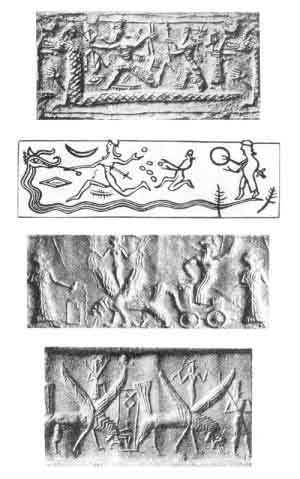
Click to enlarge
PLATE XIX
GODS AND DRAGONS
(for description, see opposite page.)
p. 79
we have only a very brief laconic passage from which to reconstruct our story; the tablets on which the details of the myth are inscribed are still lying no doubt in the ruins of Sumer. What we do have is part of the introductory prologue to the epic tale "Gilgamesh, Enkidu, and the Nether World," whose contents have been described on page 30 ff. Briefly sketched, this version of our story runs as follows:
After heaven and earth had been separated, An, the heaven-god, carried off the heaven, while Enlil, the air-god, carried off the earth. It was then that the foul deed was committed. The goddess Ereshkigal was carried off violently into the nether world, perhaps by Kur itself. Thereupon Enki, the water-god, whose Sumerian origin is uncertain, but who toward the end of the third millennium B. C. gradually became one of the most important deities of the Sumerian pantheon, set out in a boat, in all probability to attack Kur and avenge the abduction of the goddess Ereshkigal. Kur fought back savagely with all kinds of stones, large and small. Moreover it attacked Enki's boat, front and rear, with the primeval waters which it no doubt controlled. Here our brief prologue passage ends, since the author of "Gilgamesh, Enkidu, and the Nether World" is not interested in the dragon story primarily but is anxious to proceed with the Gilgamesh tale. And so we are left in the dark as to the outcome of the battle. There is little doubt, however, that Enki was victorious. Indeed it is not at all unlikely that the myth was evolved in large part for the purpose of explaining why, in historical times, Enki, like the Greek Poseidon, was conceived as a sea-god; why he is described as "lord of the abyss"; and why his temple in Eridu was designated as the "sea-house." 74
The second version of the slaying-of-the-dragon myth is particularly significant since this is the version which must have been utilized in large part by the Semitic redactors of the Babylonian "Epic of Creation." 74 The story is part of a large epic tale of over six hundred lines, best entitled
p. 80
[paragraph continues] "The Feats and Exploits of Ninurta." The contents can now be reconstructed in large part from at least 49 tablets and fragments, 30 of which have been copied and published by various scholars in the course of the past several decades; a large part of the text has therefore been known for some time. 75 Nevertheless, because of the numerous breaks and gaps, several of the more important pieces could not be properly arranged. This situation was eased to a considerable extent when I located in Istanbul and Philadelphia more than a score of additional pieces belonging to the poem., And so, while the text is still badly broken at numerous crucial points, the contents as a whole can now be reconstructed with a fair degree of certainty. 76
Hero of the tale is Ninurta, the warrior-god, who was conceived by the Sumerians as the son of Enlil, the air-god. After a hymnal introduction the story begins with an address to Ninurta by Sharur, his personified weapon. For some reason not stated in the text as yet available, Sharur has set its mind against Kur. In its speech, therefore, which is full of phrases extolling the heroic qualities and deeds of Ninurta, it urges Ninurta to attack and destroy Kur. Ninurta sets out to do as bidden. At first, however, be seems to have met more than his match and he "flees like a bird." Once again, however, Sharur addresses him with reassuring and encouraging words. Ninurta now attacks Kur fiercely with all the weapons at his command, and Kur is completely destroyed.
With the destruction of Kur, however, a serious calamity overtakes the land. The primeval waters which Kur had held in check rise to the surface and as a result of their violence no fresh water can reach the fields and gardens. The gods of the land who "carried the pickax and the basket," that is, who had charge of irrigating the land and preparing it for cultivation, are desperate. The Tigris waters do not rise, the river carries no good water.
The small rivers were not cleaned, the dirt was not carried off, p. 81
On the steadfast fields no water was sprinkled, there was no digging of ditches,
In all the lands there were no crops, only weeds grew.
Thereupon the lord sets his lofty mind,
Ninurta, the son of Enlil, brings great things into being.
What by Kur had been dissipated,
He guided and hurled into the Tigris,
The high waters it pours over the farmland. Behold now everything on earth
Rejoiced afar at Ninurta, the king of the land;
The fields produced much grain,
The harvest of palm-grove and vineyard was fruitful,
It was heaped up in granaries and hills;
The lord made mourning disappear from the land,
He made good the liver of the gods.
O Ninmah, because for my sake thou wouldst enter an inimical land,
Because thou hast no fear of the terror of the battle surrounding me,
Therefore, of the hill which I, the hero, have heaped up,
Let its name be Hursag (mountain), and thou be its queen."
Ninurta then blesses the Hursag that it may produce all kinds of herbs, wine and honey, various kinds of trees, gold, silver, and bronze, cattle, sheep, and all "four-legged creatures." After this blessing of the Hursag, he turns to the stones, cursing those which have been his enemies in his battle with Kur and blessing those which have been his friends; this entire passage, in style and tone, not in content, is very reminiscent of the blessing and cursing of Jacob's sons in the forty-ninth chapter of Genesis. The poem closes with a long hymnal passage exalting Ninurta.
The third version of the slaying-of-the-dragon myth is a poem consisting of one hundred and ninety lines of text which may be best entitled "Inanna and Ebih." 77 Although by 1934 eight pieces belonging to the story 78 had already been copied and published by the late Edward Chiera and Stephen Langdon, so little was understood of the myth that several of the pieces were not even recognized as belonging to it. A thorough reexamination of the material, including four hitherto unknown pieces, two from Istanbul and two from Philadelphia, 79 enabled me to reconstruct the major part of the text in the course of the past two years.
The dragon-slayer in this version of the story is not a god but a goddess, none other than Inanna, the counterpart of the Semitic Ishtar. For curious as it may seem, Inanna, to judge from our literary material, was conceived not only as the goddess of love but also as the goddess of battle and strife. And the reason for one of the puzzling and enigmatic epithets regularly ascribed to Inanna in the hymns, namely, "destroyer of Kur," is now clear. In our myth, it must be noted, Kur is also called "mountain Ebih," a district northeast of Sumer. This Kur represents, therefore, an inimical land, and is not to be identified with the cosmic Kur of the Ninurta and Enki versions.
The poem begins with a long hymnal passage extolling the virtues of Inanna. Follows a long address by Inanna to An, the heaven-deity, nominally, at least, the leading
p. 83
deity of the Sumerian pantheon (actually by the third millennium. B. C. Enlil, the air-god, had already usurped his place). While the meaning of her speech is at times difficult to penetrate, Inanna's demand is clear; unless Kur, which seems quite unaware of, or at least oblivious to, her might and power, becomes duly submissive and is ready to glorify her virtues, she will do violence to the monster. To quote but part of her threat:
The throw-stick, the weapon, I shall direct against it,
At its neighboring forests I shall strike up fire,
At its . . . I shall set up the bronze ax,
All its waters like Gibil (the fire-god) the purifier I shall dry up,
Like the mountain Aratta, I shall remove its dread,
Like a city cursed by An, it will not be restored,
Like (a city) on which Enlil frowns, it shall not rise up."
In the sitting place of the Anunnaki it has led forth fearfulness,
Its dreadful fear it has hurled upon the land,
The 'mountain,' its dreadful rays of fire it has directed against all the lands."
INANNA'S DESCENT TO THE NETHER WORLD u
The text of this myth, which I have designated as "Inanna's Descent to the Nether World," has been reconstructed and deciphered by me in the course of the past six years. Its influence on literature and mythology has been universal and profound. Moreover, the story of its deciphermentp. 84
furnishes a most illuminating illustration of the not uninteresting process involved in the reconstruction of the texts of the Sumerian literary compositions.
For many years, for almost three-quarters of a century, a myth usually designated as "Ishtar's Descent to the Nether World" has been known to scholar and layman. Like the Babylonian "Epic of Creation," this poem was found inscribed in the Accadian language on tablets dating from the first millennium B. C.; these, therefore, postdate our Sumerian literary tablets by more than a millennium. Like the "Epic of Creation," "Ishtar's Descent to the Nether World," too, was therefore generally assumed to be of Semitic origin; it is cited and quoted in the major works concerned with mythology and religion as a remarkable example of Babylonian myth-making. With the appearance of the publications devoted to the Nippur material, however, it became gradually obvious that this "Semitic" myth goes back to a Sumerian original in which Ishtar is replaced by
___________________________________________________
PLATE XX. INANNA'S DESCENT TO THE NETHER WORLD
The 14 tablets and fragments illustrated here furnish a historical commentary on the reconstruction and translation of the myth "Inanna's Descent to the Nether World," recently published by the author. 80 The arrangement of the plate is aimed to illustrate the process of piecing together the tablets and fragments utilized in the reconstruction of the poem. Nos. 1, 2, and 5 were published by Poebel in 1914. 81 Nos. 3 and 4 were published by Langdon in 1914. 81 No. 6, which is in the University Museum, was identified by Chiera as the lower half of the very same tablet whose upper half, no. 3 on our plate, had been copied by Langdon in Istanbul. Chiera's discovery enabled me to publish my first reconstruction of the myth in 1937. 83 Nos. 7-9 were published by Chiera in 1934. 84 Nos. 10-12 were identified and copied by the author some five years ago in the Museum of the Ancient Orient at Istanbul. 85 Nos. 13 and 14 were identified and copied by the author recently in Philadelphia. 86 The utilization of these five newly discovered texts made possible the edition published in 1942. The marked passage on no. 8 contains the lines describing Inanna's decision to descend to the nether world; that on no. 13 contains the lines describing the death of the goddess; the reverse of no. 10 (not on our plate, which contains the obverse only) has the resurrection passage. The transliteration and the translation of these three most significant passages will be found in note 87.(This plate is arranged from Proceedings of the American Philosophical Society 85 (3), plates 1-10.)

Click to enlarge
PLATE XX
INANNA'S DESCENT TO THE NETHER WORLD
(For description, see opposite page.)
p. 85
[paragraph continues] Inanna, her Sumerian counterpart. Arno Poebel, now of the Oriental Institute of the University of Chicago, was the first to locate three small pieces belonging to this myth in the University Museum at Philadelphia; these were published as early as 1914. 81 In the very same year, the late Stephen Langdon, of Oxford, published two pieces which he had uncovered in the Museum of the Ancient Orient at Istanbul. 82 One of these was the upper half of a large four-column tablet which, as will soon become evident, proved to be of major importance for the reconstruction of the text of the myth. The late Edward Chiera uncovered three additional pieces in the University Museum. These were published in his two posthumous volumes consisting of copies of Sumerian literary texts which I prepared for publication for the Oriental Institute in 1934. 84
By this time, therefore, we had eight pieces, all more or less fragmentary, dealing with the myth. Nevertheless the contents remained obscure, for the breaks in the tablets were so numerous and came at such crucial points in the story that an intelligent reconstruction of the extant parts of the myth remained impossible. It was a fortunate and remarkable discovery of Chiera which saved the situation. He discovered in the University Museum at Philadelphia, the lower half of the very same four-column tablet whose upper half had been found and copied by Langdon years before in the Museum of the Ancient Orient at Istanbul. The tablet had evidently been broken before or during the excavation, and the two halves had become separated; the one had been retained in Istanbul, and the other had come to Philadelphia. Unfortunately, Chiera, who fully realized the significance of his discovery, died before he was in a position to utilize it.
It was by making use of this lower half of the four-column tablet, despite the fact that it, too, is very poorly preserved, that I was enabled to reconstruct the contents of the myth. For when the two halves of the tablet were joined, the combined text furnished an excellent framework in which and about which all the other extant fragments
p. 86
could be properly arranged. Needless to say, there were still numerous gaps and breaks in the text which made the translation and interpretation of the text no easy matter, and the meaning of several of the more significant passages in the story remained obscure. In 1937 I was fortunate enough to discover in Istanbul three additional pieces belonging to the myth, 85 and upon returning to the United States in 1939 I located another large piece in the University Museum at Philadelphia, and yet another in 1940. 86 These three fragments helped to fill in the most serious lacunae in my first reconstruction and translation, and as a result, the myth, as far as it goes, is now almost complete; the scientific edition, including the original text, and its transliteration and translation, has just been published."
Inanna, queen of heaven, the goddess of light and love and life, has set her heart upon visiting the nether world, perhaps in order to free her lover Tammuz. She gathers together all the appropriate divine decrees, adorns herself with her queenly robes and jewels, and is ready to enter the "land of no return." Queen of the nether world is her elder sister and bitter enemy Ereshkigal, the goddess of darkness and gloom and death. Fearing lest her sister put her to death in the nether world, Inanna instructs her messenger, Ninshubur, who is always at her beck and call, that if after three days she shall have failed to return, he is to go to heaven and set up a hue and cry for her in the assembly hall of the gods. Moreover, he is to go to Nippur, the very city where our tablets have been excavated, and there weep and plead before the god Enlil to save Inanna from Ereshkigal's clutches. If Enlil should refuse, he is to go to Ur, Ur of the Chaldees, whence according to Biblical tradition Abraham migrated to Palestine, and there repeat his plea before Nanna, the great Sumerian moon-god. If Nanna, too, refuses, he is to go to Eridu, the city in which Sumerian civilization is said to have originated, and weep and plead before Enki, the "god of wisdom." And the latter, "who knows the food of life, who knows the water of life," will restore Inanna to life.
p. 87
Having taken these precautions, Inanna descends to the nether world and approaches Ereshkigal's temple of lapis lazuli. At the gate she is met by the chief gatekeeper, who demands to know who she is and why she came. Inanna concocts a false excuse for her visit, and the gatekeeper, upon instructions from his mistress Ereshkigal, leads her through the seven gates of the nether world. As she passes through each of the gates part of her robes and jewels are removed in spite of her protest. Finally after entering the last gate she is brought stark naked and on bended knees before Ereshkigal and the seven Anunnaki, the dreaded judges of the nether world. These latter fasten upon Inanna their "look of death," whereupon she is turned into a corpse and hung from a stake.
So pass three days and three nights. On the fourth day, Ninshubur, seeing that his mistress has not returned, proceeds to make the rounds of the gods in accordance with his instructions. As Inanna had foreseen, both Enlil of Nippur and Nanna of Ur refuse all help. Enki, however, devises a plan to restore her to life. He fashions the kurgarru and kalaturru, two sexless creatures, and entrusts to them the "food of life" and the "water of life," with instructions to proceed to the nether world and to sprinkle this food and this water sixty times upon Inanna's suspended corpse. This they do and Inanna revives. As she leaves the nether world, however, to reascend to the earth, she is accompanied by the shades of the dead and by the bogies and harpies who have their home there. Surrounded by this ghostly, ghastly crowd, she wanders through Sumer from city to city.
Here all extant source material for "Inanna's Descent to the Nether World" unfortunately breaks off, but this is not the end of the myth. It is not too much to hope, however, that some day in the not too distant future the pieces on which the conclusion of the story is inscribed will be discovered and deciphered. Following is a literal translation of the composition; even in its present incomplete state
p. 88
it provides an excellent illustration of the mood and temper, the swing and rhythm of Sumerian poetry:
The goddess, from the "great above" she set her mind toward the "great below,"
Inanna, from the "great above" she set her mind toward the "great below." My lady abandoned heaven, abandoned earth,
To the nether world she descended,
Inanna abandoned heaven, abandoned earth,
To the nether world she descended,
Abandoned lordship, abandoned ladyship,
To the nether world she descended.
In Erech she abandoned Eanna,
To the nether world she descended,
In Badtibira she abandoned Emushkalamma,
To the nether world she descended,
In Zabalam she abandoned Giguna,
To the nether world she descended,
In Adab she abandoned Esharra,
To the nether world she descended,
In Nippur she abandoned Baratushgarra,
To the nether world she descended,
In Kish she abandoned Hursagkalamma,
To the nether world she descended,
In Agade she abandoned Eulmash,
To the nether world she descended.
The seven divine decrees she fastened at the side,
She sought out the divine decrees, placed them at her hand,
All the decrees she set up at (her) waiting foot,
The shugurra, the crown of the plain, she put upon her bead,
Radiance she placed upon her countenance,
The . . . rod of lapis lazuli she gripped in (her) hand,
Small lapis lazuli stones she tied about her neck,
Sparkling . . . stones she fastened to her breast,
A gold ring she gripped in her band,
A . . . breastplate she bound about her breast,
All the garments of ladyship she arranged about her body,
. . . ointment she put on her face. p. 89
Inanna walked toward the nether world,
Her messenger Ninshubur walked at her side,
The pare Inanna says to Ninshubur:
"O (thou who art) my constant support,
My messenger of favorable words,
My carrier of supporting words,
I am now descending to the nether world.
"When I shall have come to the nether world,
Fill heaven with complaints for me,
In the assembly shrine cry out for me,
In the house of the gods rush about for me,
Lower thy eye for me, lower thy mouth for me,
With . . . lower thy great . . . for me,
Like a pauper in a single garment dress for me,
To the Ekur, the house of Enlil, all alone direct thy step.
"Upon thy entering the Ekur, the house of Enlil,
Weep before Enlil:
'O father Enlil, let not thy daughter be put to death in the nether world,
Let not thy good metal be ground up into the dust of the nether world,
Let not thy good lapis lazuli be broken up into the stone of the stone-worker,
Let not thy boxwood be cut up into the wood of the wood-worker,
Let not the maid Inanna be put to death in the nether world.'
"If Enlil stands not by thee in this matter, go to Ur.
"In Ur upon thy entering the house of the . . . of the land,
The Ekishshirgal, the house of Nanna,
Weep before Nanna:
'O Father Nanna, let not thy daughter be put to death in the nether world,
Let not thy good metal be ground up into the dust of the nether world,
Let not thy good lapis lazuli be broken up into the stone of the stone-worker,
Let not thy boxwood be cut up into the wood of the wood-worker,
Let not the maid Inanna be put to death in the nether world.'
"If Nanna stands not by thee in this matter, go to Eridu. p. 90
"In Eridu upon thy entering the house of Enki,
Weep before Enki:
'O father Enki, let not thy daughter be put to death in the nether world,
Let not thy good metal be ground up into the dust of the nether world,
Let not thy good lapis lazuli be broken up into the stone of the stone-worker,
Let not thy boxwood be cut up into the wood of the wood-worker,
Let not the maid Inanna be put to death in the nether world.'
"Father Enki, the lord of wisdom,
Who knows the food of life, who knows the water of life,
He will surely bring me to life."
Inanna walked toward the nether world,
To her messenger Ninshubur she says:
"Go, Ninshubur,
The word which I have commanded thee . . ."
When Inanna had arrived at the lapis lazuli palace of the nether world,
At the door of the nether world she acted evilly,
In the palace of the nether world she spoke evilly:
"Open the house, gatekeeper, open the house,
Open the house, Neti, open the house, all alone I would enter."
Neti, the chief gatekeeper of the nether world,
Answers the pure Inanna:
"Who pray art thou?"
"I am the queen of heaven, the place where the sun rises."
"If thou art the queen of heaven, the place where the sun rises,
Why pray hast thou come to the land of no return?
On the road whose traveller returns not how has thy heart led thee?"
The pure Inanna answers him:
"My elder sister Ereshkigal,
Because her husband, the lord Gugalanna, had been killed,
To witness the funeral rites,
. . .; so be it."
Neti, the chief gatekeeper of the nether world,
Answers the pure Inanna:
"Stay, Inanna, to my queen let me speak,
To my queen Ereshkigal let me speak . . . let me speak." p. 91
Neti, the chief gatekeeper of the nether world,
Enters the house of his queen Ereshkigal and says to her:
"O my queen, a maid,
Like a god . . .,
The door . . .,
. . .,
In Eanna . . .,
The seven divine decrees she has fastened at the side,
She has sought out the divine decrees, has placed them at her hand,
All the decrees she has set up at (her) waiting foot,
The shugurra, the crown of the plain, she has put upon her head,
Radiance she has placed upon her countenance,
The . . . rod of lapis lazuli she has gripped in (her) hand,
Small lapis lazuli stones she has tied about her neck,
Sparkling . . . stones she has fastened to her breast,
A gold ring she has gripped in her hand,
A . . . breastplate she has bound about her breast,
All her garments of ladyship she has arranged about her body,
. . . ointment she has put on her face."
Then Ereshkigal . . .,
Answers Neti, her chief gatekeeper:
"Come, Neti, chief gatekeeper of the nether world,
Unto the word which I command thee, give ear.
Of the seven gates of the nether world, open their locks,
Of the gate Ganzir, the 'face' of the nether world, define its rules;
Upon her (Inanna's) entering,
Bowed low . . . let her . . ."
Neti, the chief gatekeeper of the nether world,
Honored the word of his queen.
Of the seven gates of the nether world, he opened their locks,
Of the gate Ganzir, the 'face' of the nether world, he defined its rules.
To the pure Inanna he says:
"Come, Inanna, enter."
Upon her entering the first gate,
The shugurra, the "crown of the plain" of her head, was removed.
"What, pray, is this?"
"Extraordinarily, O Inanna, have the decrees of the nether world been perfected,
O Inanna, do not question the rites of the nether world." p. 92
Upon her entering the second gate,
The . . . rod of lapis lazuli was removed.
"What, pray, is this?"
"Extraordinarily, O Inanna, have the decrees of the nether world been perfected,
O Inanna, do not question the rites of the nether world."
Upon her entering the third gate,
The small lapis lazuli stones of her neck were removed.
"What, pray, is this?"
"Extraordinarily, O Inanna, have the decrees of the nether world been perfected,
O Inanna, do not question the rites of the nether world."
Upon her entering the fourth gate,
The sparkling . . . stones of her breast were removed.
"What, pray, is this?"
"Extraordinarily, O Inanna, have the decrees of the nether world been perfected,
O Inanna, do not question the rites of the nether world."
Upon her entering the fifth gate,
The gold ring of her hand was removed.
"What, pray, is this?"
"Extraordinarily, O Inanna, have the decrees of the nether world been perfected,
O Inanna, do not question the rites of the nether world."
Upon her entering the sixth gate,
The . . . breastplate of her breast was removed.
"What, pray, is this?"
"Extraordinarily, O Inanna, have the decrees of the nether world been perfected,
O Inanna, do not question the rites of the nether world."
Upon her entering the seventh gate,
All the garments of ladyship of her body were removed.
"What, pray, is this?"
"Extraordinarily, O Inanna, have the decrees of the nether world been perfected,
O Inanna, do not question the rites of the nether world."
Bowed low . . .
The pure Ereshkigal seated herself upon her throne,
The Anunnaki, the seven judges, pronounced judgment before her,
They fastened (their) eyes upon her, the eyes of death, p. 93
At their word, the word which tortures the spirit,
. . . ,
The sick woman was turned into a corpse,
The corpse was hung from a stake.
After three days and three nights had passed,
Her messenger Ninshubur,
Her messenger of favorable words,
Her carrier of supporting words,
Fills the heaven with complaints for her,
Cried for her in the assembly shrine,
Rushed about for her in the house of the gods,
Lowered his eye for her, lowered his mouth for her,
With . . . he lowered his great . . . for her,
Like a pauper in a single garment he dressed for her,
To the Ekur, the house of Enlil, all alone he directed his step.
Upon his entering the Ekur, the house of Enlil,
Before Enlil he weeps:
"O father Enlil, let not thy daughter be put to death in the nether world,
Let not thy good metal be ground up into the dust of the nether world,
Let not thy good lapis lazuli be broken up into the stone of the stone-worker,
Let not thy boxwood be cut up into the wood of the wood-worker,
Let not the maid Inanna be put to death in the nether world."
Father Enlil answers Ninshubur:
"My daughter, in the 'great above' . . ., in the 'great below' . . .,
Inanna, in the 'great above' . . ., in the 'great below'. . .,
The decrees of the nether world, the . . . decrees, to their place . . .,
Who, pray, to their place . . .?"
Father Enlil stood not by him in this matter, he went to Ur.
In Ur upon his entering the house of the . . . of the land,
The Ekishshirgal, the house of Nanna,
Before Nanna he weeps:
"O father Nanna, let not thy daughter be put to death in the nether world,
Let not thy good metal be ground up into the dust of the nether world, p. 94
Let not thy good lapis lazuli be broken up into the stone of the stone-worker,
Let not thy boxwood be cut up into the wood of the wood-worker,
Let not the maid Inanna be put to death in the nether world."
Father Nanna answers Ninshubur:
"My daughter in the 'great above' . . ., in the 'great below' . . .,
Inanna, in the 'great above' . . ., in the 'great below' . . .,
The decrees of the nether world, the . . . decrees, to their place . . .,
Who, pray, to their place . . .?"
Father Nanna stood not by him in this matter, he went to Eridu.
In Eridu upon his entering the house of Enki,
Before Enki he weeps:
"O father Enki, let not thy daughter be put to death in the nether world,
Let not thy good metal be ground up into the dust of the nether world,
Let not thy good lapis lazuli be broken up into the stone of the stone-worker,
Let not thy boxwood be cut up into the wood of the wood-worker,
Let not the maid Inanna be put to death in the nether world."
Father Enki answers Ninshubur:
"What now has my daughter done! I am troubled,
What now has Inanna done! I am troubled,
What now has the queen of all the lands done! I am troubled,
What now has the hierodule of heaven done! I am troubled."
. . . he brought forth dirt (and) fashioned the kurgarru,
. . . he brought forth dirt (and) fashioned the kalaturru,
To the kurgarru he gave the food of life,
To the kalaturru he gave the water of life,
Father Enki says to the kalaturru and kurgarru:
. . . (nineteen lines destroyed)
"Upon the corpse hung from a stake direct the fear of the rays of fire,
Sixty times the food of life, sixty times the water of life, sprinkle upon it,
Verily Inanna will arise."
. . . (twenty-four(?) lines destroyed) p. 95
Upon the corpse hung from a stake they directed the fear of the rays of fire,
Sixty times the food of life, sixty times the water of life, they sprinkled upon it,
Inanna arose.
Inanna ascends from the nether world,
The Anunnaki fled,
(And) whoever of the nether world that had descended peacefully to the nether world;
When Inanna ascends from the nether world,
Verily the dead hasten ahead of her.
Inanna ascends from the nether world,
The small demons like . . . reeds,
The large demons like tablet styluses,
Walked at her side.
Who walked in front of her, being without . . ., held a staff in the hand,
Who walked at her side, being without . . ., carried a weapon on the loin.
They who preceded her,
They who preceded Inanna,
(Were beings who) know not food, who know not water,
Who eat not sprinkled flour,
Who drink not libated wine,
Who take away the wife from the loins of man,
Who take away the child from the breast of the nursing mother.
Inanna ascends from the nether world;
Upon Inanna's ascending from the nether world,
Her messenger Ninshubur threw himself at her feet,
Sat in the dust, dressed in dirt.
The demons say to the pure Inanna:
"O Inanna, wait before thy city, we would bring him to thee."
The pure Inanna answers the demons:
"(He is) my messenger of favorable words,
My carrier of supporting words,
He fails not my directions,
He delays not my commanded word,
He fills heaven with complaints for me,
In the assembly shrine he cried out for me,
In the house of the gods he rushed about for me,
He lowered his eye for me, he lowered his mouth for me,
With . . . he lowered his great . . . for me, p. 96
Like a pauper in a single garment he dressed for me,
To the Ekur, the house of Enlil,
In Ur, to the house of Nanna,
In Eridu, to the house of Enki (he directed his step),
He brought me to life."
"Let us precede her, in Umma to the Sigkurshagga let us precede her."
In Umma, from the Sigkurshagga,
Shara threw himself at her feet,
Sat in the dust, dressed in dirt.
The demons say to the pure Inanna:
"O Inanna, wait before thy city, we would bring him to thee."
The pure Inanna answers the demons:
(Inanna's answer is destroyed)
"Let us precede her, in Badtibira to the Emushkalamma let us precede her."
In Badtibira from the Emushkalamma,
. . . threw themselves at her feet,
Sat in the dust, dressed in dirt.
The demons say to the pure Inanna:
"O Inanna, wait before thy city, we would bring them to thee."
The pure Inanna answers the demons:
(Inanna's answer destroyed; the end of the poem is wanting)
Sumerian Mythology
By Samuel Noah Kramer
[1944, 1961]
http://www.sacred-texts.com/index.htm
Myths of Tammuz and Ishtar
Myths of Tammuz and Ishtar
Forms of Tammuz--The Weeping Ceremony--Tammuz the Patriarch and the Dying God--Common Origin of Tammuz and other Deities from an Archaic God--The Mediterranean Racial Myth--Animal Forms of Gods of Fertility--Two Legends of the Death of Tammuz--Attis, Adonis, and Diarmid Slain by a Boar--Laments for Tammuz--His Soul in Underworld and the Deep--Myth of the Child God of Ocean--Sargon Myth Version--The Germanic Scyld of the Sheaf--Tammuz Links with Frey, Heimdal, Agni, &c.--Assyrian Legend of "Descent of Ishtar"--Sumerian Version--The Sister Belit-sheri and the Mother Ishtar--The Egyptian Isis and Nepthys--Goddesses as Mothers, Sisters, and Wives--Great Mothers of Babylonia--Immortal Goddesses and Dying Gods--The Various Indras--Celtic Goddess with Seven Periods of Youth--Lovers of Germanic and Classic Goddesses--The Lovers of Ishtar--Racial Significance of Goddess Cult--The Great Fathers and their Worshippers--Process of Racial and Religious Fusion--Ishtar and Tiamat--Mother Worship in Palestine--Women among Goddess Worshippers.AMONG the gods of Babylonia none achieved wider and more enduring fame than Tammuz, who was loved by Ishtar, the amorous Queen of Heaven--the beautiful youth who died and was mourned for and came to life again. He does not figure by his popular name in any of the city pantheons, but from the earliest times of which we have knowledge until the passing of Babylonian civilization, he played a prominent part in the religious life of the people
Tammuz, like Osiris of Egypt, was an agricultural deity, and as the Babylonian harvest was the gift of the rivers, it is probable that one of his several forms was Dumu-zi-abzu, "Tammuz of the Abyss". He was also
p. 82
[paragraph continues] "the child", "the heroic lord", "the sentinel", "the healer", and the patriarch who reigned over the early Babylonians for a considerable period. "Tammuz of the Abyss" was one of the members of the family of Ea, god of the Deep, whose other sons, in addition to Merodach, were Nira, an obscure deity; Ki-gulla, "world destroyer", Burnunta-sa, "broad ear", and Bara and Baragulla, probably "revealers" or "oracles". In addition there was a daughter, Khi-dimme-azaga, "child of the renowned spirit". She may have been identical with Belit-sheri, who is referred to in the Sumerian hymns as the sister of Tammuz. This family group was probably formed by symbolizing the attributes of Ea and his spouse Damkina. Tammuz, in his character as a patriarch, may have been regarded as a hostage from the gods: the human form of Ea, who instructed mankind, like King Osiris, how to grow corn and cultivate fruit trees. As the youth who perished annually, he was the corn spirit. He is referred to in the Bible by his Babylonian name.
When Ezekiel detailed the various idolatrous practices of the Israelites, which included the worship of the sun and "every form of creeping things and abominable beasts"--a suggestion of the composite monsters of Babylonia--he was brought "to the door of the gate of the Lord's house, which was towards the north; and, behold, there sat women weeping for Tammuz". 1
The weeping ceremony was connected with agricultural rites. Corn deities were weeping deities, they shed fertilizing tears; and the sowers simulated the sorrow of divine mourners when they cast seed in the soil "to die", so that it might spring up as corn. This ancient custom, like many others, contributed to the poetic
p. 83
imagery of the Bible. "They that sow in tears", David sang, "shall reap in joy. He that goeth forth and weepeth, bearing precious seed, shall doubtless come again with rejoicing, bringing his sheaves with him." 1 In Egypt the priestesses who acted the parts of Isis and Nepthys, mourned for the slain corn god Osiris.
Gods and men before the face of the gods are weeping for thee at the same time, when they behold me! . . .
All thy sister goddesses are at thy side and behind thy couch,
Calling upon thee with weeping--yet thou are prostrate upon thy bed! . . .
Live before us, desiring to behold thee. 2
It was believed to be essential that human beings should share the
universal sorrow caused by the death of a god. If they remained
unsympathetic, the deities would punish them as enemies. Worshippers of
nature gods, therefore, based their ceremonial practices on natural
phenomena. "The dread of the worshippers that the neglect of the usual
ritual would be followed by disaster, is particularly intelligible",
writes Professor Robertson Smith, "if they regarded the necessary
operations of agriculture as involving the violent extinction of a
particle of divine life." 3
By observing their ritual, the worshippers won the sympathy and
co-operation of deities, or exercised a magical control over nature.All thy sister goddesses are at thy side and behind thy couch,
Calling upon thee with weeping--yet thou are prostrate upon thy bed! . . .
Live before us, desiring to behold thee. 2
The Babylonian myth of Tammuz, the dying god, bears a close resemblance to the Greek myth of Adonis. It also links with the myth of Osiris. According to Professor Sayce, Tammuz is identical with "Daonus or Daos, the shepherd of Pantibibla", referred to by Berosus as the ruler of one of the mythical ages of Babylonia. We
p. 84
have therefore to deal with Tammuz in his twofold character as a patriarch and a god of fertility.
The Adonis version of the myth may be summarized briefly. Ere the god was born, his mother, who was pursued by her angry sire, as the river goddesses of the folk tales are pursued by the well demons, transformed herself into a tree. Adonis sprang from the trunk of this tree, and Aphrodite, having placed the child in a chest, committed him to the care of Persephone, queen of Hades, who resembles the Babylonian Eresh-ki-gal. Persephone desired to retain the young god, and Aphrodite (Ishtar) appealed to Zeus (Anu), who decreed that Adonis should spend part of the year with one goddess and part of the year with the other.
It is suggested that the myth of Adonis was derived in post-Homeric times by the Greeks indirectly from Babylonia through the Western Semites, the Semitic title "Adon", meaning "lord", having been mistaken for a proper name. This theory, however, cannot be accepted without qualifications. It does not explain the existence of either the Phrygian myth of Attis, which was developed differently from the Tammuz myth, or the Celtic story of "Diarmid and the boar", which belongs to the archæological "Hunting Period". There are traces in Greek mythology of pre-Hellenic myths about dying harvest deities, like Hyakinthos and Erigone, for instance, who appear to have been mourned for. There is every possibility, therefore, that the Tammuz ritual may have been attached to a harvest god of the pre-Hellenic Greeks, who received at the same time the new name of Adonis. Osiris of Egypt resembles Tammuz, but his Mesopotamian origin has not been proved. It would appear probable that Tammuz, Attis, Osiris, and the deities represented by Adonis and Diarmid were all developed
p. 85
from an archaic god of fertility and vegetation, the central figure of a myth which was not only as ancient as the knowledge and practice of agriculture, but had existence even in the "Hunting Period". Traces of the Tammuz-Osiris story in various forms are found all over the area occupied by the Mediterranean or Brown race from Sumeria to the British Isles. Apparently the original myth was connected with tree and water worship and the worship of animals. Adonis sprang from a tree; the body of Osiris was concealed in a tree which grew round the sea-drifted chest in which he was concealed. Diarmid concealed himself in a tree when pursued by Finn. The blood of Tammuz, Osiris, and Adonis reddened the swollen rivers which fertilized the soil. Various animals were associated with the harvest god, who appears to have been manifested from time to time in different forms, for his spirit pervaded all nature. In Egypt the soul of Osiris entered the Apis bull or the ram of Mendes.
Tammuz in the hymns is called "the pre-eminent steer of heaven", and a popular sacrifice was "a white kid of the god Tammuz", which, however, might be substituted by a sucking pig. Osiris had also associations with swine, and the Egyptians, according to Herodotus, sacrificed a pig to him annually. When Set at full moon hunted the boar in the Delta marshes, he probably hunted the boar form of Osiris, whose human body had been recovered from the sacred tree by Isis. As the soul of Bata, the hero of the Egyptian folk tale, 1 migrated from the blossom to the bull, and the bull to the tree, so apparently did the soul of Osiris pass from incarnation to incarnation. Set, the demon slayer of the harvest god, had also a boar form; he was the black pig who devoured the waning moon and blinded the Eye of Ra.
p. 86
In his character as a long-lived patriarch, Tammuz the King Daonus or Daos of Berosus, reigned in Babylonia for 36,000 years. When he died, he departed to Hades or the Abyss. Osiris, after reigning over the Egyptians, became Judge of the Dead.
Tammuz of the Sumerian hymns, however, is the Adonis-like god who lived on earth for a part of the year as the shepherd and agriculturist so dearly beloved by the goddess Ishtar. Then he died so that he might depart to the realm of Eresh-ki-gal (Persephone), queen of Hades. According to one account, his death was caused by the fickle Ishtar. When that goddess wooed Gilgamesh, the Babylonian Hercules, he upbraided her, saying:
On Tammuz, the spouse of thy youth,
Thou didst lay affliction every year.
King's Translation.
References in the Sumerian hymns suggest that there also existed a
form of the legend which gave an account of the slaying of the young god
by someone else than Ishtar. The slayer may have been a Set-like
demon--perhaps Nin-shach, who appears to have symbolized the destroying
influence of the sun. He was a war deity, and his name, Professor
Pinches says, "is conjectured to mean 'lord of the wild boar'". There is
no direct evidence, however, to connect Tammuz's slayer with the boar
which killed Adonis. Ishtar's innocence is emphasized by the fact that
she mourned for her youthful lover, crying:Thou didst lay affliction every year.
King's Translation.
Oh hero, my lord, ah me! I will say;
Food I eat not . . . water I drink not . . .
Because of the exalted one of the nether world, him of the radiant face, yea radiant,
Of the exalted one of the nether world, him of the dove-like voice, yea dove-like. 1
p. 87Food I eat not . . . water I drink not . . .
Because of the exalted one of the nether world, him of the radiant face, yea radiant,
Of the exalted one of the nether world, him of the dove-like voice, yea dove-like. 1
The Phrygian Attis met his death, according to one legend, by self-mutilation under a sacred tree. Another account sets forth, however, that he was slain by a boar. The Greek Adonis was similarly killed by a boar. This animal was a form of Ares (Mars), god of war and tempest, who also loved Aphrodite (Ishtar). The Celtic Diarmid, in his character as a love god, with lunar attributes, was slain by "the green boar", which appears to have been one of the animals of a ferocious Hag, an earth and air "mother" with various names. In one of the many Fingalian stories the animal is
[paragraph continues] Diarmid had eloped with the wife of Finn-mac-Coul (Fingal), who, like Ares, plotted to bring about his rival's death, and accordingly set the young hero to hunt the boar. As a thunder god Finn carried a hammer with which he smote his shield; the blows were heard in Lochlann (Scandinavia). Diarmid, like Tammuz, the "god of the tender voice and shining eyes", had much beauty. When he expired, Finn cried:
No maiden will raise her eye
Since the mould has gone over thy visage fair . . .
Blue without rashness in thine eye!
Passion and beauty behind thy curls! . . .
Oh, yesternight it was green the hillock,
Red is it this day with Diarmid's blood. 2
Tammuz died with the dying vegetation, and Diarmid expired when the hills apparently were assuming their purple tints. 3 The month of Tammuz wailings was fromSince the mould has gone over thy visage fair . . .
Blue without rashness in thine eye!
Passion and beauty behind thy curls! . . .
Oh, yesternight it was green the hillock,
Red is it this day with Diarmid's blood. 2
p. 88
[paragraph continues] 20th June till 20th July, when the heat and dryness brought forth the demons of pestilence. The mourners chanted:
He has gone, he has gone to the bosom of the earth,
And the dead are numerous in the land . . .
Men are filled with sorrow: they stagger by day in gloom .
In the month of thy year which brings not peace hast thou gone.
Thou hast gone on a journey that makes an end of thy people.
The following extract contains a reference to the slaying of the god:And the dead are numerous in the land . . .
Men are filled with sorrow: they stagger by day in gloom .
In the month of thy year which brings not peace hast thou gone.
Thou hast gone on a journey that makes an end of thy people.
The holy one of Ishtar, in the middle of the year the fields languish . . .
The shepherd, the wise one, the man of sorrows, why have they slain? . . .
In his temple, in his inhabited domain,
The child, lord of knowledge, abides no more . . .
In the meadows, verily, verily, the soul of life perishes.
There is wailing for Tammuz "at the sacred cedar, where the mother
bore thee", a reference which connects the god, like Adonis and Osiris,
with tree worship:The shepherd, the wise one, the man of sorrows, why have they slain? . . .
In his temple, in his inhabited domain,
The child, lord of knowledge, abides no more . . .
In the meadows, verily, verily, the soul of life perishes.
The wailing is for the herbs: the first lament is, "they are not produced".
The wailing is for the grain, ears are not produced.
The wailing is for the habitations, for the flocks which bring forth no more.
The wailing is for the perishing wedded ones; for the perishing children; the dark-headed people create no more.
[paragraph continues] The wailing is also for the shrunken river, the parched meadows, the fishpools, the cane brakes, the forests, theThe wailing is for the grain, ears are not produced.
The wailing is for the habitations, for the flocks which bring forth no more.
The wailing is for the perishing wedded ones; for the perishing children; the dark-headed people create no more.
p. 89
plains, the gardens, and the palace, which all suffer because the god of fertility has departed. The mourner cries:
How long shall the springing of verdure be restrained?
How long shall the putting forth of leaves be held back?
Whither went Tammuz? His destination has already been referred to as
"the bosom of the earth", and in the Assyrian version of the "Descent of
Ishtar" he dwells in "the house of darkness" among the dead, "where
dust is their nourishment and their food mud", and "the light is never
seen"--the gloomy Babylonian Hades. In one of the Sumerian hymns,
however, it is stated that Tammuz "upon the flood was cast out". The
reference may be to the submarine "house of Ea", or the Blessed Island
to which the Babylonian Noah was carried. In this Hades bloomed the
nether "garden of Adonis".How long shall the putting forth of leaves be held back?
The following extract refers to the garden of Damu (Tammuz) 1:--
Damu his youth therein slumbers .
Among the garden flowers he slumbers; among the garden flowers he is cast away .
Among the tamarisks he slumbers, with woe he causes us to be satiated.
Although Tammuz of the hymns was slain, he returned again from Hades.
Apparently he came back as a child. He is wailed for as "child, Lord
Gishzida", as well as "my hero Damu". In his lunar character the
Egyptian Osiris appeared each month as "the child surpassingly
beautiful"; the Osiris bull was also a child of the moon; "it was
begotten", says Plutarch, "by a ray of generative light falling from the
moon". When the bull of Attis was sacrificed his worshippers were
drenchedAmong the garden flowers he slumbers; among the garden flowers he is cast away .
Among the tamarisks he slumbers, with woe he causes us to be satiated.
p. 90
with its blood, and were afterwards ceremonially fed with milk, as they were supposed to have "renewed their youth" and become children. The ancient Greek god Eros (Cupid) was represented as a wanton boy or handsome youth. Another god of fertility, the Irish Angus, who resembles Eros, is called "the ever young"; he slumbers like Tammuz and awakes in the Spring.
Apparently it was believed that the child god, Tammuz, returned from the earlier Sumerian Paradise of the Deep, and grew into full manhood in a comparatively brief period, like Vyasa and other super-men of Indian mythology. A couplet from a Tammuz hymn says tersely:
The "boat" may be the "chest" in which Adonis was concealed by Aphrodite when she confided him to the care of Persephone, queen of Hades, who desired to retain the young god, but was compelled by Zeus to send him back to the goddess of love and vegetation. The fact that Ishtar descended to Hades in quest of Tammuz may perhaps explain the symbolic references in hymns to mother goddesses being in sunken boats also when their powers were in abeyance, as were those of the god for part of each year. It is possible, too, that the boat had a lunar and a solar significance. Khonsu, the Egyptian moon god, for instance, was associated with the Spring sun, being a deity of fertility and therefore a corn spirit; he was a form of Osiris, the Patriarch, who sojourned on earth to teach mankind how to grow corn and cultivate fruit trees. In the Egyptian legend Osiris received the corn seeds from Isis, which suggests that among Great-Mother-worshipping
p. 91
peoples, it was believed that agricultural civilization had a female origin. The same myths may have been attached to corn gods and corn goddesses, associated with water, sun, moon, and stars.
That there existed in Babylonia at an extremely remote period an agricultural myth regarding a Patriarch of divine origin who was rescued from a boat in his childhood, is suggested by the legend which was attached to the memory, of the usurper King Sargon of Akkad. It runs as follows:
"I am Sargon, the mighty King of Akkad. My mother was a vestal (priestess), my father an alien, whose brother inhabited the mountain. . . . When my mother had conceived me, she bare me in a hidden place. She laid me in a vessel of rushes, stopped the door thereof with pitch, and cast me adrift on the river. . . . The river floated me to Akki, the water drawer, who, in drawing water, drew me forth. Akki, the water drawer, educated me as his son, and made me his gardener. As a gardener, I was beloved by the goddess Ishtar."
It is unlikely that this story was invented by Sargon. Like the many variants of it found in other countries, it was probably founded on a form of the Tammuz-Adonis myth. Indeed, a new myth would not have suited Sargon's purpose so well as the adaptation of an old one, which was more likely to make popular appeal when connected with his name. The references to the goddess Ishtar, and Sargon's early life as a gardener, suggest that the king desired to be remembered as an agricultural Patriarch, if not of divine, at any rate of semi-divine origin.
What appears to be an early form of the widespread Tammuz myth is the Teutonic legend regarding the mysterious child who came over the sea to inaugurate a new era of civilization and instruct the people how to
p. 92
grow corn and become great warriors. The Northern peoples, as archæological evidence suggests, derived their knowledge of agriculture, and therefore their agricultural myths, from the Neolithic representatives of the Mediterranean race with whom they came into contact. There can be no doubt but that the Teutonic legend refers to the introduction of agriculture. The child is called "Scef" or "Sceaf", which signifies "Sheaf", or "Scyld, the son of Sceaf". Scyld is the patriarch of the Scyldings, the Danes, a people of mixed origin. In the Anglo-Saxon Beowulf poem, the reference is to "Scyld", but Ethelweard, William of Malmesbury, and others adhered to "Sceaf" as the name of the Patriarch of the Western Saxons.
The legend runs that one day a boat was seen approaching the shore; it was not propelled by oars or sail. In it lay a child fast asleep, his head pillowed upon a sheaf of grain. He was surrounded by armour, treasure, and various implements, including the fire-borer. The child was reared by the people who found him, and he became a great instructor and warrior and ruled over the tribe as king. In Beowulf Scyld is the father of the elder Beowulf, whose grandson Hrothgar built the famous Hall. The poem opens with a reference to the patriarch "Scyld of the Sheaf". When he died, his body, according to the request he had made, was laid in a ship which was set adrift:
Upon his breast lay many treasures which were to travel with him into the power of the flood. Certainly they (the mourners) furnished him with no less of gifts, of tribal treasures, than those had done who, in his early days, started him over the sea alone, child as he was. Moreover, they set besides a gold-embroidered standard high above his head, and let the flood bear him--gave him to the sea. Their soul was sad, their spirit sorrowful. Who
p. 93
received that load, men, chiefs of council, heroes under heaven, cannot for certain tell. 1
Sceaf or Scyld is identical with Yngve, the patriarch of the Ynglings; with Frey, the harvest and boar god, son of Njord, 2 the sea god; and with Hermod, referred to as follows in the Eddic "Lay of Hyndla":
To some grants he wealth, to his children war fame,
Word skill to many and wisdom to men,
Fair winds to sea-farers, song craft to skalds,
And might of manhood to many a warrior.
Tammuz is similarly "the heroic lord of the land", the "wise one",
the "lord of knowledge", and "the sovereign, lord of invocation".Word skill to many and wisdom to men,
Fair winds to sea-farers, song craft to skalds,
And might of manhood to many a warrior.
Heimdal, watchman of the Teutonic gods, also dwelt for a time among men as "Rig", and had human offspring, his son Thrall being the ancestor of the Thralls, his son Churl of churls, and Jarl of noblemen.
Tammuz, like Heimdal, is also a guardian. He watches the flocks and herds, whom he apparently guards against the Gallu demons as Heimdal guards the world and the heavens against attacks by giants and monsters. The flocks of Tammuz, Professor Pinches suggests, "recall the flocks of the Greek sun god Helios. These were the clouds illuminated by the sun, which were likened to sheep--indeed, one of the early Sumerian expressions for 'fleece' was 'sheep of the sky'. The name of Tammuz in Sumerian is Dumu-zi, or in its rare fullest form, Dumu-zida, meaning 'true or faithful son'. There is probably some legend attached to this which is at present unknown." 3
p. 94
So the Sumerian hymn-chanters lamented:
Like an herdsman the sentinel place of sheep and cattle he (Tammuz) has forsaken . . .
From his home, from his inhabited domain, the son, he of wisdom, pre-eminent steer of heaven,
The hero unto the nether herding place has taken his way. 1
Agni, the Aryo-Indian god, who, as the sky sentinel, has points of
resemblance to Heimdal, also links with Tammuz, especially in his Mitra
character:From his home, from his inhabited domain, the son, he of wisdom, pre-eminent steer of heaven,
The hero unto the nether herding place has taken his way. 1
Agni has been established among the tribes of men, the son of the waters, Mitra acting in the right way. Rigveda, iii, 5, 3.
Agni, who has been looked and longed for in Heaven,
who has been looked for on earth--he who has been looked for has entered
all herbs. Rigveda, i, 98. 2
Tammuz, like the Egyptian lunar and solar god Khonsu, is "the
healer", and Agni "drives away all disease". Tammuz is the god "of
sonorous voice"; Agni "roars like a bull"; and Heimdal blows a horn when
the giants and demons threaten to attack the citadel of the gods. As
the spring sun god, Tammuz is "a youthful warrior", says Jastrow,
"triumphing over the storms of winter". 3
The storms, of course, were symbolized as demons. Tammuz, "the heroic
lord", was therefore a demon slayer like Heimdal and Agni. Each of these
gods appear to have been developed in isolation from an archaic spring
god of fertility and corn whose attributes were symbolized. In Teutonic
mythology, for instance, Heimdal was the warrior form of the patriarch
Scef, while Frey was the deified agriculturist who came over the deep as
a child. In Saxo's mythical history of Denmark,p. 95
[paragraph continues] Frey as Frode is taken prisoner by a storm giant, Beli, "the howler", and is loved by his hag sister in the Teutonic Hades, as Tammuz is loved by Eresh-ki-gal, spouse of the storm god Nergal, in the Babylonian Hades. Frode returns to earth, like Tammuz, in due season.
It is evident that there were various versions of the Tammuz myth in Ancient Babylonia. In one the goddess Ishtar visited Hades to search for the lover of her youth. A part of this form of the legend survives in the famous Assyrian hymn known as "The Descent of Ishtar". It was first translated by the late Mr. George Smith, of the British Museum. A box containing inscribed tablets had been sent from Assyria to London, and Mr. Smith, with characteristic patience and skill, arranged and deciphered them, giving to the world a fragment of ancient literature infused with much sublimity and imaginative power. Ishtar is depicted descending to dismal Hades, where the souls of the dead exist in bird forms:
I spread like a bird my hands.
I descend, I descend to the house of darkness, the dwelling of the god Irkalla:
To the house out of which there is no exit,
To the road from which there is no return:
To the house from whose entrance the light is taken,
The place where dust is their nourishment and their food mud.
Its chiefs also are like birds covered with feathers;
The light is never seen, in darkness they dwell. . . .
[paragraph continues] When the goddess reaches the gate of Hades she cries to the porter:I descend, I descend to the house of darkness, the dwelling of the god Irkalla:
To the house out of which there is no exit,
To the road from which there is no return:
To the house from whose entrance the light is taken,
The place where dust is their nourishment and their food mud.
Its chiefs also are like birds covered with feathers;
The light is never seen, in darkness they dwell. . . .
Keeper of the waters, open thy gate,
Open thy gate that I may enter.
If thou openest not the gate that I may enter
I will strike the door, the bolts I will shatter, p. 96
I will strike the threshold and will pass through the doors;
I will raise up the dead to devour the living,
Above the living the dead shall exceed in numbers.
[paragraph continues]
The porter answers that he must first consult the Queen of Hades, here
called Allatu, to whom he accordingly announces the arrival of the Queen
of Heaven. Allatu's heart is filled with anger, and makes reference to
those whom Ishtar caused to perish:Open thy gate that I may enter.
If thou openest not the gate that I may enter
I will strike the door, the bolts I will shatter, p. 96
I will strike the threshold and will pass through the doors;
I will raise up the dead to devour the living,
Above the living the dead shall exceed in numbers.
Let me weep over the strong who have left their wives,
Let me weep over the handmaidens who have lost the embraces of their husbands,
Over the only son let me mourn, who ere his days are come is taken away.
[paragraph continues] Then she issues abruptly the stern decree:Let me weep over the handmaidens who have lost the embraces of their husbands,
Over the only son let me mourn, who ere his days are come is taken away.
Go, keeper, open the gate to her,
Bewitch her according to the ancient rules;
that is, "Deal with her as you deal with others who come here".Bewitch her according to the ancient rules;
As Ishtar enters through the various gates she is stripped of her ornaments and clothing. At the first gate her crown was taken off, at the second her ear-rings, at the third her necklace of precious stones, at the fourth the ornaments of her breast, at the fifth her gemmed waist-girdle, 1 at the sixth the bracelets of her hands and feet, and at the seventh the covering robe of her body. Ishtar asks at each gate why she is thus dealt with, and the porter answers, "Such is the command of Allatu."
After descending for a prolonged period the Queen of Heaven at length stands naked before the Queen of Hades. Ishtar is proud and arrogant, and Allatu, desiring to punish her rival whom she cannot humble,
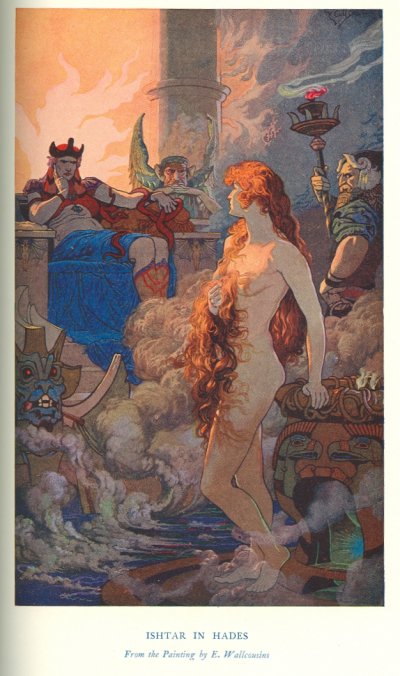
Click to enlarge
ISHTAR IN HADES
From the Painting by E. Wallcousins.
p. 97
commands the plague demon, Namtar, to strike her with disease in all parts of her body. The effect of Ishtar's fate was disastrous upon earth: growth and fertility came to an end.
Meanwhile Pap-sukal, messenger of the gods, hastened to Shamash, the sun deity, to relate what had occurred. The sun god immediately consulted his lunar father, Sin, and Ea, god of the deep. Ea then created a man lion, named Nadushu-namir, to rescue Ishtar, giving him power to pass through the seven gates of Hades. When this being delivered his message
Allatu . . . struck her breast; she bit her thumb,
She turned again: a request she asked not.
[paragraph continues] In her anger she cursed the rescuer of the Queen of Heaven.She turned again: a request she asked not.
May I imprison thee in the great prison,
May the garbage of the foundations of the city be thy food,
May the drains of the city be thy drink,
May the darkness of the dungeon be thy dwelling,
May the stake be thy seat,
May hunger and thirst strike thy offspring.
She was compelled, however, to obey the high gods, and addressed Namtar, saying:May the garbage of the foundations of the city be thy food,
May the drains of the city be thy drink,
May the darkness of the dungeon be thy dwelling,
May the stake be thy seat,
May hunger and thirst strike thy offspring.
Unto Ishtar give the waters of life and bring her before me.
[paragraph continues]
Thereafter the Queen of Heaven was conducted through the various gates,
and at each she received her robe and the ornaments which were taken
from her on entering. Namtar says:
Since thou hast not paid a ransom for thy deliverance to her (Allatu), so to her again turn back,
For Tammuz the husband of thy youth.
The glistening waters (of life) pour over him .
In splendid clothing dress him, with a ring of crystal adorn him.
p. 98For Tammuz the husband of thy youth.
The glistening waters (of life) pour over him .
In splendid clothing dress him, with a ring of crystal adorn him.
Ishtar mourns for "the wound of Tammuz", smiting her breast, and she did not ask for "the precious eye-stones, her amulets", which were apparently to ransom Tammuz. The poem concludes with Ishtar's wail:
O my only brother (Tammuz) thou dost not lament for me.
In the day that Tammuz adorned me, with a ring of crystal,
With a bracelet of emeralds, together with himself, he adorned me, 1
With himself he adorned me; may men mourners and women mourners
On a bier place him, and assemble the wake. 2
A Sumerian hymn to Tammuz throws light on this narrative. It sets
forth that Ishtar descended to Hades to entreat him to be glad and to
resume care of his flocks, but Tammuz refused or was unable to return.In the day that Tammuz adorned me, with a ring of crystal,
With a bracelet of emeralds, together with himself, he adorned me, 1
With himself he adorned me; may men mourners and women mourners
On a bier place him, and assemble the wake. 2
His spouse unto her abode he sent back.
[paragraph continues] She then instituted the wailing ceremony:
The amorous Queen of Heaven sits as one in darkness. 3
Mr. Langdon also translates a hymn (Tammuz III) which appears to
contain the narrative on which the Assyrian version was founded. The
goddess who descends to Hades, however, is not Ishtar, but the "sister",
Belit-sheri. She is accompanied by various demons--the "gallu-demon",
the "slayer", &c.--and holds a conversation with Tammuz which,
however, is "unintelligible and badly broken". Apparently, however, he
promises to return to earth.
. . . I will go up, as for me I will depart with thee . . .
. . . I will return, unto my mother let us go back.
p. 99. . . I will return, unto my mother let us go back.
Probably two goddesses originally lamented for Tammuz, as the Egyptian sisters, Isis and Nepthys, lamented for Osiris, their brother. Ishtar is referred to as "my mother". Isis figures alternately in the Egyptian chants as mother, wife, sister, and daughter of Osiris. She cries, "Come thou to thy wife in peace; her heart fluttereth for thy love", . . . "I am thy wife, made as thou art, the elder sister, soul of her brother". . . . "Come thou to us as a babe". . . . "Lo, thou art as the Bull of the two goddesses--come thou, child growing in peace, our lord!" . . "Lo! the Bull, begotten of the two cows, Isis and Nepthys". . . . "Come thou to the two widowed goddesses". . . . "Oh child, lord, first maker of the body". . . . "Father Osiris." 1
As Ishtar and Belit-sheri weep for Tammuz, so do
Isis and Nepthys weep for Osiris.
Calling upon thee with weeping--yet thou art prostrate upon thy bed!
Gods and men . . . are weeping for thee at the same time, when they behold me (Isis).
Lo! I invoke thee with wailing that reacheth high as heaven.
[paragraph continues] Isis is also identified with Hathor (Ishtar) the Cow. . . . "The cow weepeth for thee with her voice." 2Gods and men . . . are weeping for thee at the same time, when they behold me (Isis).
Lo! I invoke thee with wailing that reacheth high as heaven.
There is another phase, however, to the character of the mother goddess which explains the references to the desertion and slaying of Tammuz by Ishtar. "She is", says Jastrow, "the goddess of the human instinct, or passion which accompanies human love. Gilgamesh . . . reproaches her with abandoning the objects of her passion after a brief period of union." At Ishtar's temple "public maidens accepted temporary partners, assigned to them by
p. 100
[paragraph continues] Ishtar". 1 The worship of all mother goddesses in ancient times was accompanied by revolting unmoral rites which are referred to in condemnatory terms in various passages in the Old Testament, especially in connection with the worship of Ashtoreth, who was identical with Ishtar and the Egyptian Hathor.
Ishtar in the process of time overshadowed all the other female deities of Babylonia, as did Isis in Egypt. Her name, indeed, which is Semitic, became in the plural, Ishtaráte, a designation for goddesses in general. But although she was referred to as the daughter of the sky, Anu, or the daughter of the moon, Sin or Nannar, she still retained traces of her ancient character. Originally she was a great mother goddess, who was worshipped by those who believed that life and the universe had a female origin in contrast to those who believed in the theory of male origin. Ishtar is identical with Nina, the fish goddess, a creature who gave her name to the Sumerian city of Nina and the Assyrian city of Nineveh. Other forms of the Creatrix included Mama, or Mami, or Ama, "mother", Aruru, Bau, Gula, and Zer-panitum. These were all "Preservers" and healers. At the same time they were "Destroyers", like Nin-sun and the Queen of Hades, Eresh-ki-gal or Allatu. They were accompanied by shadowy male forms ere they became wives of strongly individualized gods, or by child gods, their sons, who might be regarded as "brothers" or "husbands of their mothers", to use the paradoxical Egyptian term. Similarly Great Father deities had vaguely defined wives. The "Semitic" Baal, "the lord", was accompanied by a female reflection of himself--Beltu, "the lady". Shamash, the sun god, had for wife the shadowy Aa.
Click to enlarge
WINGED HUMAN-HEADED COW (?)
From Kouyunjik (Nineveh): now in the British Museum.
Photo. Mansell.
p. 101
As has been shown, Ishtar is referred to in a Tammuz hymn as the mother of the child god of fertility. In an Egyptian hymn the sky goddess Nut, "the mother" of Osiris, is stated to have "built up life from her own body." 1 Sri or Lakshmi, the Indian goddess, who became the wife of Vishnu, as the mother goddess Saraswati, a tribal deity, became the wife of Brahma, was, according to a Purana commentator, "the mother of the world . . . eternal and undecaying". 2
The gods, on the other hand, might die annually: the goddesses alone were immortal. Indra was supposed to perish of old age, but his wife, Indrani, remained ever young. There were fourteen Indras in every "day of Brahma", a reference apparently to the ancient conception of Indra among the Great-Mother-worshipping sections of the Aryo-Indians. 3 In the Mahàbhàrata the god Shiva, as Mahadeva, commands Indra on "one of the peaks of Himavat", where they met, to lift up a stone and join the Indras who had been before him. "And Indra on removing that stone beheld a cave on the breast of that king of mountains in which were four others resembling himself." Indra exclaimed in his grief, "Shall I be even like these?" These five Indras, like the "Seven Sleepers", awaited the time when they would be called forth. They were ultimately reborn as the five Pandava warriors. 4
The ferocious, black-faced Scottish mother goddess, Cailleach Bheur, who appears to be identical with Mala Lith, "Grey Eyebrows" of Fingalian story, and the English "Black Annis", figures in Irish song and legend as "The Old Woman of Beare". This "old woman" (Cailleach) "had", says Professor Kuno Meyer, "seven
p. 102
periods of youth one after another, so that every man who had lived with her came to die of old age, and her grandsons and great-grandsons were tribes and races". When old age at length came upon her she sang her "swan song", from which the following lines are extracted:
Ebb tide to me as of the sea!
Old age causes me reproach . . .
It is riches
Ye love, it is not men:
In the time when we lived
It was men we loved . . .
My arms when they are seen
Are bony and thin:
Once they would fondle,
They would be round glorious kings . . .
I must take my garment even in the sun:
The time is at hand that shall renew me. 1
Freyja, the Germanic mother goddess, whose car was drawn by cats, had
similarly many lovers. In the Icelandic poem "Lokasenna", Loki taunts
her, saying:Old age causes me reproach . . .
It is riches
Ye love, it is not men:
In the time when we lived
It was men we loved . . .
My arms when they are seen
Are bony and thin:
Once they would fondle,
They would be round glorious kings . . .
I must take my garment even in the sun:
The time is at hand that shall renew me. 1
Silence, Freyja! Full well I know thee,
And faultless art thou not found;
Of the gods and elves who here are gathered
Each one hast thou made thy mate.
Idun, the keeper of the apples of immortal youth, which prevent the gods growing old, is similarly addressed:And faultless art thou not found;
Of the gods and elves who here are gathered
Each one hast thou made thy mate.
Silence, Idun! I swear, of all women
Thou the most wanton art;
Who couldst fling those fair-washed arms of thine
About thy brother's slayer.
p. 103Thou the most wanton art;
Who couldst fling those fair-washed arms of thine
About thy brother's slayer.
Frigg, wife of Odin, is satirized as well:
The goddesses of classic mythology had similar reputations. Aphrodite (Venus) had many divine and mortal lovers. She links closely with Astarte and Ashtoreth (Ishtar), and reference has already been made to her relations with Adonis (Tammuz). These love deities were all as cruel as they were wayward. When Ishtar wooed the Babylonian hero, Gilgamesh, he spurned her advances, as has been indicated, saying:
On Tammuz, the spouse of thy youth,
Thou didst lay affliction every year.
Thou didst love the brilliant Allalu bird
But thou didst smite him and break his wing;
He stands in the woods and cries "O my wing".
[paragraph continues] He likewise charged her with deceiving the lion and the horse, making reference to obscure myths:Thou didst lay affliction every year.
Thou didst love the brilliant Allalu bird
But thou didst smite him and break his wing;
He stands in the woods and cries "O my wing".
Thou didst also love a shepherd of the flock,
Who continually poured out for thee the libation,
And daily slaughtered kids for thee;
But thou didst smite him and didst change him into a leopard,
So that his own sheep boy hunted him,
And his own hounds tore him to pieces. 2
These goddesses were ever prone to afflict human beings who might
offend them or of whom they wearied. Demeter (Ceres) changed Ascalaphus
into an owl and Stellio into a lizard. Rhea (Ops) resembledWho continually poured out for thee the libation,
And daily slaughtered kids for thee;
But thou didst smite him and didst change him into a leopard,
So that his own sheep boy hunted him,
And his own hounds tore him to pieces. 2
The tow’red Cybele,
Mother of a hundred gods,
p. 104Mother of a hundred gods,
the wanton who loved Attis (Adonis). Artemis (Diana) slew her lover Orion, changed Actæon into a stag, which was torn to pieces by his own dogs, and caused numerous deaths by sending a boar to ravage the fields of Œneus, king of Calydon. Human sacrifices were frequently offered to the bloodthirsty "mothers". The most famous victim of Artemis was the daughter of Agamemnon, "divinely tall and most divinely fair". 1 Agamemnon had slain a sacred stag, and the goddess punished him by sending a calm when the war fleet was about to sail for Troy, with the result that his daughter had to be sacrificed. Artemis thus sold breezes like the northern wind hags and witches.
It used to be customary to account for the similarities manifested by the various mother goddesses by assuming that there was constant cultural contact between separate nationalities, and, as a result, a not inconsiderable amount of "religious borrowing". Greece was supposed to have received its great goddesses from the western Semites, who had come under the spell of Babylonian religion. Archæological evidence, however, tends to disprove this theory. "The most recent researches into Mesopotamian history", writes Dr. Farnell, "establish with certainty the conclusion that there was no direct political contact possible between the powers in the valley of the Euphrates and the western shores of the Ægean in the second millennium B.C. In fact, between the nascent Hellas and the great world of Mesopotamia there were powerful and possibly independent strata of cultures interposing." 2
The real connection appears to be the racial one. Among the Mediterranean Neolithic tribes of Sumeria, Arabia, and Europe, the goddess cult appears to have
p. 105
been influential. Mother worship was the predominant characteristic of their religious systems, so that the Greek goddesses were probably of pre-Hellenic origin, the Celtic of Iberian, the Egyptian of proto-Egyptian, and the Babylonian of Sumerian. The northern hillmen, on the other hand, who may be identified with the "Aryans" of the philologists, were father worshippers. The Vedic Aryo-Indians worshipped father gods, 1 as did also the Germanic peoples and certain tribes in the "Hittite confederacy". Earth spirits were males, like the Teutonic elves, the Aryo-Indian Ribhus, and the Burkans, "masters", of the present-day Buriats, a Mongolian people. When the father-worshipping peoples invaded the dominions of the mother-worshipping peoples, they introduced their strongly individualized gods, but they did not displace the mother goddesses. "The Aryan Hellenes", says Dr. Farnell, "were able to plant their Zeus and Poseidon on the high hill of Athens, but not to overthrow the supremacy of Athena in the central shrine and in the aboriginal soul of the Athenian people." 2 As in Egypt, the beliefs of the father worshippers, represented by the self-created Ptah, were fused with the beliefs of the mother worshippers, who adored Isis, Mut, Neith, and others. In Babylonia this process of racial and religious fusion was well advanced before the dawn of history. Ea, who had already assumed manifold forms, may have originally been the son or child lover of Damkina, "Lady of the Deep", as was Tammuz of Ishtar. As the fish, Ea was the offspring of the mother river.
The mother worshippers recognized male as well as female deities, but regarded the great goddess as the First Cause. Although the primeval spirits were grouped in
p. 106
four pairs in Egypt, and apparently in Babylonia also, the female in the first pair was more strongly individualized than the male. The Egyptian Nu is vaguer than his consort Nut, and the Babylonian Apsu than his consort Tiamat. Indeed, in the narrative of the Creation Tablets of Babylon, which will receive full treatment in a later chapter, Tiamat, the great mother, is the controlling spirit. She is more powerful and ferocious than Apsu, and lives longer. After Apsu's death she elevates one of her brood, named Kingu, to be her consort, a fact which suggests that in the Ishtar-Tammuz myth survives the influence of exceedingly ancient modes of thought. Like Tiamat, Ishtar is also a great battle heroine, and in this capacity she was addressed as "the lady of majestic rank exalted over all gods". This was no idle flattery on the part of worshippers, but a memory of her ancient supremacy.
Reference has been made to the introduction of Tammuz worship into Jerusalem. Ishtar, as Queen of Heaven, was also adored by the backsliding Israelites as a deity of battle and harvest. When Jeremiah censured the people for burning incense and serving gods "whom they knew not", he said, "neither they, ye, nor your fathers", they made answer: "Since we left off to burn incense to the queen of heaven, and to pour out drink offerings unto her, we have wanted all things, and have been consumed by the sword and the famine". The women took a leading part in these practices, but refused to accept all the blame, saying, "When we burned incense to the queen of heaven, and poured out drink offerings unto her, did we make our cakes and pour out drink offerings unto her without our men?" 1 That the husbands, and the children even, assisted at the ceremony is made evident in another reference to goddess worship:
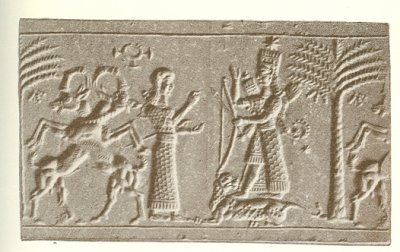
Click to enlarge
Female figure in adoration before a goddess
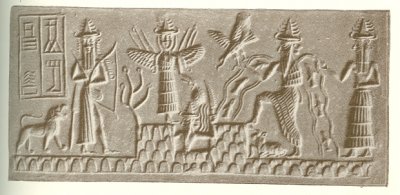
Click to enlarge
The winged Ishtar above the rising sun god, the river god, and other deities
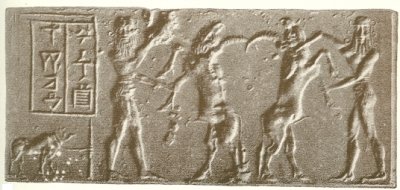
Click to enlarge
Gilgamesh in conflict with bulls
(see page 176)
CYLINDER-SEAL IMPRESSIONS
(British Museum)
(British Museum)
p. 107
[paragraph continues] "The children gather wood, and the fathers kindle the fire, and the women knead the dough, to make cakes to the queen of heaven". 1
Jastrow suggests that the women of Israel wept for Tammuz, offered cakes to the mother goddess, &c., because "in all religious bodies . . . women represent the conservative element; among them religious customs continue in practice after they have been abandoned by men". 2 The evidence of Jeremiah, however, shows that the men certainly co-operated at the archaic ceremonials. In lighting the fires with the "vital spark", they apparently acted in imitation of the god of fertility. The women, on the other hand, represented the reproductive harvest goddess in providing the food supply. In recognition of her gift, they rewarded the goddess by offering her the cakes prepared from the newly ground wheat and barley--the "first fruits of the harvest". As the corn god came as a child, the children began the ceremony by gathering the wood for the sacred fire. When the women mourned for Tammuz, they did so evidently because the death of the god was lamented by the goddess Ishtar. It would appear, therefore, that the suggestion regarding the "conservative element" should really apply to the immemorial practices of folk religion. These differed from the refined ceremonies of the official cult in Babylonia, where there were suitable temples and organized bands of priests and priestesses. But the official cult received no recognition in Palestine; the cakes intended for a goddess were not offered up in the temple of Abraham's God, but "in the streets of Jerusalem" and those of other cities. 3
p. 108
The obvious deduction seems to be that in ancient times women everywhere played a prominent part in the ceremonial folk worship of the Great Mother goddess, while the men took the lesser part of the god whom she had brought into being and afterwards received as "husband of his mother". This may account for the high social status of women among goddess worshippers, like the representatives of the Mediterranean race, whose early religion was not confined to temples, but closely associated with the acts of everyday life.
Footnotes
82:1 Ezekiel, viii.83:1 Psalms, cxxvi.
83:2 The Burden of Isis, J. T. Dennis (Wisdom of the East series), pp. 21, 22.
83:3 Religion of the Semites, pp. 412, 414.
85:1 Egyptian Myth and Legend, pp. 45 et seq.
86:1 Langdon's Sumerian and Babylonian Psalms, pp. 319-321.
87:1 Campbell's West Highland Tales, vol. iii, p. 74..
87:2 West Highland Tales, vol. iii, pp. 85, 86.
87:3 If Finn and his band were really militiamen--the original Fenians--as is believed in Ireland, they may have had attached to their memories the legends of archaic Iberian p. 88 deities who differed from the Celtic Danann deities. Theodoric the Goth, as Dietrich von Bern, was identified, for instance, with Donar or Thunor (Thor), the thunder god, In Scotland Finn and his followers are all giants. Diarmid is the patriarch of the Campbell clan, the MacDiarmids being "sons of Diarmid".
89:1 Isaiah condemns a magical custom connected with the worship of Tammuz in the garden, Isaiah, xvii, g, II. This "Garden of Adonis" is dealt with in the next chapter.
90:1 Quotations are from Sumerian and Babylonian Psalms, translated by Stephen Langdon, Ph.D. (Paris and London, 1909), pp. 299-341.
93:1 Beowulf, translated by J. R. Clark Hall (London, 1911), pp. 9-11.
93:2 For Frey's connection with the Ynglings see Morris and Magnusson's Heimskringla (Saga Library, vol. iii), pp. 23-71.
93:3 The Religion of Babylonia and Assyria, p. 72.
94:1 Langdon's Sumerian and Babylonian Psalms, pp. 325, 339.
94:2 Professor Oldenberg's translation.
94:3 Osiris is also invoked to "remove storms and rain and give fecundity in the night-time". As a spring sun god he slays demons; as a lunar god he brings fertility.
96:1 Like the love-compelling girdle of Aphrodite.
98:1 A wedding bracelet of crystal is worn by Hindu women; they break it when the husband dies.
98:2 Quotations from the translation in The Chaldean Account of Genesis, by George Smith.
98:3 Langdon's Sumerian and Babylonian Psalms, p. 32q et seq.
99:1 The Burden of Isis, translated by J. T. Dennis (Wisdom of the East series), pp. 24, 31, 32, 39, 45, 46, 49.
99:2 The Burden of Isis, pp. 22, 46.
100:1 Aspects of Religious Belief and Practice in Babylonia and Assyria, p. 137, and Herodotus, book i, 199.
101:1 The Burden of Isis, p. 47.
101:2 Original Sanskrit Texts, J. Muir, London, 1890, vol. i, p. 67.
101:3 Original Sanskrit Texts, vol. i, p. 44.
101:4 Adi Parva section of Mahàbhàrata (Roy's translation), pp. 553, 555.
102:1 Ancient Irish Poetry, Kuno Meyer (London, 1911), pp. 88-90.
103:1 Translations from The Elder Edda, by O. Bray (part i), London, 1908.
103:2 Babylonian Religion, L. W. King, pp. 160, 161.
104:1 Tennyson's A Dream of Fair Women.
104:2 Greece and Babylon, L. R. Farnell (Edinburgh, 1911), p. 35.
105:1 The goddesses did not become prominent until the "late invasion" of the post-Vedic Aryans.
105:2 Greece and Babylon, p. 96.
106:1 Jeremiah, xliv.
107:1 Jeremiah, vii, 18.
107:2 Aspects of Religious Belief and Practice in Babylonia and Assyria, pp. 348, 349.
107:3 Jeremiah, vii, 17.
Myths of Babylonia and Assyria, by Donald A. MacKenzie, [1915]
http://www.sacred-texts.com/index.htm
Εγγραφή σε:
Αναρτήσεις (Atom)