Σύμπαν και άνθρωπος

Όλα στο σύμπαν αφορούν τη μεταμόρφωση.Η ζωή μας μοιάζει με τις σκέψεις που τη διαμορφώνουν.

Μάρκος Αυρήλιος
Εμφάνιση αναρτήσεων με ετικέτα terence mckenna. Εμφάνιση όλων των αναρτήσεων

Σάββατο 15 Δεκεμβρίου 2012

Machine elf

Machine elves (also known as fractal elves, self-transforming machine elves) is a term coined by the late ethnobotanist, writer and philosopher Terence McKenna to describe the apparent entities (described as "elves") that have been reported by users of the psychedelic tryptamine dimethyltryptamine (DMT).[1] References to such encounters can be found in many cultures ranging from shamanic traditions of native Americans to indigenous Australians and African tribes, as well as among western users of these substances.[2]

Description by McKenna

McKenna's first published mention of the machine elves is in his and his brother Dennis' book The Invisible Landscape (published 1975):
We especially refer to the apparently autonomous and intelligent, chaotically mercurial and mischievous machine elves encountered in the trance state, strange teachers whose marvelous singing makes intricate toys out of the air and out of their own continually transforming body geometries.[3]
At about minute one or two of a DMT trip, according to McKenna, one may burst through a chrysanthemum-like mandala, and find:
There's a whole bunch of entities waiting on the other side, saying "How wonderful that you're here! You come so rarely! We're so delighted to see you!"
They're like jewelled self-dribbling basketballs and there are many of them and they come pounding toward you and they will stop in front of you and vibrate, but then they do a very disconcerting thing, which is they jump into your body and then they jump back out again and the whole thing is going on in a high-speed mode where you're being presented with thousands of details per second and you can't get a hold on [them ...] and these things are saying "Don't give in to astonishment", which is exactly what you want to do. You want to go nuts with how crazy this is, and they say "Don't do that. Pay attention to what we're doing".
What they're doing is making objects with their voices, singing structures into existence. They offer things to you, saying "Look at this! Look at this!" and as your attention goes towards these objects you realise that what you're being shown is impossible. It's not simply intricate, beautiful and hard to manufacture, it's impossible to make these things. The nearest analogy would be the Fabergé eggs, but these things are like the toys that are scattered around the nursery inside a U.F.O., celestial toys, and the toys themselves appear to be somehow alive and can sing other objects into existence, so what's happening is this proliferation of elf gifts, which are moving around singing, and they are saying "Do what we are doing" and they are very insistent, and they say "Do it! Do it! Do it!" and you feel like a bubble inside your body beginning to move up toward your mouth, and when it comes out it isn't sound, it's vision. You discover that you can pump "stuff" out of your mouth by singing, and they're urging you to do this. They say "That's it! That's it! Keep doing it!".
We're now at minute 4.5 [of the trip] and you speak in a kind of glossolalia. There is a spontaneous outpouring of syntax unaccompanied by what is normally called "meaning". After a minute or so of this the whole thing begins to collapse in on itself and they begin to physically move away from you. Usually their final shot is that they wave goodbye and say "Deja vu! Deja vu!".

Other mentions of the DMT elves

McKenna was not the first to experience or report DMT elves, even if they probably owe most of their popularization to him. In an article published in The Journal of Mental Science (now the British Journal of Psychiatry) in 1958 under the title “Dimethyltryptamine Experiments with Psychotics”, researcher Stephen Szara (the chemist who first studied the human effects of DMT) talked about how one of his subjects under the influence of DMT had experienced “strange creatures, dwarves or something” at the beginning of the trip.[4]
In a book entitled Psychedelic Monographs and Essays Volume 5,[5] Peter Meyer, a philosopher, mathematician and developer of Terence McKenna's "Timewave Zero" software, spoke about the DMT elves. He reported a subject's experience of the elves after ingestion of DMT: "The elves were dancing in and out of the multidimensional visible language matrix". Meyer associates this experience with that talked about by Walter Evans-Wentz, who expressed that a world of entities such as fairies and elves exists "as a supernormal state of consciousness into which men and women may enter temporarily in dreams, trances, or in various ecstatic conditions".[6] Meyer believes that the objective space that one may enter on DMT, and the faerie world described by Evans-Wentz, are one and the same.[7]
Psychiatrist Rick Strassman, who made extensive research on DMT, encountered many DMT smokers who had experienced beings similar to McKenna's machine elves. Since, at the time, all of the subjects were from California, his first guess was that this was a just a "West Coast eccentricity". In Strassmans words, "Also surprising were the common themes of what these beings were doing with so many of our volunteers: manipulating, communicating, showing, helping, questioning. It was definitely a two-way street".[1]
The subject of machine elves is one that occupies the works of author and scientist Cliff Pickover and has been a major theme in his book Sex, Drugs, Einstein, & Elves.[8]

Possible explanations

James Kent has put forth an explanation for machine elves.[9] Kent postulates that the DMT landscape is simply disrupting or "editing" our processing of visual information and causing a chaotic interpretation of it inspired by hyperactive phosphene activity. The brain may fill in the blanks and since we all have an affinity for anthropomorphic things, a humanoid entity may appear out of all this chaos. Our "imaginal workplace" will take the center stage in brain activity, allowing internal data to be interpreted as external stimuli.

 http://en.wikipedia.org/wiki/

Terence McKenna

Terence Kemp McKenna (November 16, 1946 – April 3, 2000) was an American ethnobotanist, philosopher, psychonaut, researcher, teacher, lecturer and writer on many subjects, such as human consciousness, language, psychedelic substances, the evolution of civilizations, the origin and end of the universe, alchemy, and extraterrestrial beings.

Biography

Early life

Terence McKenna was born and raised in Paonia, Colorado.[1] McKenna's father was of Irish ancestry and his mother was of Welsh descent.[2] He was introduced to geology through his uncle and developed a hobby of solitary fossil hunting in the arroyos near his home.[3] From this he developed a deep artistic and scientific appreciation of nature.
At age 16, McKenna moved to Los Altos, California to live with family friends for a year. He finished high school in Lancaster, CA.[1] In 1963, McKenna was introduced to the literary world of psychedelics through The Doors of Perception and Heaven and Hell by Aldous Huxley and certain issues of The Village Voice that talked about psychedelics.[1][4]
McKenna claimed that one of his early psychedelic experiences with morning glory seeds showed him "that there was something there worth pursuing."[1] In an audio interview Terence Mckenna claims to have started smoking cannabis regularly during the summer following his 17th birthday.

Studying and traveling

In 1965, McKenna enrolled in the University of California, Berkeley[5] to study art history.[1] In 1967, while in college, he discovered and began studying shamanism through the study of Tibetan folk religion.[6] That year, which he called his "opium and kabbala phase"[7] he also traveled to Jerusalem, where he met Kathleen Harrison, who would later become his wife.[7]
In 1969, McKenna traveled to Nepal led by his "interest in Tibetan painting and hallucinogenic shamanism."[7] During his time there, he studied the Tibetan language and worked as a hashish smuggler, until "one of his Bombay-to-Aspen shipments fell into the hands of U. S. Customs." He was forced to move to avoid capture by Interpol.[7] He wandered through Southeast Asia viewing ruins, collected butterflies in Indonesia, and worked as an English teacher in Tokyo. He then went back to Berkeley to continue studying biology, which he called "his first love".[7]
After the partial completion of his studies, and his mother's death from cancer in 1971,[8] McKenna, his brother Dennis, and three friends traveled to the Colombian Amazon in search of oo-koo-hé, a plant preparation containing dimethyltryptamine (DMT). Instead of oo-koo-hé they found various forms of ayahuasca, or yagé, and gigantic Psilocybe cubensis which became the new focus of the expedition.[7] In La Chorrera, at the urging of his brother, he was the subject of a psychedelic experiment which he claimed put him in contact with "Logos": an informative, divine voice he believed was universal to visionary religious experience.[7] The voice's reputed revelations and his brother's simultaneous peculiar experience prompted him to explore the structure of an early form of the I Ching, which led to his "Novelty Theory".[7] During their stay in the Amazon, McKenna also became romantically involved with his interpreter, Ev.[7]
In 1972, McKenna returned to Berkeley to finish his studies.[5] There he decided to switch majors to a Bachelor of Science in ecology and conservation, in a then new experimental section of the same university called the Tussman Experimental College.[1] During his studies, he would also develop techniques for cultivating psilocybin mushrooms with Dennis.[7]
In 1975, he parted with his girlfriend, Ev, when she left him for one of his friends from Berkeley. Their parting left him "tormented with migraines and living alone".[7] He graduated in 1975.[9] That same year, he began a relationship with Kathleen Harrison, whom he had met in Jerusalem.
Soon after graduating, McKenna and Dennis published a book inspired by their Amazon experiences, The Invisible Landscape: Mind, Hallucinogens and the I Ching. He also began lecturing.[5] The brothers' experiences in the Amazon would later play a major role in McKenna's book True Hallucinations, published in 1993.[7] In 1976, the brothers published what they had learned about the cultivation of mushrooms in a book entitled Psilocybin - Magic Mushroom Grower's Guide under the pseudonyms "OT Oss" and "ON Oeric".[10]

Later life

In the early 1980s, McKenna began to speak publicly on the topic of psychedelic drugs, lecturing extensively and conducting weekend workshops. Though associated with the New Age and human potential movements, McKenna himself had little patience for New Age sensibilities. He repeatedly stressed the importance and primacy of felt experience, as opposed to dogma.[11] Timothy Leary once introduced him as "one of the five or six most important people on the planet."[12]
“ It's clearly a crisis of two things: of consciousness and conditioning. These are the two things that the psychedelics attack. We have the technological power, the engineering skills to save our planet, to cure disease, to feed the hungry, to end war; But we lack the intellectual vision, the ability to change our minds. We must decondition ourselves from 10,000 years of bad behavior. And, it's not easy. ”
—Terence McKenna, "This World...and Its Double", [13]
He soon became a fixture of popular counterculture. His growing popularity culminated in the early-to-mid-1990s with the publication of several books: True Hallucinations, relating the tale of his 1971 La Chorrera experience; Food of the Gods; and The Archaic Revival. He became a popular personality in the psychedelic rave/dance scene of the early 1990s, with frequent spoken word performances at raves and contributions to psychedelic and goa trance albums by The Shamen, Spacetime Continuum, Alien Project, Capsula, Entheogenic, Zuvuya, Shpongle, and Shakti Twins. His speeches were, and are, sampled by many. In 1994 he appeared as a speaker at the Starwood Festival, documented in the book Tripping by Charles Hayes. His lectures were produced on both cassette tape and CD.[14]
McKenna was a colleague of chaos mathematician Ralph Abraham, and biologist Rupert Sheldrake, creator of the theory of "morphogenetic fields", not to be confused with the mainstream usage of the same term. He conducted several public debates known as trialogues with them from the late 1980s until his death. Books containing transcriptions of some of these events were published. He was also a friend and associate of Ralph Metzner, Nicole Maxwell, and Riane Eisler, participating in joint workshops and symposia with them. He was a personal friend of Tom Robbins, and influenced the thought of many scientists, writers, artists, and entertainers.[citation needed] Comedian Bill Hicks' routines about psychedelic drugs drew heavily from McKenna's works.[citation needed] He also may have been the inspiration for the Twin Peaks character Dr. Jacoby.[15]
In addition to psychedelic drugs, McKenna spoke on the subjects of virtual reality, which he saw as a way to artistically communicate the experience of psychedelics; techno-paganism; artificial intelligence; evolution; extraterrestrials; and aesthetic theory, specifically about art/visual experience as information representing the significance of hallucinatory visions experienced under the influence of psychedelics.
In 1985,[9] McKenna co-founded Botanical Dimensions with his then-wife Kathleen, a nonprofit ethnobotanical preserve in Hawaii, where he lived for many years before he died. In 1997 he and Kathleen divorced.[5] Before moving to Hawaii permanently, McKenna split his time between Hawaii and Occidental, located in the redwood-studded hills of Sonoma County, California.

Death

A longtime sufferer of migraines, in mid-1999 McKenna returned to his home on the big island of Hawaii after a long lecturing tour. He began to suffer from increasingly painful headaches. This culminated in three brain seizures in one night, which he claimed were the most powerful psychedelic experiences he had ever known. Upon his emergency trip to the hospital on Oahu, Terence was diagnosed with glioblastoma multiforme, a highly aggressive form of brain cancer. For the next several months he underwent various treatments, including experimental gamma knife radiation treatment. According to Wired magazine, McKenna was worried that his tumour was caused by his 35-years of smoking cannabis; though his doctors assured him there was no causal relation.[5]
In late 1999, Erik Davis conducted what would be the last interview of McKenna.[16] During the interview McKenna also talked about the announcement of his death:
“ I always thought death would come on the freeway in a few horrifying moments, so you'd have no time to sort it out. Having months and months to look at it and think about it and talk to people and hear what they have to say, it's a kind of blessing. It's certainly an opportunity to grow up and get a grip and sort it all out. Just being told by an unsmiling guy in a white coat that you're going to be dead in four months definitely turns on the lights. ... It makes life rich and poignant. When it first happened, and I got these diagnoses, I could see the light of eternity, a la William Blake, shining through every leaf. I mean, a bug walking across the ground moved me to tears.[17]
”
McKenna died on April 3, 2000, at the age of 53, with his loved ones at his bedside. He is survived by his brother Dennis, his son Finn, and his daughter Klea.

Library fire

On February 7, 2007, McKenna's library of rare books and personal notes was destroyed in a fire that burned offices belonging to Big Sur's Esalen Institute, which was storing the collection. An index maintained by his brother Dennis survives, though little else.[18]

Ideas

“ There are these things, which I call "self transforming machine elves," I also call them self-dribbling basketballs. They are, but they are none of these things. I mean you have to understand: these are metaphors in the truest sense, meaning that they're lies! [...] I name them 'Tykes' because tyke is a word that means to me a small child, ... and when you burst into the DMT space this is the Aeon - it's a child, and it's at play with colored balls, and I am in eternity, apparently, in the presence of this thing. ”
—Terence McKenna, "Time and Mind", [19]
Terence McKenna advocated the exploration of altered states of mind via the ingestion of naturally occurring psychedelic substances. For example, and in particular, as facilitated by the ingestion of high doses of psychedelic mushrooms, and DMT, which he believed was the apotheosis of the psychedelic experience. He spoke of the "jeweled, self-dribbling basketballs" or "self-transforming machine elves" that one encounters in that state.
Although he avoided giving his allegiance to any one interpretation (part of his rejection of monotheism), he was open to the idea of psychedelics as being "trans-dimensional travel"; literally, enabling an individual to encounter what could be ancestors, or spirits of earth.[11] He remained opposed to most forms of organized religion or guru-based forms of spiritual awakening.
Either philosophically or religiously, he expressed admiration for Marshall McLuhan, Pierre Teilhard de Chardin, Gnostic Christianity, Alfred North Whitehead and Alchemy. McKenna always regarded the Greek philosopher Heraclitus as his favorite philosopher.[12]
He also expressed admiration for the works of James Joyce (calling Finnegans Wake "the quintessential work of art, or at least work of literature of the 20th century")[20] and Vladimir Nabokov: McKenna once said that he would have become a Nabokov lecturer if he had never encountered psychedelics.
During the final years of his life and career, McKenna became very engaged in the theoretical realm of technology. He has advocated the idea of a technological singularity.[21] In his last recorded public talk, Psychadelics in The Age of Intelligent Machines, he outlined strong ties between psychedelics, computation technology, and humans. [22]

"Stoned Ape" theory of human evolution

In his book Food of the Gods,[23] McKenna proposed that the transformation from humans' early ancestors Homo erectus to the species Homo sapiens mainly had to do with the addition of the mushroom Psilocybe cubensis in its diet - an event which according to his theory took place in about 100,000 BC (this is when he believed that the species diverged from the Homo genus). He based his theory on the main effects, or alleged effects, produced by the mushroom. One of the effects that comes about from the ingestion of low doses, which agrees with one of scientist Roland Fischer's findings from the late 1960s-early 1970s,[24] is it significantly improves the visual acuity of humans - so theoretically, of other human-like mammals too. According to McKenna, this effect would have definitely proven to be of evolutionary advantage to humans' omnivorous hunter-gatherer ancestors that would have stumbled upon it "accidentally"; as it would make it easier for them to hunt.
In higher doses, McKenna claims, the mushroom acts as a sexual stimulator, which would make it even more beneficial evolutionarily, as it would result in more offspring. At even higher doses, the mushroom would have acted to "dissolve boundaries", which would have promoted community-bonding and group sexual activities-that would result in a mixing of genes and therefore greater genetic diversity. Generally McKenna believed that the periodic ingestion of the mushroom would have acted to dissolve the ego in humans before it ever got the chance to grow in destructive proportions. In this context, he likened the ego to a cancerous tumor that can grow uncontrollable and become destructive to its host. In his own words:
Wherever and whenever the ego function began to form, it was akin to a cancerous tumor or a blockage in the energy of the psyche. The use of psychedelic plants in a context of shamanic initiation dissolved-as it dissolves today-the knotted structure of the ego into undifferentiated feeling, what Eastern philosophy calls the Tao.
—Terence McKenna, Food of the Gods
The mushroom, according to McKenna, had also given humans their first truly religious experiences (which, as he believed, were the basis for the foundation of all subsequent religions to date). Another factor that McKenna talked about was the mushroom's potency to promote linguistic thinking. This would have promoted vocalisation, which in turn would have acted in cleansing the brain (based on a scientific theory that vibrations from speaking cause the precipitation of impurities from the brain to the cerebrospinal fluid), which would further mutate the brain. All these factors according to McKenna were the most important factors that promoted evolution towards the Homo sapiens species. After this transformation took place, the species would have begun moving out of Africa to populate the rest of the planet[23] Later on, this theory by McKenna was given the name "The 'Stoned Ape' Theory of Human Evolution".[25]

Novelty theory

According to McKenna the universe has a teleological attractor at the end of time that increases interconnectedness, eventually reaching a singularity of infinite complexity in 2012 at which point anything and everything imaginable will occur simultaneously, what he referred to as the Eschaton. He conceived this idea over several years in the early to mid-1970s while using psilocybin mushrooms and DMT.[26]
McKenna viewed the universe as a swarm of matter waves, spiralling down the gradient of their synergetic (energetically favourable) constructive interference. He saw the universe as being "pulled from the future toward a goal that is as inevitable as a marble reaching the bottom of a bowl when you release it up near the rim...it comes to rest at the lowest energy state, which is the bottom of the bowl. That’s precisely my model of human history."[27]
In novelty theory, when two matter waves become connected by mutual constructive interference (quantum entanglement, rapport), they imagine or grok each other. Mc Kenna believed that imagination was capable of interconnecting matter waves instantaneously, stating that "the imagination is a dimension of nonlocal information,"[28] and "novelty is density of connection." [29]
a greyscale graph with multiple, jagged peaks and troughs and an overall descending pattern, set amidst complex virtual instrumentation
A screenshot of the "Timewave Zero" software
"What is happening to our world is ingression of novelty toward what Whitehead called "concrescence", a tightening gyre. Everything is flowing together. The "autopoietic lapis", the alchemical stone at the end of time, coalesces when everything flows together. When the laws of physics are obviated, the universe disappears, and what is left is the tightly bound plenum, the monad, able to express itself for itself, rather than only able to cast a shadow into physis as its reflection. I come very close here to classical millenarian and apocalyptic thought in my view of the rate at which change is accelerating. From the way the gyre is tightening, I predict that the concrescence will occur soon—around 2012 AD. It will be the entry of our species into hyperspace, but it will appear to be the end of physical laws accompanied by the release of the mind into the imagination."[30]
McKenna expressed "novelty" in a computer program which purportedly produces a waveform known as "timewave zero" or the "timewave". "Timewave zero" is a numerological formula that purports to calculate the ebb and flow of "novelty", defined as increase over time in the universe's interconnectedness, or organized complexity.[26] Based on McKenna's interpretation of the King Wen sequence of the I Ching,[5] the graph appears to show great periods of novelty corresponding with major shifts in humanity's biological and sociocultural evolution. He believed that the events of any given time are recursively related to the events of other times, and chose the atomic bombing of Hiroshima as the basis for calculating his end date of 16 November 2012. When he later discovered that the end of the 13th baktun in the Maya Calendar had been correlated by Western Maya scholars with December 21, not far from his own hypothesized end date, he decided that the Maya were more likely to be right on this subject and he adopted their end date.[31] The 1975 first edition of Mc Kenna's The Invisible Landscape refers to 2012 (but no specific day during the year) only twice. In the 1993 second edition, McKenna employed the 21st of December 2012 throughout, the date arrived at by the Mayanist researcher Robert J. Sharer's.[Note d][32]

Bibliography

  • 1975 - The Invisible Landscape: Mind, Hallucinogens, and the I Ching (with Dennis McKenna) (Seabury; 1st Ed) ISBN 0-8164-9249-2.
  • 1976 - The Invisible Landscape (with Dennis McKenna, and Quinn Taylor) (Scribner) ISBN 0-8264-0122-8
  • 1976 - Psilocybin - Magic Mushroom Grower's Guide (with Dennis McKenna: credited under the pseudonyms OT Oss and ON Oeric) (2nd edition 1986) (And/Or Press) ISBN 0-915904-13-6
  • 1992 - Psilocybin - Magic Mushroom Grower's Guide (with Dennis McKenna: (credited under the pseudonyms OT Oss and ON Oeric) (Quick American Publishing Company; Revised edition) ISBN 0-932551-06-8
  • 1992 - The Archaic Revival (HarperSanFrancisco; 1st edition) ISBN 0-06-250613-7
  • 1992 - Food of the Gods: The Search for the Original Tree of Knowledge - A Radical History of Plants, Drugs, and Human Evolution (Bantam) ISBN 0-553-37130-4
  • 1992 - Synesthesia (with Timothy C. Ely) (Granary Books 1st Ed) ISBN 1-887123-04-0
  • 1992 - Trialogues at the Edge of the West: Chaos, Creativity, and the Resacralization of the World (with Ralph H. Abraham, Rupert Sheldrake and Jean Houston) (Bear & Company Publishing 1st Ed) ISBN 0-939680-97-1
  • 1993 - True Hallucinations: Being an Account of the Author’s Extraordinary Adventures in the Devil’s Paradise (HarperSanFrancisco 1st Ed) ISBN 0-06-250545-9
  • 1994 - The Invisible Landscape (HarperSanFrancisco; Reprint edition) ISBN 0-06-250635-8
  • 1998 - True Hallucinations & the Archaic Revival: Tales and Speculations About the Mysteries of the Psychedelic Experience (Fine Communications/MJF Books) (Hardbound) ISBN 1-56731-289-6
  • 1998 - The Evolutionary Mind : Trialogues at the Edge of the Unthinkable (with Rupert Sheldrake and Ralph H. Abraham) (Trialogue Press; 1st Ed) ISBN 0-942344-13-8
  • 1999 - Food of the Gods: A Radical History of Plants, Drugs, and Human Evolution (Rider & Co; New edition) ISBN 0-7126-7038-6
  • 1999 - Robert Venosa: Illuminatus (with Robert Venosa, Ernst Fuchs, H. R. Giger, and Mati Klarwein) (Craftsman House) ISBN 90-5703-272-4
  • 2001 - Chaos, Creativity, and Cosmic Consciousness (with Rupert Sheldrake and Ralph H. Abraham) (Park Street Press; revised ed) ISBN 0-89281-977-4 (Revised edition of Trialogues at the Edge of the West)
  • 2005 - The Evolutionary Mind: Trialogues on Science, Spirit & Psychedelics (Monkfish Book Publishing; Revised Ed) ISBN 0-9749359-7-2
 http://en.wikipedia.org/wiki/

Terence McKenna's Timewave Zero Theory

The principal device of the Timewave Zero theory is a fractal function (constructed using numerical values derived from the King Wen Sequence of I Ching hexagrams) which maps time onto 'novelty'. This theory was developed by Terence McKenna (1946-2000) from the early 1970s to the late 1990s, and was first described by him in the book The Invisible Landscape (1974), written with his brother Dennis. This theory follows from

timewave image
the "revealed" axiom that all phenomena are at root constellated by a wave form which is the hierarchical summation of its constituent parts, morphogenetic patterns related to those in DNA. ... We argue that the theory of the hyperspatial nature of superconductive bonds, and the experiment we devised to test that theory, yielded ... a modular wave-hierarchy theory of the nature of time that we have been able to construe, using a particular mathematical treatment of the I Ching, into a general theory of systems, which illuminates the nature of time and organism and provides an idea model which explains the interconnection of physical and psychological phenomena from the submolecular to the macrocosmic level. — Dennis and Terence McKenna, The Invisible Landscape, original (1975) edition, pp. 101-103

... and we have assumed the most recent such epoch to have begun in 1945. The end of World War II and the development of atomic weapons and their use in war are forms of novelty whose appearance attended the shift of epochs that created the post modern world. If our understanding is correct, then the same 67+-year cycle at, or near, the end of a 4300 year cycle will terminate around the year 2012 ... — Op.cit., p. 124

Alfred North Whitehead proposed ... that history grows toward what he called a "nexus of completion." And these nexuses of completion themselves grow together into what he called the "concrescence." A concrescence exerts a kind of attraction, which can be thought of as the temporal equivalent of gravity, except all objects in the universe are drawn toward it through time, not space.  As we approach the lip of this cascade into concrescence, novelty, and completion, time seems to speed up and boundaries begin to dissolve. The more boundaries that dissolve, the closer to the concrescence we are. When we finally reach it, there will be no boundaries, only eternity as we become all space and time, alive and dead, here and there, before and after. Because this singularity can simultaneously co-exist in states that are contradictory, it is something which transcends rational apprehension. But it gives the universe meaning, because all processes can be seen to be seeking and moving in an effort to approximate, connect with, and append to this transcendental object at the end of time.— Terence McKenna, Timewave Zero and Language
The movement into the future always involves the revisioning of the past.  ... History turns on a spiral, and with each turn it comes back on a new level to the initial position, from the Freemasonry of Mozart's Magic Flute to the Hermeticism of the Renaissance to the syncretism of Plutarch's Roman Empire to the New Kingdom and the reformation of Egyptian religion to the Old Kingdom and the founding of civilization. — William Irwin Thompson, The Time Falling Bodies Take To Light, pp. 208-210

 The Goddess Calendar

Most "Goddess Calendars" that you can find on the web are actually just the usual Gregorian Calendar with the twelve months renamed after goddesses, so they are not really new calendars — and they are solar calendars, not lunar calendars. This page defines an accurate 13-month lunar calendar in which the months actually do coincide with the lunar cycles. It is based on a proposal for a new calendar made by Terence McKenna in 1987 but has been given its final form only recently.


Terence McKenna's Goddess Calendar

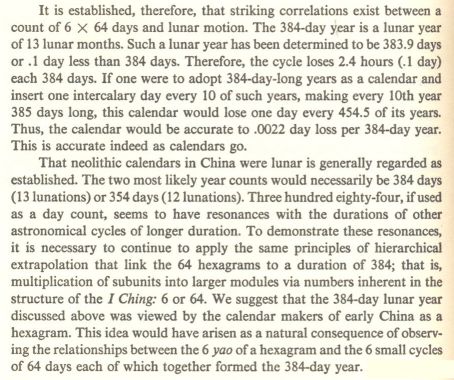
In The Invisible Landscape Terence McKenna cited a scholar who suggested that the I Ching hexagrams were connected with some early calendar system (see the 1975 edition, Chapter 8, pages 113-114). He then proceeded to speculate that the neolithic Chinese used a lunar calendar in which a year of 384 days consisted of 13 lunar months (alternating in length between 29 days and 30 days). Here are the relevant sections from pages 113 and 114 of The Invisible Landscape:

Extract from page 114 of Terence McKenna's The Invisible Landscape
Extract from page 113 of Terence McKenna's The Invisible Landscape

In a talk entitled "A Calendar for the Goddess" given by Terence McKenna on October 3, 1987, at Shared Visions Community Center in Berkeley (available on tape from Sound Photosynthesis) he put forward a proposal for a new calendar similar to the one allegedly used by the neolithic Chinese. In this calendar there are thirteen months in a year, the odd-numbered months having 30 days and the even-numbered months having 29 days, for a total of 384 days in a calendar year (this is not a solar year of 365 or 366 days as in the commonly-used calendar). Thus the average length of each month would be 384/13 = 29.538 days, which is somewhat in the neighborhood of the length of the mean lunar month, 29.531 days. The names of the months, he suggested, could be the same as in the present Gregorian calendar except that there would be an extra month called "Remember" between August and September (so as to remind us to remember the Goddess).

One of the virtues of this calendar, according to its author, would be that it would help to free us from "solar paternalism", subservience to the myth of the solar deity (originally the Roman Emperor, now his successor, the holder of the office of President, Chancellor, etc., chief executive of the modern bureaucratic patriarchal nation state). The solar deity ruled over a static ordering of time in which everything, from the seasons down, had its fixed and allotted place. A calendar in which the months are no longer fixed to the seasons might allow for a less bureaucratic way of thinking among its users.

An accurate lunar calendar, however, is not constructed as easily as one might suppose. The main property that a lunar calendar should possess is that the calendar months stay in sync with the phases of the moon over a long period of time. If we simply used a year of thirteen calendrical months alternating in lengths of 30, 29, 30, 29, etc., days then (as Terence says in The Invisible Landscape shown above) a calendar year, consisting of 384 days, would differ from thirteen mean lunar months by an average of about 0.1 days, since 13 times 29.531 days = 383.903 days. Thus after ten of these 13-month years the calendar would be out of sync with the lunar cycle by about one day, and after 70 years, when the calendar said there was full moon in the sky there would actually be a half moon.

Thus some correction to the basic scheme of alternating 30- and 29-day months is needed in order that the new moon (or the full moon) should always occur on (or at least close to) the first day of the calendrical month. In The Invisible Landscape (page 114) it is suggested that a leap day be inserted every ten 384-day years, "making every 10th year 385 days long". Actually it is necessary to remove a day rather than to add one. This would make the average length of a calendar month to be (10 * 384 - 1) / ( 10 * 13) = 29.53077 days, or 0.00018 days less than the current true length of 29.53059 days. Thus after about 5555 calendar months (1/0.00018), or about 450 solar years, this calendar would be out of sync with the lunar cycle by about one day.

While this accuracy is not too bad, it is not particularly good, and is insufficient for a calendar which is intended to remain accurate over a period of several thousand years, so a further correction is needed.


The McKenna-Meyer Goddess Calendar

This calendar is named after Terence McKenna who originally proposed an early version as described above, and Peter Meyer, who (in May 2012) formulated the improved version defined here (first published 2012-06-07). It can be referred to as "the Goddess Calendar" for short.

This calendar partitions the empirical sequence of days-and-nights ('days' for short, though the technical term is nychthemeron) into months, years and cycles. A nychthemeron begins at midnight local time. All months have either 29 days or 30 days, numbered '1' to '30'. Every year has exactly thirteen months, '1' to '13'.

Every cycle has exactly 470 years, numbered '1' to '470'. Cycles are numbered by the integers: ..., -2, -1, 0, 1, 2, ... (This calendar is intended mainly for use with current dates rather than for recording dates of all past events, since that can be done as now with the Common Era Calendar, a.k.a. the Gregorian Calendar, so dates with cycle numbers which are zero or negative are theoretically possible but are not intended to be used.)

Odd-numbered months have 30 days and even-numbered months have 29 days except that in a year whose number is divisible by 10 or by 235 (or by both) the 13th month has just 29 days. (Such a year is termed a short year.)

A date in this calendar is written as cycle-year-month-day, with 'MMG' appended to show that this is a date in this calendar. Thus the first day of the first month of the first year of the first cycle is 1-1-1-1 MMG, and the last day of the last month of year 101 of the second cycle is 2-101-13-30 MMG. For dates in the first cycle, the leading '1' can be dropped, so then dates are of the form year-month-day.

In a lunar calendar intended as a way of disengaging from the currently-used solar calendar it is not advisable to take over the month names used in that calendar ("January", "February", etc.), and a calendar which is "for the Goddess" does better to name the months after goddesses, such as the following (see The Thirteen Goddesses):

Month
number
Month
name
Number
of days
1Athena30
2Brigid29
3Cerridwen30
4Diana29
5Epona30
6Freya29
Month
number
Month
name
Number
of days
7Gaea30
8Hathor29
9Inanna30
10Juno29
11Kore30
12Lilith29
13Maria29 or 30

This calendar is related to the sequence of empirical days by identifying the date 1-1-1-1 MMG with the date 1901-08-14 CE. In other words, Athena 1 in the year 1 in the McKenna-Meyer Goddess Calendar corresponds to August 14 in the year 1901 in the Common Era Calendar. On this date a dark moon occurred at 8:27 GMT (and there also occurred the first manned, powered, controlled, heavier-than-air flight). This establishes a one-to-one correspondence between dates in the two calendars and makes possible conversion of any date in one of them to a specific date in the other.

While not part of the definition of this calendar, the present system of 7-day weeks (which has almost no relation to the lunar cycle) may be used concurrently, just as now done with the Common Era Calendar. Also a nychthemeron in this calendar may be divided into hours and minutes according to the present custom, with '00:00' denoting local midnight.


Average Length of a Month in the Goddess Calendar

This calendar is a lunar calendar whose months are intended to stay in sync with the cycles of the moon, a.k.a. lunations. A lunation runs from the time of the dark moon (the moment when the Moon, in its orbit around the Earth, is in exactly the same direction as the Sun). The time of a lunation is not constant, but varies slightly from one lunation to the next. The average time of a lunation is known as the synodic month. The present value of the synodic month is 29.530588 mean solar days.

So what is the average length of a calendar month in the McKenna-Meyer Goddess Calendar? The pattern of month lengths is repeated every 470 calendar years, so the average length of a month is the number of days in 470 years divided by the number of months in 470 years.

A year whose number is not divisible by 10 or by 235 is called a normal year; otherwise it is a short year. A normal year has 384 days and a short year has 383 days. In years 1 through 470 there are 47 years divisible by 10 and there are two years divisible by 235, namely, years 235 and 470. Year 470 is divisible both by 10 and by 235, so there are 47 + 1 = 48 short years, each with 383 days. The other 422 years are normal years, each with 384 days. So the total number of days in 470 years is 48*383 + 422*384 = 180,432 days. Since the number of months in 470 years is 13*470 = 6,110, the average length of a month is 180,432/6,110 = 29.5306056 days.

This differs from the current value of the synodic month by 0.0000168 days, so (assuming no change in the value of the synodic month) it will take about 1/0.0000168 = 59,523 months (about 4,579 calendar years, or about 4813 solar years) before the calendar is out of sync with the lunar cycle by one day. Thus this is an accurate lunar calendar in the sense that months remain in sync with lunations.


Other Properties of the Goddess Calendar

The average length of a solar year (measured from the vernal equinox) is 365.2424 days. The average length of a calendar year is 180,432/470 = 383.89787 days so New Years Day in this calendar moves forward in the seasons by 18 or 19 days each year, completing a cycle in approximately 19.58 solar years.

As stated above, in 470 calendar years there are 6,110 months, almost exactly equal to 26 Metonic cycles (each of which consists of 235 lunations).

A period of 18 calendar years lasts on average 6910.162 days, equal to 18.919 solar years. A period of 18 calendar years plus one calendar month lasts on average 6939.69 days, which is almost exactly 19 solar years and is almost exactly one Metonic cycle.

In 470 calendar years there are exactly 180,432/7 = 25,776 7-day weeks.

Due to the irregularity of the Moon's orbit, dark moons and full moons can never occur on fixed days in a rule-based lunar calendar. For the 470 MMG calendar years in cycle 1 (August 1901 CE to August 2395 CE) a full moon always occurs on the 14th, 15th, 16th or 17th of the calendar month, and a dark moon always occurs on the 1st, 2nd, 29th or 30th of the calendar month.


Conversion between Goddess Calendar Dates and Common Era Calendar Dates

The page The Goddess Calendar for Year ... displays all months in the Goddess Calendar for the current year and for any selected year (1 through 470 in cycle 1). It also shows the full moon date in each month. A date is a full moon date if the exact time of the full moon occurs on that day after 12:00 or on the next day before 12:00. Full moon parties are best held on a full moon date. Full moon dates depend on timezone, because the time of the exact full moon differs in different timezones. That page allows you to choose between GMT and your local timezone.

To discover which goddess is associated with the month in the Goddess Calendar in which you were born go to Find Your Goddess from your birthdate.

You can print out a wall-calendar-type page for a single month at A Printable Month in the Goddess Calendar. This can be used as a planner. You could even print all 13 months for a year and bind them.

There is a Windows program which converts between Goddess Calendar dates (in any cycle, not just cycle 1) and dates in the Common Era Calendar, and also dates in four other lunar calendars — see Lunar Calendars and Eclipse Finder.

The CD-ROM contains a Windows program for Goddess Calendar date conversion. To install it, locate (in Windows Explorer) the file mmgc_setup.exe in the folder mmgc\exe. Click on the file name or the program icon to run the installation program, then follow the prompts.

http://www.fractal-timewave.com/