Σύμπαν και άνθρωπος

Όλα στο σύμπαν αφορούν τη μεταμόρφωση.Η ζωή μας μοιάζει με τις σκέψεις που τη διαμορφώνουν.

Μάρκος Αυρήλιος
Εμφάνιση αναρτήσεων με ετικέτα mars. Εμφάνιση όλων των αναρτήσεων

Παρασκευή 14 Δεκεμβρίου 2012

Mystery cloud appears on Mars

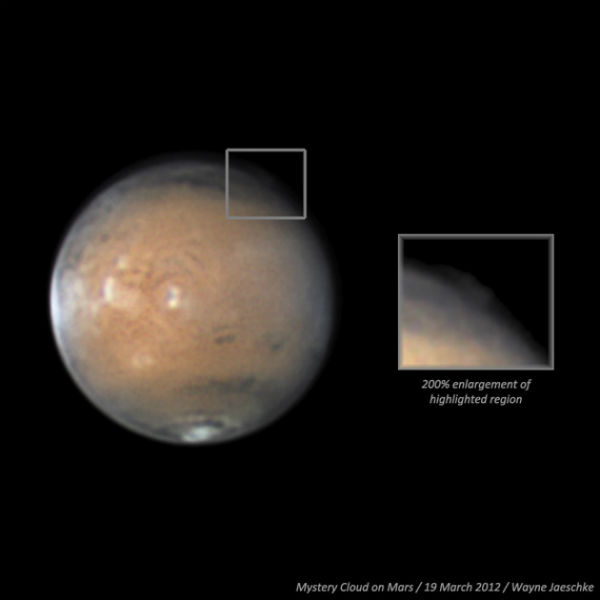
Strange phenomenon spotted over Mars two weeks ago puzzled astronomy community. An unusual protrusion has appeared in the planet’s southern hemisphere, preceding the sunrise terminator. Astrophotographer Wayne Jaeschke reports on his website of a “strange feature” over the Martian plain called Acidalia that moves with the planet and seems to rise over the limb, occurring at 190.5° east, 43.7° south. Some of the observers suggest the feature extend 150 miles up from the surface. Other planetary observers also report capturing the feature as the area rotated into view during the past few nights, and planetary photographers from Europe have identified it in their images as far back as March...
  • The
  • 295
     
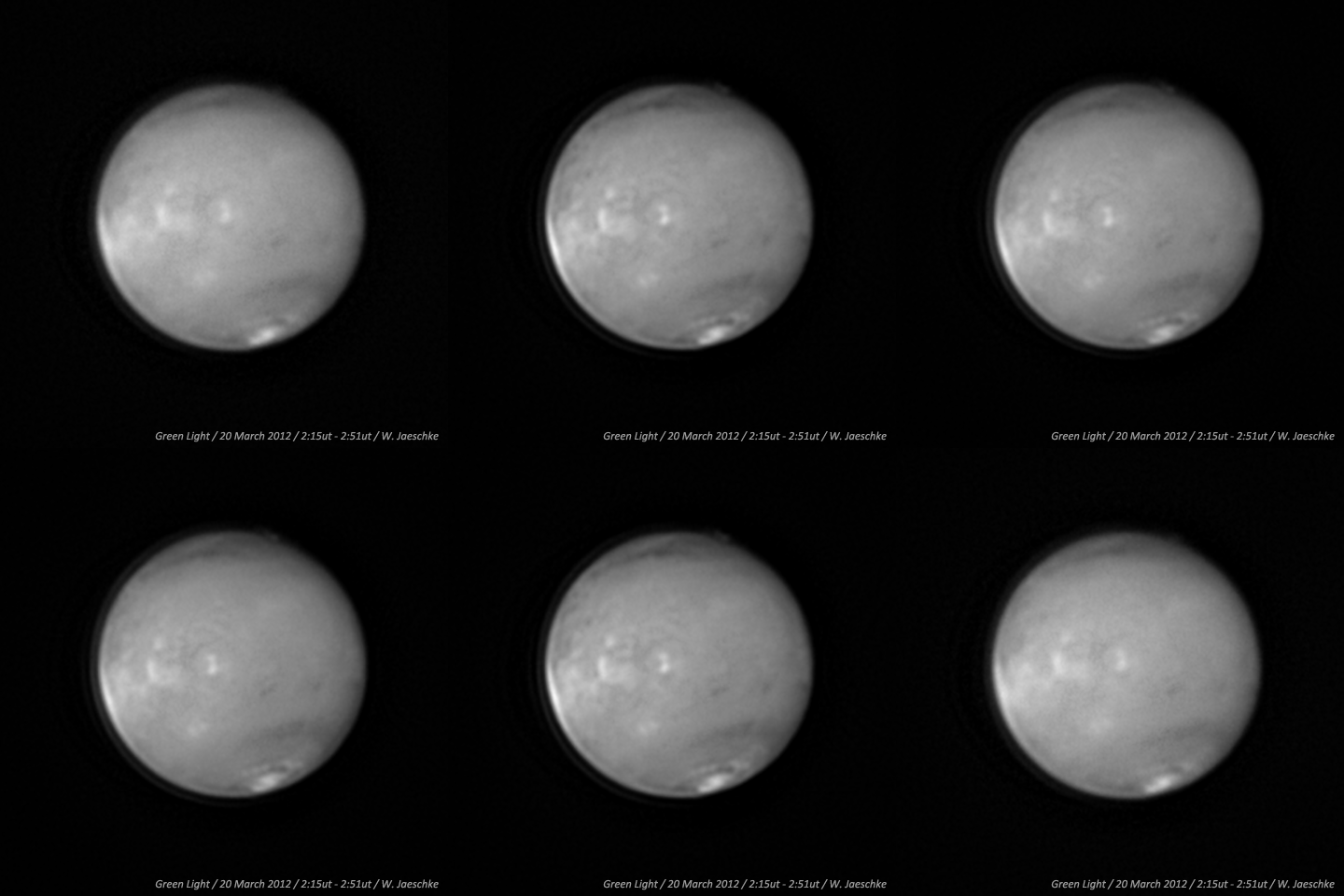
Strange phenomenon spotted over Mars two weeks ago puzzled astronomy community. An unusual protrusion has appeared in the planet’s southern hemisphere, preceding the sunrise terminator. Astrophotographer Wayne Jaeschke reports on his website of a “strange feature” over the Martian plain called Acidalia that moves with the planet and seems to rise over the limb, occurring at 190.5° east, 43.7° south. Some of the observers suggest the feature extend 150 miles up from the surface. Other planetary observers also report capturing the feature as the area rotated into view during the past few nights, and planetary photographers from Europe have identified it in their images as far back as March 12th. Although there has been plenty of conjecture as to what this strange extension might be, nothing has been proven as of yet.
On March 20th, the slightly gibbous disk of Mars showed an unusual extension along the day-night terminator in its southern hemisphere (white line). This image is shown south up, as it would appear in many telescopes. (Credit: Wayne Jaeschke)
(Credit: Jim Phillips South Carolina,U.S.A)”]
Mysterious cloud seen on this images from March 21st - [CLICK ON IMAGE FOR LARGER VIEW
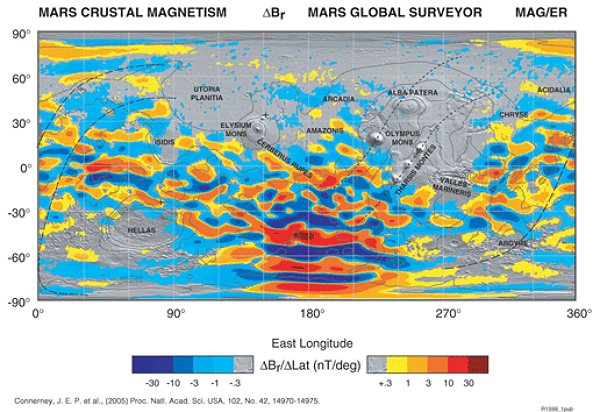
Atmospheric researchers from Arizona State University  are pretty excited about the possibility of not only getting a good look at the cloud structures, but also their temperatures. Whatever it is – or was – the feature is diminishing in size. This has led some to believe that it was some sort of transient-type event. Some suggestions are that it could be a dust cloud from a meteorite impact, a massive storm system or a trick of light. The THEMIS data for the area isn’t showing enough dust in the upper atmosphere to suggest a dust plume from an impact. The most likely scenario at this time is a major mesospheric cloud being caught in sunlight where the sun had risen at the cloud but not on the underlying ground. Some suggest that it could be aurora display but Mars doesn’t have a global magnetic like Earths, thus aurora wouldn’t be concentrated near the poles, if there is any aurora activity on Mars at all. Mars Global Surveyor mapped ‘umbrella-like’ localized fields back in 2004. Observations by the SPICAM instrument (Spectroscopy for the Investigations and the Characteristics of the Atmosphere on Mars) made on 11 August 2004, revealed light emissions now interpreted as an aurora. This feature is very localized and has shown up at the same time each day on Mars for at least 11 days in a row. Bruce Cantor at the Malin Space Science Institute says its most likely a condensate/haze cloud made up of water.
This is a map of the magnetic field of Mars observed by the Mars Global Surveyor satellite at a nominal 400 km altitude. Red and blue stripes represent magnetic fields with opposite directions. Darker hues represent more intense magnetic fields. To show the location of the magnetic stripes on Mars, the map is superimposed on a topography relief map from the Mars Observer Laser Altimeter instrument. (Credit: NASA)
Arizona State University astronomer Jonathon Hill and his colleagues will be looking at the area where the cloud was spotted using the Thermal Emission Imaging System, or THEMIS, which is one of the instruments on NASA’s Mars Odyssey orbiter. THEMIS will be checking out heightened cloud activity around Mars’ shield volcanoes as well as around the southern site spotted by the amateurs. Pictures from a camera on NASA’s Mars Reconnaissance Orbiter, called the Mars Color Imager, or MARCI, might provide further clues about the southern cloud feature. And amateur astronomers are sending out the alert for observers to keep a close watch on the Red Planet over the coming days.
There’s been lots of buzz about the high-altitude cloud on Cloudy Nights and other online discussion forums for skywatchers. Sky & Telescope’s Sean Walker says the puff of white was first noticed on March 20 by Wayne Jaeschke, an amateur astrophotographer from Pennsylvania. Since then, other observers have identified the feature in images going back as far as March 12.
Although unusual, similar “terminator projections” have been noted throughout observational history of the Red Planet, the last being imaged by Japanese amateur Isao Miyazaki on November 8, 2003.
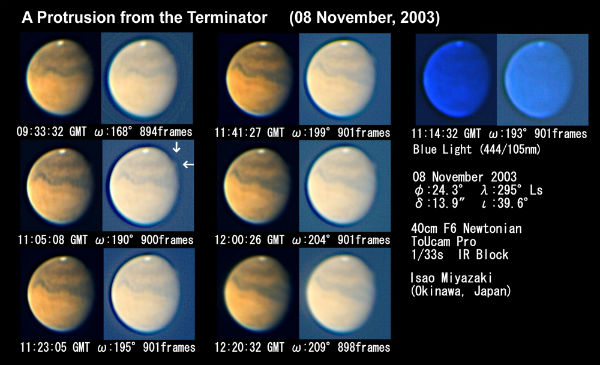
The same anomaly was imaged in 2003 (Credit: HIDA/Isao Miyazaki)
 
http://thewatchers.adorraeli.com/

Κυριακή 25 Νοεμβρίου 2012

Mars Mystery: What HAS Curiosity Discovered?

Curiosity-drive2
Science isn't something that just happens overnight. It takes many measurements, oodles of analysis, re-testing and re-analysis before any groundbreaking announcement can be made.
So, on the surface of Mars, inside Gale Crater on a plain called Aeolis Palus, our tenacious six-wheeled Mars Science Laboratory (MSL) is doing cutting-edge laboratory work on an alien world and mission scientists are itching to announce a "historic" discovery.
"This data is gonna be one for the history books. It's looking really good," John Grotzinger, lead scientist of the MSL mission, said in an interview with NPR.
But what is he referring to and why all the secrecy?
PHOTOS: Curiosity Flips Powerful Camera's Dust Cap
For the past few weeks, rover Curiosity has been busily scooping dirt from a sandy ridge in a geologically interesting location called "Rocknest." Using a little scooper attached to its instrument-laden robotic arm, Curiosity has been carefully digging, shaking and dumping the fine soil grains into its Sample Analysis at Mars (SAM) and Chemistry and Mineralogy (CheMin) instruments.
Recently, NASA announced some results from SAM after analyzing samples of Mars air. Interestingly, clues as to Martian atmospheric history were uncovered. Also, mission scientists announced an apparent dearth of methane in the air -- a result that undoubtedly frustrated many hoping for the detection of the gas that may, ultimately, reveal the presence of sub-surface microbial life.
It appears that SAM has made yet another profound discovery... but mission scientists are keeping quiet for the time being.
ANALYSIS: Curiosity Finds Some Aloha Spirit in Mars Soil
One of the prime mission objectives is for Curiosity is to understand the past and current habitability for life on the Red Planet. Curiosity can not directly detect the presence of Mars life, but it has been kitted-out with miniature laboratories capable of not only establishing what materials soil samples contain, but also whether the Mars soil contains carbon-laden organic molecules.
Should Curiosity detect these organics, the mission will have confirmed the presence of the building blocks of life on the surface of Mars. This does not, however, infer the genesis of life on Mars, it just means that some of the ingredients are there.
According to this NPR article, Grotzinger refers to the SAM data as being the source of the excitement. Indeed, one of the instrument's objectives is to address "carbon chemistry through a search for organic compounds, the chemical state of light elements other than carbon, and isotopic tracers of planetary change," according to the JPL mission site.
ANALYSIS: Mars Microbes May Juice Up On Rocket Fuel
Might these data indicate the detection of organic chemistry? This would certainly be "historic" news. Also, this would back up the Viking landers' likely discovery of organics in the 1970s -- a result that could only be confirmed after Mars lander Phoenix made the groundbreaking 2008 discovery that the Martian surface is laced with perchorates.
Although the focus appears to be on organics, this is pure speculation for now. Science isn't about announcing the first result, no matter how profound, historic or earth-shattering it appears to be. As an example, the initial SAM results for Martian air analysis hinted at the presence of methane, only for that result to be proven false during follow-up tests -- air from Earth (which does contain methane) was trapped in the instrument and needed to be flushed out before pure Mars air could be properly analyzed.
NASA JPL mission scientists have, again, rightly decided that nothing needs to be announced until further work is done -- even though they've communicated their excitement for a big discovery. They are, after all, human.
So now we wait...
Image: The view from Curiosity after re-commencing its drive on sol 102 of the mission after camping out at Rocknest. Credit: NASA/JPL-Caltech
http://news.discovery.com/