Σύμπαν και άνθρωπος

Όλα στο σύμπαν αφορούν τη μεταμόρφωση.Η ζωή μας μοιάζει με τις σκέψεις που τη διαμορφώνουν.

Μάρκος Αυρήλιος
Εμφάνιση αναρτήσεων με ετικέτα joseph barclay. Εμφάνιση όλων των αναρτήσεων

Τρίτη 4 Δεκεμβρίου 2012

The Talmud, by Joseph Barclay, [1878] 16

A MODERN POLISH RABBI WITH TALITH AND PHYLACTERIES.<br> PAGE 359
Click to enlarge

A MODERN POLISH RABBI WITH TALITH AND PHYLACTERIES.
PAGE 359

p. 359

APPENDIX.

NOTE ON MODERN JUDAISM.

Every Jew when he attains the age of thirteen years and one day becomes a bar Mitzvah (son of commandment), and is henceforth responsible for his own sins. The ceremonies connected with this event correspond to the Christian rite of confirmation. He is also bound to observe the three fundamental principles of Judaism—the wearing of the Talith, the wearing of the Phylacteries, and the observance of the Mezuza, or the Sign upon the door-posts.

TALITH.

The Talith, which resembles an oblong shawl, is worn over the head or shoulders. From its having four corners it is called arba canphoth. Its chief name, Tsitsith, is derived from the fringes on which its holiness depends. The Talith is made of sheep or lamb's wool, and sometimes of camel's hair. The fringes, which are of wool, carefully shorn, must be specially spun for this purpose. Four threads, of which one must (if possible) be blue, are passed through eyelet holes made in the four corners. These threads are doubled to make eight. Seven of them are of equal length, but the eighth thread must be long enough to twist five times round the rest, and after being tied into five tight knots, to have an end of the same length as the others. These five knots added to the eight threads make the number thirteen. The numerical value of the Hebrew word Tsitsith
p. 360
is 600, so that the sum total is 613, which represents the 613 precepts of the oral law. These rabbinic precepts correspond to the 613 Hebrew letters of which the decalogue is composed. They are divided into 248 positive precepts, which, the Rabbis say, equal the members of the human body; and into 365 negative precepts which, they also say, equal the number of the human veins. When the Talith is put on, the Jews pray, "That it may be made through my fulfilling this precept a spiritual garment for my soul, spirit, and breath, for my 248 spiritual members, and for my 365 spiritual veins." Orthodox Jews also daily wear a smaller Talith underneath their garments, and those who are more religious allow the fringes to be seen to remind them of the 613 precepts. The Scripture on which this observance is founded is Numb. xv. 37-39, "And the Lord spake unto Moses, saying, speak unto the children of Israel, and bid them that they make them fringes in the borders of their garments, throughout their generations, and that they put upon the fringe of the border a riband (or, as the Rabbis say, a thread) of blue: And it shall be unto you for a fringe, that ye may look upon it, and remember all the commandments of the Lord and do them." Our Lord, when on earth, wore the Tsitsith, for the diseased woman touched "the hem" (fringe κρασπέδον) of His garment (Matt. ix. 20), “And he rebuked the Pharisees for their ostentation in enlarging the “borders” (fringes κράσπεδα) of their garments (Matt. xxiii. 5).

PHYLACTERIES.

The second fundamental principle of Judaism is the wearing of Phylacteries. These are supposed by some writers to be the same as the frontlets (Tataphoth), mentioned (Ex. xiii. 16; Deut. vi. 8; xi. 18). The Totaphoth mean properly "Ornaments," and refer to the law and commandments, as understood in such passages as "Bind them about thy neck; write them upon the table of thine head" (Prov. iii. 3; vi. 21; viii. 3). And so the Karaite Jews interpret all these passages figuratively. But since their return from the
p. 361
[paragraph continues] Babylonian captivity, the Rabbinical Jews insist upon their literal meaning, and they enjoin the wearing of Phylacteries (φυλακτήρια, preservatives, Matt. xxiii. 5), upon the forehead and arm of the worshipper. Phylacteries, called in Hebrew Tephillin (from Palal to pray) are, firstly, one for the forehead (Rev. xiv. 1). It is a leathern box which contains four compartments, in which are enclosed four portions of the Law written on parchment, and carefully folded. This box is made of leather, pressed upon blocks of wood specially prepared for the purpose, while the leather is well soaked in water. When it is dry and ready for use, the following passages of the law are sewn into it—(Ex. xiii. 1-10,11-16; Deut. vi. 4-9; xi. 13-21). On this box there is also impressed the letter ‏ש‎ (Shin), with three strokes for the right hand side of the wearer, and also the same letter with four strokes for the left hand side of the wearer. Secondly, there is another leathern box, without any ‏ש‎ (Shin), for the arm of the worshipper, and with only one compartment, into which the same passages of Scripture are sewn with the sinews of animals, specially prepared for this object. The phylacteries are bound on the forehead and arm by long leathern straps (R’tsuoth) which pass through the Maabarta, or passages in their sides. The straps round the head must be tied in a knot shaped like the letter ‏ד‎ (Daleth). And the straps on the arm must be long enough to go round it seven times, and three times round the middle finger, with a small surplus over in the form of the letter ‏י‎ (Yod). There is thus formed by the letter Shin on the phylactery, and by the knot Daleth on the back of the head, and by the Yod on the hand the word Shaddai, or Almighty. This is said to fulfil the text, "And all people of the earth shall see that thou art called by the name of the Lord (or as the Rabbis say, 'the name of the Lord is read upon thee'), and they shall be afraid of thee" (Deut. xxviii. 10). The time for putting on the phylacteries is during the day, at the time of prayer and reading of the Shema, or "Hear O Israel," etc. (Deut. vi. 4, etc.) They are not to be worn at night, on the Sabbath, or on the festival days, because it is said, "And it shall be for a sign"
p. 362
[paragraph continues] (Ex. xiii. 9). As the Sabbaths and festivals are signs in themselves, no other signs are needed. The phylacteries are to be kept in special bags with the greatest reverence. The Rabbis assert that they are worn by God, and "that the single precept of the phylacteries is equal to all the commandments."

MEZUZA.

The third fundamental principle of Judaism is Mezuza, or Sign upon the door post. This precept is founded upon the command, "And thou shalt write them upon the posts of thy house, and on thy gates" (Deut. vi. 9; xi. 20). The door-posts must be those of a dwelling-house; and accordingly, Maimonides mentions ten different things which are requisite to constitute a dwelling-house. Public buildings, such as synagogues, are excluded from this command. The Karaite Jews reverse this order, and affix Mezuzas to synagogues but not to private houses. The way in which Mezuzas are made is as follows:—Two portions of Scripture (Deut. vi. 4-9; xi. 13-21) are written on ruled vellum which must be prepared according to Rabbinic rules. This vellum is rolled up so as to fit into a cylindrical tube of lead or tin. The word Shaddai (Almighty) is written on the outside of the roll, and a section is cut from the tube, so that Shaddai may be clearly seen. It is then nailed through both its ends to the door posts of all the apartments on the right hand side. Those who enter are thus reminded that the eye of God is upon all their doings. Under the word Shaddai, some Jews write the three angelic names, Coozu, Bemuchsaz, Coozu; and to these three angels they even pray for success in business. When the Mezuzas are being fastened to the door-posts the following prayer must be used, "Blessed art thou, O Lord our God! King of the universe, who hath sanctified us with His laws, and commanded us to fix the Mezuza."
The Talmud estimates the virtue of the Talith, the phylacteries, and the Mezuza in the following terms:—
MEZUZA AND PHYLACTERIES.
Click to enlarge

MEZUZA AND PHYLACTERIES.
MEZUZA, OR SIGN UPON THE DOOR-POST
PHYLACTERY FOR THE FOREHEAD
PHYLACTERY FOR THE ARM.
PAGE 362
p. 363
[paragraph continues] “Whoever has the phylacteries bound to his head and arm, and the fringes thrown over his garments, and the Mezuza fixed on his door-post, is safe from sin: for these are excellent memorials, and the angels secure him from sin; as it is written, “The angel of the Lord encampeth round about them that fear Him and delivereth them” (Ps. xxxiv. 7).
If, instead of resting in the mere routine of these observances, which they too often do, the eyes of Israel were enlightened by the Holy Ghost, they would see them to be shadows of glorious truths. The Talith would be seen as a symbol of the imputed righteousness of Christ, who has fulfilled the law. The phylacteries would appear as symbols of the necessity of having God's Word engraven both on head and heart. And the Mezuza would be regarded as a symbol of the omniscient eye of an holy God from whom nothing can be hidden or unknown.

CALENDAR OF THE MONTHS AND CHIEF JEWISH FEASTS AND FASTS IN EACH YEAR.

I.—Nisan, called in Scripture Abib (part of March and April).
(Beginning of the Sacred or Ecclesiastical Reckoning).
1. New Moon.
14. Passover.
15. First Day of the Feast of Unleavened Bread.
16. Waving of the first ripe Omer (wave sheaf), Lev. xxiii. 10-12.
21. Last Day of Unleavened Bread.
II.—Iyar (part of April and May).
1. New Moon.
15. The Second or "little" Passover.
18. Feast of the 33d day after the Omer.
III.—Sivan (part of May and June).
1. New Moon.
6. Feast of Pentecost or Weeks. Seven Weeks or 50 days after the Sheaf offering. The two loaves of fine flour, called first-fruits, were waved before the Lord. This Feast commemorates also the giving of the Law on Mount Sinai.
27. Fast for the burning of Rabbi Chanina, by the Greeks.
IV.—Thamuz (part of June and July).
1. New Moon.
17. Fast for the taking of Jerusalem, by Nebuchadnezzar, on the 9th, and by Titus, on the 17th. If this day fall on a Sabbath, the Fast is kept on the following day.
V.—Ab (part of July and August).
1. New Moon.
9. Fast for the threefold destruction of the Temple.
15. Feast for the readmission of the Tribe of Benjamin (Judges xxi. 15). It is also called the Day of the Wood Offering.
VI.—Elul (part of August and September).
1. New Moon.
p. 365
VII.—Tishri (part of September and October).
(Beginning of the Civil Reckoning).
1 and 2. Feast of the Civil New Year, and of Trumpets.
3. Fast for the Murder of Gedaliah.
4-9. Days of Penitence.
10. Fast on the Great Day of Atonement.
15-21. Feast of Tabernacles. The last day is called "Hosanna Rabba" (i.e. save with a great salvation).
22. Feast on the completion of the Yearly Reading of the Law. It is called "Rejoicings of the Law."
VIII.—Marchesvan (part of October and November).
1. New Moon.
IX.—Kislev (part of November and December).
1. New Moon.
25. Feast of Dedication or Lighted Lamps to commemorate the cleansing and dedication of the Temple after the victory of Judas Maccabæus over the Syrians, B.C. 148. This feast lasts eight days.
X.—Tebeth (part of December and January).
1. New Moon.
10. Fast for the commencement of the siege of Jerusalem by Nebuchadnezzar.
XI.—Shebat (part of January and February).
1. New Moon.
The last Sabbath in this month is called the "Portion of Shekels." Such Portions of the Law, as Exodus xxx. 15, etc., are read, and collections of money are made for the poor Jews in Jerusalem.
XII.—Adar (part of February and March).
1. New Moon.
13. Fast of Esther (Esther iv. 16). If it fall on a Sabbath its observance takes place two days before.
14 and 15. Feast of Purim for the destruction of Haman.
(       ) Veaddar or the additional Adar—the month intercalated to make the lunar and solar years correspond. (See note [1], page 176). In the present year, A.D. 1877, according to Jewish Chronology, the year A.M. 5638 began on the first day of Tishri.

NOTE ON THE SANHEDRIN.

The Synedrion (συνέδριον) called in Aramaic Sanhedrin, was the Supreme Court of the Jewish nation. It is invested with an awful interest, as having been the tribunal, which deliberately rejected the Messiahship and Deity of the Lord Jesus Christ,—a decision to which the Jewish people have adhered up to the present time. As its name implies, it was a kind of senate, established during the Greek occupation of Palestine, which preceded the Maccabæan period, and is not, f as the Jews think, a continuation of the seventy elders appointed by Moses. It seems to be mentioned in 2 Mac. i. 10; iv. 44; xi. 27; under the name of the Council (ἡ γερουσία). To speak accurately, there were three Sanhedrins—two smaller, and one great one. The two smaller ones seem to have served as standing committees of the general body. The chief president was called "Prince," and the vice president "Father of the House of Judgment." When priests, elders, and scribes are mentioned together, the Great Sanhedrin is meant. The Rabbis say that to be an ordinary member of the Sanhedrin, a man must have been wise, handsome, aristocratic, old, a magician, and able to speak seventy languages, that the Sanhedrin might not need an interpreter. It is said to have had ten "flittings"—from the chamber in the temple to the shops in the outer court; from the shops in the outer court to Jerusalem; from Jerusalem to Jabneh; from Jabneh to Osha; from Osha to Shepharaam; from Shepharaam to Bethshaaraim; from Bethshaaraim to Sepphoris; from Sepphoris to Tiberias. To make up the number ten, it is said to have flitted backward and forward twice between Osha and Jabneh. These flittings began forty years before the destruction of the Temple.
The Presidents are stated to have been,
Ezra,
Simon the Just,
Antigonus of Socho (the Master of Sadoc),
Joseph, son of Joezer; P. Joseph, son of Jochanan. V. P.
Joshua, son of Perachiah, fled to Alexandria, from Alexander Janneus.
Judah, son of Tabbai, P. Simon, son of Shetach. V. P.; they were remarkable for hanging eighty witches in one day.
Shemaiah, P. Abtalion, V. P., descendants of Sennacharib; supposed to be the Sameas and Pollio of Josephus.
Hillel P. Shammai, V. P. Hillel was likened to Moses. At forty years of age he came to Jerusalem; forty years he studied the law; forty years he was president.
Simeon, son of Hillel, supposed to be the one who took our Saviour in his arms.
Gamaliel, son of Simeon (teacher of St. Paul). When he died the honour of the law and purity died also.
p. 367
Simeon, his son (slain in Jerusalem).
Jochanan, son of Zaccai.
Gamaliel of Jabneh, son of Simeon.
Simeon, son of Gamaliel (first patriarch of Tiberias).
Judah, son of Simeon.
Gamaliel, son of Judah.
Gamaliel of Jabneh is said to have been deposed for a time from the presidency, and afterwards restored with Rabbi Eliezer, the son of Azariah, as joint president. The reason of his deposition is said to have been his want of judgment in dealing with Rabbi Joshua, who said that "prayer is a thing arbitrary," while he taught it to be "a bounden duty." Whereupon he made the Rabbi stand while he expounded the law. The congregation resented this as a sign of pride and passion, and elected Eliezer who was but sixteen years old but very grave. Rabbi Akiba was offended that he himself was not chosen, and said, "it is not because he is more learned, but because he is of nobler birth—happy is he who has ancestors to privilege him—happy is the man who has a nail to hang on." "And what was the nail of Rabbi Eliezer, the son of Azariah?" "He was tenth from Ezra."
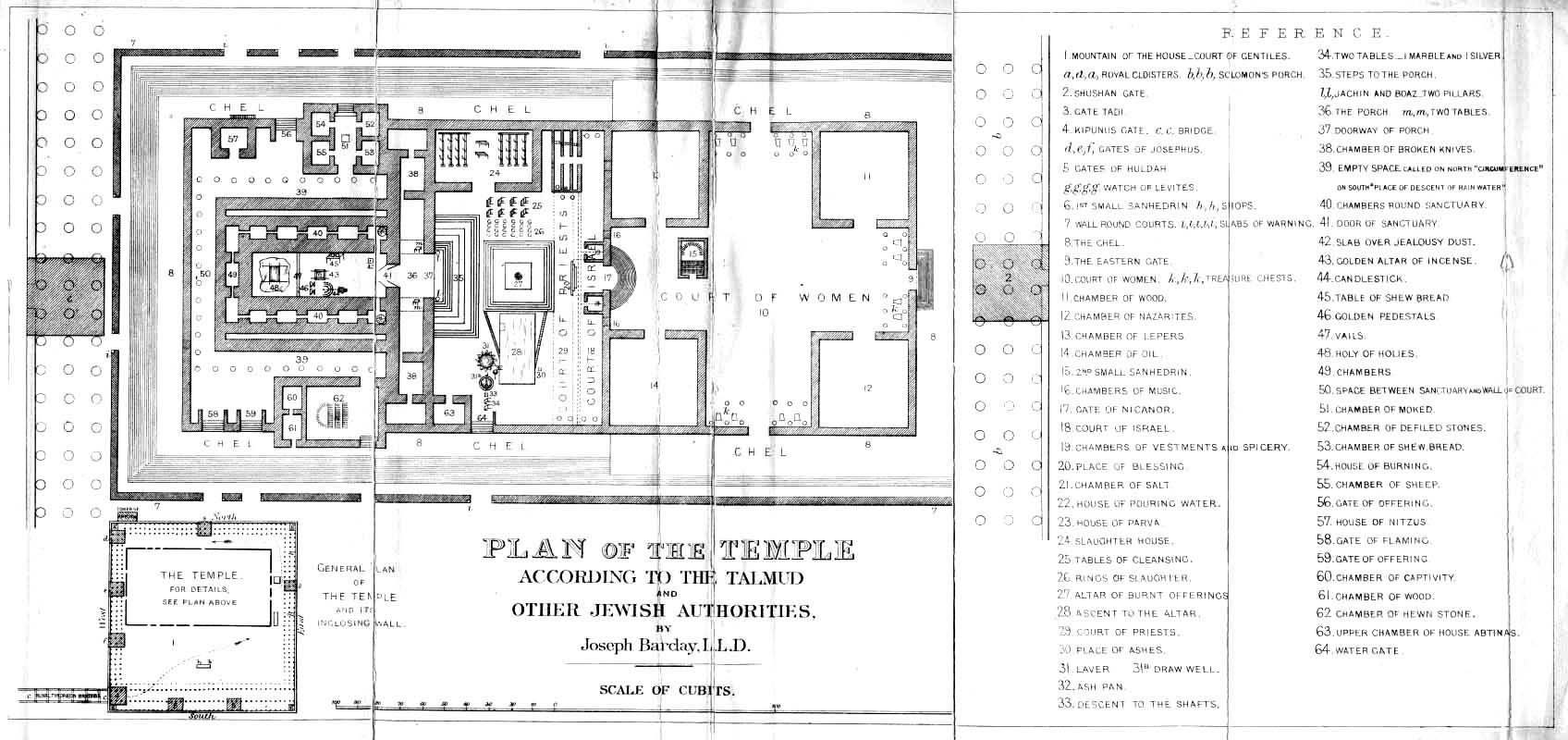
Plan of the Temple
Click to enlarge

Plan of the Temple
Plan of the Temple. Detail: Temple
Click to enlarge

Plan of the Temple. Detail: Temple
Plan of the Temple. Detail: Legend
Click to enlarge

Plan of the Temple. Detail: Legend
Plan of the Temple. Detail: lower left hand corner of plan
Click to enlarge

Plan of the Temple. Detail: lower left hand corner of plan

NOTES ON THE PLAN OF THE TEMPLE

FROM THE TALMUD AND OTHER JEWISH AUTHORITIES.

See Plan at end of Volume.
1. The Mountain of the House was a square of 500 cubits. The south side was "more empty" than the other sides. The east "more empty" than the north and west, and the north "more empty" than the west, a a a, Royal Cloisters (Josephus, Antiquities, xv. xi. 5). b b b, Solomon's Porch, Jno. x. 23; Acts iii. 11.
2. The gate of the wall of the Mountain of the House in the east was called the Shushan Gate, because there was engraved on it the city Shushan.
3. The gate of the wall of the Mountain of the House called Tadi. It served only for priests by night.
4. The West Gate, called Kipunus (Coponius), was for thoroughfare. To it was probably joined, c c, the bridge which spanned the Tyropæon Valley. d e f, Gates mentioned by Josephus. Of these four gates, three have been discovered by the officers of the Palestine Explorations. The gate Kipunus is alone mentioned in the tract Measurements, as being probably that one through which worshippers I usually entered.
5. The two southern gates were called the Gates of Huldah. g g g g, Where the Levites watched.
6. The assembly of the small Sanhedrin at the door of the
p. 368
[paragraph continues] Eastern Gate, and there sat three rows, each containing twenty-three men, h h h h, Shops in the Court of the Gentiles. Matt. xxi. 12.
7. A wall about ten hands high around the whole court, and in it were thirteen openings as if opposite thirteen gates. i i i i i, Slabs (Josephus, Antiquities, xv. xi. 5) on which was engraven the prohibition against foreigners entering the temple (Acts xxi. 29). One of these "stones of warning" was discovered in Jerusalem in 1871. A facsimile of it (on a reduced scale) is now included in this volume, by the kind permission of the Committee of the Palestine Exploration Fund. Its translation runs thus, "No stranger is allowed to pass within the balustrade round the temple and enclosure. If found, the offender must take the consequence, and his death will follow."
8. The Chel was a space round the court between the smaller wall and the wall of the court. Its breadth was ten cubits. In it were twelve steps rising to the Eastern Gate of the Court. The height of each step was half a cubit, and its breadth was half a cubit.
9. The Eastern or Beautiful Gate (Acts iii. 2) opened into the Court of the Women and into the other courts. The length of all the courts from east to west was 187 cubits, and their breadth was 135 cubits. Besides the chief gate in the east, there were two more gates, one on the north, and one on the south, leading into the Court of the Women.
10. The Court of the Women was a square of 135 cubits, and in its four corners were four chambers, each forty cubits long and twenty broad, k k k k, Treasure chests (Mark xii. 1; Luke xxi. 2; John. viii. 20). The chests or trumpets (Matt. vi. 2), (so called from their; shape), were thirteen in number. Of these nine were for the legal payments of the worshippers, and four were for freewill gifts. Trumpets numbered 1 and 2 were for the half shekel tribute. Trumpets 3 and 4 were respectively for the money paid by women for the offerings of turtle-doves and young pigeons. Trumpet 5 received offerings for the wood of the altar. Trumpet 6 received offerings for incense. Trumpet 7 received offerings for golden vessels of service. Trumpet 8 received what remained over out of a predetermined sum from the purchase of a sin-offering. Trumpet 9 received whatever remained over after the purchase of a trespass-offering. Trumpet 10 received whatever remained over after the offerings of birds. Trumpet 11 received whatever remained over from the offering of the Nazarite. Trumpet 12 received whatever remained over from the offering of the cleansed leper. And trumpet 13 received freewill gifts: These I trumpets are to be distinguished from the three chests, each holding, three seahs of coin, which received the contributions and taxes from Israelites in foreign lands. These chests were emptied at the three) great festivals, and yielded enormous treasures for the Temple and, public revenue.
11. The chamber of the wood, which was arranged for each day's use,
FACSIMILE OF A GREEK INSCRIPTION ON ONE OF THE “STONES OF WARNING” IN THE PARTITION WALL OF THE TEMPLE
Click to enlarge

FACSIMILE OF A GREEK INSCRIPTION ON ONE OF THE “STONES OF WARNING” IN THE PARTITION WALL OF THE TEMPLE
—Jos. Antiq. xv. xi. 5. (See Notes on the Temple, 7, iiii.)
(Discovered in Jerusalem, 1873.)
PAGE 368
p. 369
12. The chamber of the Nazarites. There they boiled their peace-offerings, and burned their hair under the kettle.
13. The chamber of the lepers, where they shaved their hair.
14. The chamber of the "house of oil," for the "candlestick" and "flour-offering."
15. The second small Sanhedrin sitting at the door of the court of Israel, "as half a round threshing floor," and there sat three rows, each containing twenty-three men.
16. Two chambers under the Court of Israel in the earth. There the Levites put their musical instruments and learned the art of singing. Their doors were open towards the Court of the Women.
17. The gate of Nicanor which opened into the Court of Israel from the Court of the Women. It is called "the higher gate" (2 Kings xv. 35) and the "new gate" (Jer. xxxvi. 10). The ascent to it was fifteen steps. Each step was half a cubit high and half a cubit broad.
18. The Court of Israel. Its length from north to south was 187 cubits and its breadth from east to west eleven cubits.
19. Two chambers to the two sides of the gate, the right called the "Chamber of Phineas" the vestment keeper; and the left the "Chamber of Spicery."
20. The place where the priests gave the blessing. It was a landing of three steps, each being half a cubit high.
21. The chamber of salt, a cave under the Court of the Priests. Its door opened towards the Court of Israel.
22. The chamber of the "House of pouring" water on offerings. It opened to the "Chamber of Salt," and to the chamber of the "House of Parva." In it was a staircase for persons to ascend to the roof of the "House of Parva."
23. The chamber of the "House of Parva," where the skins of the offerings were sold. On the roof was the "House of Baptism," for the high priest on the Day of Atonement.
24. The slaughter house. In it were eight pillars called "dwarfs," and in each of them were three iron hooks.
25. Eight tables before the slaughter house. On them the entrails were cleansed.
26. Twenty-four rings, in which the necks of the victims were placed for slaughter.
27. The altar of burnt-offerings, described in the. Tract Measurements. "An apple," i.e. an heap of ashes always remained on the midst of the altar.
28. The ascent to the altar was in length thirty-two cubits from south to north, and in breadth sixteen cubits. There was a small
p. 370
space between it and the altar, so that it might not touch it. From the ascent proceeded two small staircases, one from the east that reached the circumference, and one from the west that reached the foundation. In the west was a window, and it was called Rabuba (deep). There they put the fowls that were ceremonially defiled until their forms changed. The space from the southern wall of the court to the ascent measured eight cubits.
29. The court of the priests. Its length from north to south was 135 cubits, and its breadth from east to west eleven cubits. And there was a railed gallery there round the walls.
30. The place where the priests put the ashes of the outside and inside altars, and the crops of the fowls. It was distant three handbreadths from the east of the ascent.
31. The laver and its pedestal. In it were twelve pipes that twelve priests might wash at the same time. There was a cavity near them to let the water flow off during the night. Their place was between the porch and the altar—both of them inclined to the south. Next to them was the draw-well (31a) for supplying the laver and the court with water.
32. The pan for taking away the ashes of the altar. It was placed westward of the ascent.
33. A tablet of marble. In it was fastened a ring, and there the young priests descended to "the shafts."
34. Two tables to the west of the ascent, one of marble and one of silver. Upon the marble one the priests placed the members and' fat. And upon the silver one they placed the silver vessels for service.
35. Twelve steps ascended from the altar to the porch in the space of twenty-two cubits. From the altar westward, and to the east side of the steps, was plain ground for two cubits. Up from thence were three steps—the height of each half a cubit, and its breadth a cubit. And above them was one step—its height half a cubit and its breadth three cubits, and this was called Piazza (platform). Above it were two steps—the height of each was half a cubit, and their breadth three cubits. This also was called Piazza. And higher were four steps—the height of each half a cubit, and their breadth a cubit. And higher there was one step, its height half a cubit and its breadth four cubits. It also was called Piazza. We now. find that the ground of the door of the porch was higher than the ground of the place of the altar by six cubits. l l, Jachin and Boaz—two pillars at the entrance of the porch.
36. The porch of the house—in length from north to south seventy cubits, and in breadth from east to west eleven cubits. At its door were (m m) two tables, one of marble and one of silver. On them the priests laid the shewbread in their going out and coming in.
p. 371
37. The doorway of the porch had no doors—there was only a vail. Its breadth was twenty cubits, and its height forty cubits. The thickness of the wall was five cubits. Over it were five in-wrought beams, one above the other, for ornament. They were called "cross-beams."
38. Two chambers open towards the porch in the north and south. There the broken knives were put away. Each chamber had a little rail door in the corner of the court, and the measure of each of these chambers, from north to south, was fifteen cubits, and their breadth was the breadth of the porch. We find the length of the Porch to be altogether one hundred cubits.
39. This "empty" space was called "circumference." It was a way which went all round the north and west of the Sanctuary and the chambers. On the south side it was called the "place of the descent of the waters," because there all the rain water ran down from the roof of the Sanctuary.
40. Fifteen chambers were on the north of the Sanctuary, viz. five placed upon five, etc. The same number were on the south of the Sanctuary. The chamber in the north-east corner, and the chamber in the south-east corner, had each five doors. The chamber in the north-east had one door to the "circumference"—a door to the second chamber—a door to the chamber above it—a door towards the porch—and a door to the Sanctuary. So also was it in the southern side, only there the door to the Sanctuary was always shut. 1 Kings vi. 5; Jer. xxxv. 4.
41. The door of the Sanctuary. Its breadth was ten cubits, and its height twenty cubits. The length of the Sanctuary from east to west was forty cubits, and its breadth twenty cubits from north to south.
42. A square marble slab to the right of the entrance lying upon the earth. From under it was taken the dust for the trial of jealousy.
43. The golden altar standing in the middle, between the table of shew-bread and the candlestick, inclined outwards.
44. The Candlestick standing in the south of the Sanctuary, and before it was a stone with three steps. Upon it the priest stood and trimmed the lights. And upon it the person who trimmed the lights placed the golden cup and the wicks.
45. The golden table of shewbread in the north. On it the priests laid the shewbread and the covers and bowls.
46. Two golden pedestals. Upon them the High Priest, when he went out from the Holy of Holies, placed the blood of the bullock, and the blood of the goat, on the Day of Atonement.
47. The Traksin (partition wall) was in width a cubit. In it were two vails—the thickness of each vail was an handbreath, and
p. 372
there was a void space between them of three handbreadths. The two vails and the void space were supposed to meet the dispute as to the minutely accurate line of separation between the Holy Place and the Holy of Holies.
48. The Holy of Holies in length and breadth twenty cubits by twenty. In the midst was the "Stone of Foundation," and upon it rested the ark in the Temple of Solomon.
49. Three chambers to the west of the Sanctuary and the Holy of Holies; and over them three; and over them two—in all eight. In the middle chamber was a square passage, and from it there were doors to the other chambers alongside, and also a door to the chamber above it.
50. Eleven cubits was the distance from the back of the House of Atonement to the wall of the court.
51. The chamber of the House of Moked (burning). In it were two gates—one open to the chel, and one to the court of the Sanctuary. In it also were four smaller chambers in its four corners; and there was a square of marble, and in it was fastened a ring, and under it were the golden keys of the court suspended on chains.
52. A chamber where the House of the Asmoneans deposited the stones of the altar which the Greeks defiled, and it was unconsecrated.
53. The chamber where they baked the shew-bread; and it was holy. Adjoining it was also the "seal" or "token" chamber.
54. The chamber of the House of Burning. From it the priests went down to the House of Baptism in a pathway under the arch. It was unconsecrated.
55. A chamber for sheep. It was holy.
56. Gate of the Offering.
57. The House of Nitzus (sparks, or sparkling, or of the ovens). There was a kind of divan in it, and over it was an upper chamber, where the guards stood. They went up to it by a staircase from the chel.
58. The Gate of Flaming. Through this gate the wood was brought in for the altar.
59. The Gate of the Offering.
60. The Chamber of the Captivity. There the Children of the Captivity made a cistern to supply water to the whole court.
61. Chamber of Wood. It was also called the Chamber of the "Promenade of the High Priest."
62. The Chamber of Hewn Stone. There the Great Sanhedrin sat ("like half a round threshing-floor") in the half of the unconsecrated part which was in it, and before them were three rows each of twenty-three
p. 373
men. It was open to the unconsecrated place, and to the Holy place.
63. The upper Chamber of the House Abtinas.
64. The Water Gate. Through it they brought the water at the feast of Tabernacles to pour it upon the altar.

NOTES ON THE TABERNACLE.

The Gemara in the Treatise Shabat makes the following observations on the Tabernacle:—"And to the Tabernacle thou shalt make ten curtains;—the length of one curtain shall be twenty-eight cubits." 1 Draw their length to the breadth of the Tabernacle. How much was their length? Twenty-eight. Take away for the roof ten; there remain nine cubits to this side, and nine to that side. According to Rabbi Judah (who thinks that at the top the boards were thin as a finger), one cubit of the sockets only was uncovered. And according to Rabbi Nehemiah (who thinks the boards were of uniform thickness), there remains also one cubit of the boards uncovered. Now draw their breadth to the length of the Tabernacle. How broad were they? Forty. Take away thirty cubits from the roof; there remain ten. According to Rabbi Judah, the cubit of the sockets was also covered. According to Rabbi Nehemiah, the cubit of the sockets remained uncovered. "You shall make curtains of goats’ hair, the length shall be thirty cubits." 2 Draw the length to the breadth of the Tabernacle. How much was it? Thirty. Reduce ten cubits for the roof; ten remain to this side, and ten to that side. According to Rabbi Judah, it also covered the cubit of the sockets. And according to Rabbi Nehemiah, they were uncovered. Now draw their breadth to the length of the Tabernacle. How broad were they? Forty-four. Take away thirty cubits for the roof; there remain fourteen. Take away two for the doubling, as it is written, "Thou shalt double the sixth curtain in the forefront of the Tabernacle." 3 There remain twelve cubits. According to Rabbi Judah, we understand what is written, that the half of the curtain shall trail upon the ground. But what can we do according to Rabbi Nehemiah? What is the meaning of trailing? Longer than the others. The scholars of Rabbi Ishmael have learned to what was the Tabernacle like? "To a lady who went in the market, and the ends of her dress followed her."
Aben Ezra and Ramban, repeating the old tradition, say, there were figures on every standard. On the standard of Reuben was the picture of a man. On the standard of Judah the picture of a lion. On the standard of Ephraim the picture of an ox. And on the standard of Dan the picture of an eagle. So that they were like the Cherubim which the prophet Ezekiel saw.
p. 374
The Rabbis assert that the vessels of the Tabernacle were an exact facsimile of real existences in heaven. "Rabbi José, son of Rabbi Judah, said, a fiery ark, and a fiery table, and a fiery candlestick descended from heaven. And Moses saw them, and made according to their similitude." They also think that the Ark of the Covenant is concealed in a chamber under the Temple Enclosure, and that it and all the holy vessels will be found at the coming of the Messiah. The Apocrypha, however, informs us, that Jeremiah laid the Tabernacle, and the Ark, and the Altar of Incense, in an "hollow cave, in the mountain where Moses climbed up and saw the heritage of God." And "the place shall be unknown until the time that God gather his people again together, and receive them into mercy." 1 The sacred vessels, which were taken to Rome after the destruction of Jerusalem in A.D. 70, and are now seen sculptured on the Arch of Titus, were carried off to Africa by the Vandals under Genseric. Belisarius brought them to Constantinople in A.D. 520. They were afterwards sent back to Jerusalem, and from thence they are supposed to have been carried away to Persia, when Chosroes plundered the Holy City in June 614.

Footnotes

373:1 Exod. xxvi. 1, 2.
373:2 Exod. xxvi. 8.
373:3 Exod. xxvi. 9.
374:1 2 Mac. ii. 4-7.
http://www.sacred-texts.com/index.htm

The Talmud, by Joseph Barclay, [1878] 15

FROM THE BEREITHA.

TREATISE XVIII.

The Tabernacle.
Heave-Offerings—Dimensions of the Tabernacle—Boards—Bars—Rings of Gold—Overlaying with Gold—Pipes of Gold—Curtains—Threads—Coupling—Taches—Sockets—Vail—Holy of Holies—Holy Place—Sacred Vessels—Cunning work—Court—Bars—Pins—Hangings—The Ark—The Tables of the Law both Whole and Broken—The Staves—The Table of Shew-bread—The Candlestick—Indefinite Expressions—The Altar of Incense—The Altar of Burnt-Offerings—The line for the Sprinkling of Blood—The Laver—Guards—Encampment—Standards—Preparations—Blowing the Trumpet—The March—Signs for Encamping—The Pillar of Cloud—The Shechinah.

CHAPTER I.

Rabbi Judah the Holy, said, there were ten heave-offerings, the heave-offering of the Lord, and the heave-offering of the tithes, of the dough, and of the first-fruits; and the heave-offering of the Nazarite, and the heave-offering of thanksgiving, and the heave-offering of the land, and the heave-offering of Israelites dwelling in Midian, and the heave-offering of the shekels, and the heave-offering of the tabernacle. The heave-offering of the Lord, and the heave-offering of the tithes, and of the dough, and of the first-fruits, and the heave-offering of the Nazarite, and the heave-offering of thanksgiving, were for the priests. The heave-offering of the land was for the priests, the levites, and the Nethinim, 1 and the Sanctuary and Jerusalem. The heave-offering of Midian was for Eleazar the priest, the heave-offering of shekels was for the sockets of the tabernacle, the heave-offering
p. 335
of the tabernacle furnished the material of the tabernacle, and the oil for lighting, and the sweet incense, and the garments of the priests, and the garments of the high priest. The length of the tabernacle was thirty cubits, and its breadth was ten cubits, and its height was ten cubits. Rabbi José said, "its length was thirty-one cubits." "How was the tabernacle set up?" "Forty sockets of silver were placed on the north, and forty sockets of silver on the south, and sixteen on the west, and four on the east. These are one hundred sockets. As is said, 1 'An hundred sockets of the hundred talents, a talent for a socket.'" "How were the boards set up?" "Twenty boards were placed on the north, and twenty boards on the south, and eight on the west. On the east there was no board, but there were four pillars of shittim-wood. Upon them the vail was hung. As is said, 2 'thou shalt make a vail,' etc., 'and thou shalt hang it upon four pillars of shittim-wood, overlaid with gold,' etc., and 'thou shalt hang up the vail under the taches.'" And the sockets were made with holes, and these were cut out in the boards below, a quarter from one side and a quarter from the other side, and there was cut out half of it in the middle, and it made two pins like two supports, and they entered into two sockets, as is said, "two sockets under one board for its two tenons." 3 The pins extended from the boards two and two, to every one which was inserted, the positive into the negative, as it is said, 4 "Set in order one against the other." The words of Rabbi Nehemiah, when Rabbi Nehemiah said, "there is no meaning in saying, 'set in order.'" "And what is meant by set in order?" "It is meant that there should be made for them rungs like an Egyptian ladder." There was cut out from the board above a finger breadth from one side, and a finger breadth from the other side, and they were put into the golden ring, that they should not separate one from the other, as is said, "And they shall be coupled together beneath, and they shall be coupled together above the head of it unto one ring." 5 There is no meaning
p. 336
in saying, "unto one ring," and what is meant by saying, "unto one ring?" "The place where the bar was put in, and every board had in it two rings of gold, one above, and one below; in them were put in the bars." And there were two upper bars, and two lower (bars) on the south side; the length of each of them was fifteen cubits. It follows that two were in length thirty cubits against twenty boards, and the middle (bar) was in length thirty cubits against twenty boards, which was inserted in the middle of the boards from east to west, as is said, "And the middle bar in the midst of the boards shall reach from end to end." 1 As the boards were made in the south, so the boards were made in the north, but in the west they were not so; but the length of the upper bar and the lower one was six cubits against four boards, and the middle (bar), twelve cubits against eight boards. And the boards, and the bars, and the pillars, and the sockets, the place of the thickness of the boards were overlaid with gold, as is said, "And the boards thou shalt overlay with gold." 2 "The places for the bars," there is no meaning in saying, "places for the bars;" and what is the meaning of saying, "places for the bars?" "The place where the bar entered the boards." "And the bars themselves shall be overlaid with gold." 3 "How was it done?" "Two pipes of gold were introduced—the length of each of them was a cubit and a half; and they were put into the hole of the board, the place where the bars were put in."

Footnotes

334:1 The Nethinim or the "given ones" were added, it is supposed, from amongst the Gibeonites to fill up the deficiencies in the number of Levites who returned from the captivity in Babylon. They were held in low estimation, and were forbidden to intermarry with Israelites.
335:1 Exod. xxxviii. 27.
335:2 xxvi. 31-33.
335:3 xxvi. 19.
335:4 xxvi. 17.
335:5 xxvi. 24.
336:1 Exod. xxvi. 28.
336:2 xxvi. 29.
336:3 xxvi. 29.

CHAPTER II.

"How was the tabernacle covered?" "There were provided ten curtains of blue, of purple, and scarlet, and fine-twined linen." As is said, "Moreover thou shalt make the tabernacle (with) ten curtains of fine-twined linen, and blue, and purple, and scarlet." 4 "Their threads were doubled thirty-two times." The words of Rabbi Nehemiah, when R. Nehemiah said, “thread," i.e., one doubled in two, "twined,"
p. 337
i.e., to four, "fine-twined," i.e., to eight. It follows that their threads were doubled thirty-two times." But the Sages say, "thread," i.e., one doubled in two, "twined," i.e., to three, "fine-twined," i.e., to six. It follows that their threads were doubled twenty-four times.” They were coupled in two vails, one of five, and one of five. 1 As is said, "the five curtains shall be coupled together one to another: and (other) five curtains (shall be) coupled one to another," and they were coupled with loops of blue, as is said, 2 "And thou shalt make loops of blue upon the edge of the one curtain from the selvedge in the coupling; and likewise shalt thou make in the uttermost edge of (another) curtain, in the coupling of the second." And they were coupled to fifty taches of gold, as is said, 3 "And thou shalt make fifty taches of gold, and couple the curtains together with the taches; and it shall be one tabernacle." And the taches appeared in the tabernacle as stars in the firmament. The length of the curtains was twenty-eight cubits, as is said, 4 "the length of one curtain (shall be) eight and twenty cubits." Take from them ten cubits for the breadth of the tabernacle, there will remain nine cubits from the one side, and nine cubits from the other side They hung down and covered the boards till they reached the sockets. This teaches that the sockets were one cubit high. And the breadth of the curtains was forty cubits. As is said, 5 "and the breadth of one curtain four cubits." Take from them thirty cubits from the east to the west, which were on the roof of the tabernacle, and ten cubits to the west behind the tabernacle, there are forty.

Footnotes

336:4 xxvi. 1.
337:1 Exod. xxvi. 3.
337:2 xxvi. 4.
337:3 xxvi. 6.
337:4 xxvi. 2.
337:5 xxvi. 2.

CHAPTER III.

There were provided eleven curtains of goats’ hair, and the length of every one of them was thirty cubits, as is said, "And thou shalt make curtains of goats’ (hair) to be a covering upon the tabernacle: eleven curtains shalt thou
p. 338
make. The length of one curtain (shall be) thirty cubits." 1 And they were coupled in two vails, one of five, and one of six, as is said, "And thou shalt couple five curtains by themselves, and six curtains by themselves," 2 and they were coupled with fifty loops, as is said, "And he made fifty loops upon the outmost edge of the curtain in the coupling, and fifty loops made he upon the edge of the curtain which coupleth the second." 3 And the loops were coupled to fifty taches of brass, as is said, "And thou shalt make fifty taches of brass, and put the taches into the loops, and couple the tent together that it may be one." 4 The length of the curtains was thirty cubits. Take from them ten cubits for their breadth, there will remain ten cubits from one side, and ten cubits from the other side, as they hung down and covered the boards and the sockets. The breadth of the curtains was forty-four cubits, as is said, "And the breadth of one curtain four cubits; and the eleven curtains shall be all of one measure." 5 Take from them thirty cubits for the length of the tabernacle, and ten cubits behind the tabernacle—these are forty. There was left there one curtain which was doubled in front of the tent, as is said, "and thou shalt double the sixth curtain in the forefront of the tabernacle." 6 Rabbi Judah said, "half of it was doubled in the forefront of the tabernacle, and half of it was hanging behind the tabernacle," as is said, "And the remnant that remaineth of the curtains of the tent, the half curtain that remaineth shall hang over the backside of the tabernacle." 7 There was also provided one great cover of rams’ skins dyed red, its length thirty cubits, and its breadth ten cubits; with it they clothed the tent upon the tabernacle from east to west, as is said, "And thou shalt make a covering for the tent of rams’ skins dyed red, and a covering above of badgers’ skins," 8 and it was made "like patchwork." 9 The words of Rabbi Nehemiah. Rabbi Judah said, "there were two covers—the lower one of rams’ skins dyed red, and the
p. 339
upper one of badgers’ skins," as is said, "his covering and the covering of the badgers’ skins that is above upon it." 1

Footnotes

338:1 Exod. xxvi. 7, 8.
338:2 xxvi. 9.
338:3 xxxvi. 17.
338:4 xxvi. 11.
338:5 xxvi. 8.
338:6 xxvi. 9.
338:7 xxvi. 12.
338:8 Some commentators explain these to be "skins of seals" or "dolphins," and others understand the meaning to be a "blue colour."
338:9 Exod. xxvi. 14.
339:1 Numb. iv. 25.

CHAPTER IV.

The vail was woven ten cubits square, and there were made in it four loops, and it was hung on hooks on the tops of the pillars, and it was spread in the third portion of the tabernacle, that there should be from it inwards ten cubits, and from it outwards twenty cubits, as is said, "And thou shalt hang up the vail under the taches." 2 It follows that the place of the Holy of Holies was ten cubits square, and there were put the ark, and the pot of manna, and the pan of anointing oil, and Aaron's rod with its almonds and flowers; and there Aaron entered four times on the day of atonement. Outside the vail were placed the table and candlestick. But the table was on the north, and opposite to it was the candlestick on the south; as is said, "And thou shalt set the table without the vail, and the candlestick over against the table." 3 And as they were placed in the tent of the congregation, so were they placed in the everlasting House. 4 Now the tent of the congregation was in length thirty cubits, and in breadth ten cubits. But the everlasting House was in length sixty cubits, and in breadth twenty cubits. This teaches that the tent of the congregation was one-fourth part of the everlasting House. And as the vail was woven, so was woven the ephod and the breastplate, only in these there was an additional thread of gold; as is said, "And they did beat the gold into thin plates and cut it into wires." 5 As was the weaving of the covering vail, so was the weaving of the covering for the entrance. But the vail was cunning work, as is said, "Thou shalt make the vail of blue and purple," etc.; "cunning work." 6 But the covering of the entrance was needle-work, as is said, "And thou shalt make an hanging for the door of the tent," etc., "of needle-work." 7 The words of R.
p. 340
[paragraph continues] Nehemiah. R. Nehemiah usually said, "every place where it is said cunning work (there were) two figures—in the needlework (there was) but one figure only." And the branches of the candlestick were right opposite to the breadth of the table. And the golden altar was placed in the middle of the house, and divided the house, and its half inwards was right opposite to the ark; as is said, "And thou shalt put it before the vail that is by the ark of the testimony before the mercy-seat." 1 From the boards on the south to the branches of the candlestick (there were) two cubits and a half. And from the branches of the candlestick to the table (there were) five cubits. And from the table to the boards on the north (were) two cubits and a half. This teaches that the breadth of the Holy place (was) ten cubits. From the boards on the west to the vail (were) ten cubits. From the vail to the table were five cubits. From the table to the golden altar (were) five cubits. From the golden altar to the boards on the east (were) ten cubits. This teaches that the length of the tabernacle was thirty cubits.

Footnotes

339:2 Exod. xxvi. 33.
339:3 xxvi. 35.
339:4 Or in the "House of dispensations."
339:5 Exod. xxxix. 3.
339:6 xxvi. 31.
339:7 xxvi. 36.
340:1 Exod. xxx. 6.

CHAPTER V.

The court of the tabernacle was in length one hundred cubits, and in breadth fifty cubits, as is said, "And thou shalt make the court of the tabernacle for the south side, etc., an hundred cubits, 2 and likewise for the north side an hundred cubits," as is said, "And likewise for the north side in length there shall be hangings of an hundred cubits long." 3 And on the west fifty cubits, as is said, "On the west side shall be hangings of fifty cubits." 4 And on the east fifty cubits, as is said, "On the east side eastward shall be fifty cubits." 5 Take front them fifty cubits for hangings, as is said, "The hangings of one side of the gate shall be fifteen cubits," 6 etc. "And for the other side," etc. From both sides the hangings on the south to the tent were twenty cubits, and the tent
p. 341
was ten cubits broad, and from the tent to the hangings on the north were twenty cubits. This teaches that the breadth (of the court) was fifty cubits. From the hangings on the west to the tent were twenty cubits, and the tent was thirty cubits long; and from the tent to the hangings on the east, there were fifty cubits. This teaches that its length was an hundred cubits, as is said, "The length of the court shall be an hundred cubits, and the breadth fifty everywhere." 1 Rabbi José said there is no meaning in saying "fifty everywhere," and what is meant by saying "fifty everywhere?" "That is in front of the tent." This teaches that its length was one hundred cubits, and its breadth fifty cubits. But you could not know the breadth of the hangings till you know the height of the court, as he (Moses) said, "And the height five cubits;" 1 as the height was five cubits, so was the breadth five cubits. "How was the court set up?" Twenty sockets of brass were put on the north side, and twenty on the south side, and there was a pillar in every one of them. And there were beams, and a ring was fastened in their middle, and the beams were fastened with ropes and pillars; and the length of every beam was six handbreadths, and its breadth was three (handbreadths). And the ring was hung on the hook in the pillar; and the hanging was rolled on it like the sail of a ship. It follows that the hanging extended from the pillar two cubits and a half on one side, and two cubits and a half on the other side; and so with the second pillar. This teaches that between each pillar there were five cubits. The beams were coupled with ropes and pillars, and they were coupled in the pins of brass; and as there were pins to the tabernacle, so were there pins to the court, as is said, "All the vessels of the tabernacle in all the service thereof, and all the pins thereof, and all the pins of the court, shall be of brass." 2 But you could not know how much space there was front the hangings to the entrance of the court, till he said, "And the hangings of the court, and the hanging for the door of the gate of the court, which is by the tabernacle, and by the altar." 3 As between the tabernacle
p. 342
and the altar there were ten cubits, so from the hangings to the entrance of the court there were ten cubits. But you could not know how high was the entrance of the court, till he said, "And for the gate of the court shall be an hanging of twenty cubits," in length and height. In breadth it was five cubits. "There was no meaning in saying five cubits, and what is the meaning of saying five cubits?" "To instruct thee that its length was ten cubits, and its breadth five cubits." As was the entrance of the tent, so was the entrance of the court. As was the entrance of the court, so was the entrance of the sanctuary. As was the height of the entrance of the sanctuary, so was the breadth of the entrance of the porch. "The length of the court shall be an hundred cubits, and the breadth of it fifty everywhere." 1 The oral law says, "Take fifty and surround them with fifty." 2 Hence said Rabbi José, the son of Rabbi Judah, 3 "an enclosed space which can contain two seahs (of sown grain) as the court of the tabernacle, is lawful for carrying burdens on the Sabbath day."

Footnotes

340:2 xxvii. 9.
340:3 xxvii. 11.
340:4 xxvii. 12.
340:5 xxvii. 13.
340:6 xxxviii. 14, 15.
341:1 Exod. xxvii. 18.
341:2 xxvii. 19.
341:3 Numb. iv. 26.
342:1 Exod. xxvii. 18.
342:2 Some explain this to mean "multiply fifty with one hundred" (Aruch); others think that the measurement is to be made with a rope of fifty cubits. (Eruvin.)
342:3 Some read "in the name of," etc.

CHAPTER VI.

The Ark which Moses made in the desert was in length two cubits and a half, and in breadth one cubit and a half, and in height one cubit and a half, as is said, "And they shall make an ark of shittim wood, two cubits and a half shall be the length thereof, and a cubit and a half the breadth thereof, and a cubit and a half the height thereof." 4 R. Meier said, "with a cubit containing six handbreadths—thus they make fifteen handbreadths. Take from them twelve handbreadths for the breadth of the tables, and two handbreadths for the place where the roll of the Law lay, and half a handbreadth from either side for the thickness of the ark. And the breadth of the ark was nine handbreadths. Take from them six handbreadths for the length of the tables,
p. 343
and for the place where the roll of the Law lay, two handbreadths, that it should not be pressed going in and out, and half a handbreadth on either side for the thickness of the ark." R. Judah said, "with a cubit containing five handbreadths," thus there were twelve handbreadths and a half, and, four tables lay in it—two perfect, and two broken. And the length of each table was six handbreadths, and their breadth six, and their thickness three. Take from them twelve handbreadths for the breadth of the tables, and a fingerbreadth on either side for the thickness of the ark. And the breadth of the ark was seven handbreadths and a half. Take from them six handbreadths for the length of the tables, and one handbreadth for the place where the handles (pillars) lay; and on it the explanation of the prophets is, "King Solomon made himself a chariot of the wood of Lebanon. He made the pillars thereof of silver." 1 And (there was) a fingerbreadth on either side for the thickness of the ark, but the roll of the Law was put on the side, as is said, "And put it in the side of the ark of the covenant of the LORD." 2 And so with the Philistines, he said, "And put the jewels of gold, which ye return for a trespass-offering, in a coffer by the side thereof." 3 R. Judah the son of Lakish, said, "there were two arks, one which abode in the encampment, and one which went forth with them to war, and in it were the broken tables," as is said, "And the ark of the covenant of the Lord went." 4 But the one with them in the encampment contained the roll of the Law. That is what is written, "Nevertheless the ark of the covenant of the Lord; and Moses departed not out of the camp." 5 And so he said with regard to Saul, "And Saul said unto Ahiah, bring hither the ark of God." 6 And so of Uriah it is said, "The ark, and Israel, and Judah abide in tents." 7 But the ark of the covenant went not forth to war, save once only, as is said, "So the people sent to Shiloh, that they might bring from thence the ark of the covenant of the Lord of hosts." 8
p. 344
[paragraph continues] R. Judah said, "there was nothing in the ark save the tables of the covenant only," as is said, "There was nothing in the ark save the two tables of stone." 1

Footnotes

342:4 Exod. xxv. 10.
343:1 Song of Solomon, iii. 9, 10.
343:2 Deut. xxxi. 26.
343:3 1 Sam. vi. 8.
343:4 Num. x. 33.
343:5 Num. xiv. 44.
343:6 1 Sam. xiv. 18
343:7 2 Sam. xi. 11.
343:8 1 Sam. iv. 4.

CHAPTER VII.

"How did Bezaleel make the ark?" “He made three boxes, two of gold and one of wood. He put the wooden one inside the golden one, and the golden one inside the wooden one, and covered the upper edge with gold; as is said, “And thou shalt overlay it with pure gold: within and without shalt thou overlay it.” 2 "And what is the meaning of saying, 'thou shalt overlay it?'" "It means that he covered the upper edges (with) gold." The golden mercy-seat was placed above upon it; as is said, "And thou shalt put the mercy-seat above upon the ark." 3 And four rings of gold were fastened in it, two on the north and two on the south, and in them the staves were put, and they were never moved from thence; as is said, "The staves shall be in the rings of the ark; they shall not be taken from it." 4 Even though Solomon made the pattern of all the vessels, the pattern of the ark he did not make; as is said, "And all the elders of Israel came, and the priests took up the ark." 5 The ark was placed in the midst of the House, and divided the House ten cubits by ten cubits. And two cherubs of gold stood on their feet on the ground. From the wall to the cherub there were five cubits, and from the cherub to the wall five cubits. "Where is it mentioned, that as soon as the priests brought in the ark the staves were drawn out, and they reached to the vail, and they touched the entrance?" As is said, "And they drew out the staves, that the ends of the staves were seen out in the holy place before the oracle." 6 For that reason the doors of the Holy of Holies were never closed. "And they were not seen without." 7 “It is not possible to say that they were not seen, since it was already said “they were seen.” Neither is it possible to say that
p. 345
they were seen, since it is already said "they were not seen." "How is it?" "They were pushing out in the vail, and were seen in the sanctuary like the two paps of a woman." "And from whence (do we know) that they were drawn out from the inside?" As is said, "And they were not seen without." There we learned that they were drawn out from the inside. And from thence (we learned) that they were drawn out to the outside, as is said, "And the ends of the staves were seen." And where thou sayest that as the staves were drawn out, so were drawn out the wings of the cherubim, and they covered the ark, and overshadowed the house from above, as is said, "And the cherubim covered the ark and the staves thereof, above." 1 "And where was the ark concealed?" Rabbi Judah, the son of Lachish, said, "in its place in the house of the Holy of Holies, as is said, 'And there they are unto this day.'" 2 But the Sages say, "in the chamber of the wood." "And who concealed it?" Rabbi Judah the Holy said, "Josiah concealed it, as it is said; 'And said unto the Levites that taught all Israel, which were holy unto the Lord, Put the holy ark in the house which Solomon the son of David, King of Israel, did build; it shall not be a burden upon your shoulders.'" 3 He said to them, "it shall not be carried captive with you to Babylon, that you should bear it upon your shoulders." Rabbi Eleazar said, "it went to Babylon, as is said, 'Nothing shall be left, saith the Lord,' 4 nothing, not even the words in it." The house of the Holy of Holies, which Solomon made for it, had a wall, entrance, and doors, as is said, "And the temple and the sanctuary had two doors." 5 But in the latter house there was no wall, only two boards were there, and the length of each one was a cubit and a half. And two vails of gold were there, spread over them from above, and it was called the place of Partition. 6

Footnotes

344:1 Kings viii. 9.
344:2 Exod. xxv. 11.
344:3 xxv. 21.
344:4 xxv. 15.
344:5 1 Kings viii. 3.
344:6 viii. 8.
344:7 Ibid.
345:1 1 Kings viii. 7, 8.
345:2 viii. 8.
345:3 2 Chron. xxxv. 3.
345:4 2 Kings xx. 17.
345:5 Ezek. xli. 23.
345:6 Some commentators interpret Traksin to mean "place of doubting," as zealots continually disputed the exact division between the Holy Place and the Holy of Holies.

CHAPTER VIII.

THE TABLE which Moses made in the wilderness was in length two cubits, and its breadth one cubit, and its height was one cubit and a half, as is said, "Thou shalt also make a table of shittim wood, two cubits shall be the length thereof, and a cubit the breadth thereof, and a cubit and a half the height thereof." 1 Rabbi Judah said, "the cubit (contained) five handbreadths, thus there are ten handbreadths." From thence the Sages said, "the table was in length ten handbreadths, and in breadth five handbreadths. And the shew-bread was in length ten handbreadths, and in breadth five. The length of the shew-bread was placed against the breadth of the table. It extended over two handbreadths and a half on either side. It follows that its length quite filled the breadth of the table." Rabbi Meier said, "the table was in length twelve handbreadths, and in breadth six handbreadths. And the shew-bread was in length ten (handbreadths), and in breadth five. And its length was placed against the breadth of the table. It extended over two handbreadths on either side; and there was an opening of two handbreadths in the middle, that the air might blow through them (the loaves)." Aba Shaul said, "they put there two cups of incense of the shew-bread." The Sages said to him, "and is it not already said, 'And thou shalt put pure frankincense upon each row.'" 2 He replied to them, "and is it not already said, 'And by him shall be the tribe of Manasseh?'" 3 Although Solomon made ten tables, and all of them were lawful for service, as is said, "He made also ten tables, and placed them in the temple, five on the right side, and five on the left." 4 "If thou sayest five on the south, and five on the north, is not a table on the south worthless?" But what is the meaning of saying, "five on the right and five on the left?" "Five to the right of the table
p. 347
of Moses, and five to the left of the table of Moses, even though he did not arrange the shew-bread, save for the table of Moses only, as is said, 'And the table whereupon the shew-bread was.'" 1 Rabbi José, the son of Rabbi Judah, said, "all the tables were arranged for shew-bread as is said, 'And the tables whereon the shew-bread was set.'" 2

Footnotes

346:1 Exod. xxv. 23.
346:2 Lev. xxiv. 7.
346:3 Numb. ii. 20. ‏על‎ therefore means "by" or "next," as well as "upon."
346:4 2 Chron. iv. 8.
347:1 1 Kings vii. 48.
347:2 2 Chron. iv. 19.

CHAPTER IX.

THE CANDLESTICK which Moses made in the wilderness was wrought from gold, and required hammering, and required knops and flowers, as is said, "And thou shalt make a candlestick of pure gold; of beaten work shall the candlestick be made: his shaft and his branches, his bowls, his knops, and his flowers, shall be of the same." 3 "Do I hear that he shall make separate members and join them to it?" "The teaching says, that 'they shall be of the same.'" "Whence know we that it extends to the light?" "The teaching says, 'Thou shalt make.'" "I am of opinion that it should be extended to the bowls, knops, and flowers. The teaching says 'it,' and what dost thou see to extend it to the light, and withhold it from the bowls, the knops, and the flowers?" "Because the verse extends and withholds, (therefore) I extend (it to) the lights that they should be made with it, and I withhold the bowls, the knops, and the flowers, that they should not be made with it." "Whence know we to extend (it to) the tongs and snuff-dishes?" "The teaching says, 'thou shalt make.'" "I am of opinion to extend (it to) the snuffers, and the tweezers." "The teaching says, 'it,' and what dost thou see to extend (it to) the tongs and snuff-dishes, and to withhold (it from) the snuffers?" "Because the verse extends and withholds. I extend (it to) the tongs and snuff-dishes, since they are used with it. And I withhold (it from) the snuffers and tweezers, since they are not used with it." As it was made of gold, it required hammering; when it was not of gold it did not require hammering. When it was made of gold it
p. 348
required bowls, knops, and flowers; when it was not of gold it did not require bowls, knops, and flowers. When it was made of gold it required a talent; when it was not of gold it did not require a talent. Rabbi Joshua the son of Korcha said, "it (the candlestick) was made of a talent, but the lights, and the tongs, and the snuff-dishes, were not from the talent," as is said, "Of a talent of pure gold shall he make it." 1 "And what do I establish?" "That all these vessels were vessels of pure gold. But the trumpets which Moses made in the wilderness were made of silver only, as is said, 'Make thee two trumpets of silver.'" 2

Footnotes

347:3 Exod. xxv. 31.
348:1 Exod. xxv. 39.
348:2 Numb. x. 2.

CHAPTER X.

"How did Bezaleel make the candlestick?" "He made it from an ingot of gold, and it was like a beam. And above and below he made bowls, knops, and flowers, and drew out from it two branches, one on either side, and from it he drew out two other branches, one on either side, and again drew out two branches, one on either side, as is said, 'And six branches shall come out of the sides of it.'" 3 But we could not understand the hammering of the bowls, until it be said, "And in the candlesticks shall be four bowls made like unto almonds with their knops and their flowers." 4 Aisi, the son of Judah, said, “there are five expressions in the Law, and they have no fixed meaning. These are they, “accepted,” 5 “cursed,” 6 “to-morrow,” 7 “made like unto almonds,” 8 “and will rise up.” 9 "If thou doest well, shalt thou not be accepted?" or; "thou shalt be accepted even if thou doest not well." "Cursed be their anger for it was fierce," or; "for in their anger they slew a man, and in their selfwill they houghed cursed oxen." "To-morrow I will stand" or "go out, fight with Amalek to-morrow." "Made like unto almonds with their knops, and their flowers," or "four bowls made like unto almonds." "And this people
p. 349
will rise up," or, "thou shalt sleep with thy fathers, and thou shalt rise up." These are the five expressions in the Law which have no fixed meaning. Aisa, the son of Akbia, said, "it happened once to be more (than a talent by) a dinar of gold, and it was brought into the crucible eighty times." The body of the candlestick was eighteen handbreadths, the feet and the flowers were three handbreadths, and two handbreadths were smooth, and one handbreadth was for the bowl, a knop and a flower, and two handbreadths were smooth, and one handbreadth a knop, and two branches proceeded from it, one on either side. And two handbreadths were smooth, and one handbreadth a knop, and two branches proceeded from it, one on either side, and two handbreadths were smooth, and one handbreadth a knop, and two branches proceeded from it on either side. There remained three handbreadths, in which were the bowls, the knops, and the flowers, as is said "Three bowls made like unto almonds with a knop and a flower in one branch." 1 It follows that the bowls were twenty-two, and the knops eleven, and the flowers nine. "The bowls, to what were they like?" "To cups of Alexandria." "The knops, to what were they like?" "To the apples of pine-trees." 2 "The flowers to what were they like?" "To the flowers on the pillars of the temple." It is found that you learn that there exists in the candlestick difficulty and forgetfulness more than in all the other vessels. "And whence know we that OMNIPRESENCE showed to Moses, the vessels ready, and the candlestick ready?" As it is said, "see and make them according to their patterns." 3 Although Solomon made ten candlesticks and all of them were lawful for service, as is said, "And he made ten candlesticks of gold according to heir form, and set them in the temple, five on the right hand and five on the left." 4 If you say, five on the south and five on the north, is not the candlestick on the north worthless? "And what is meant by saying, five on the right hand and five on the left?" "Five on the right side of the candlestick of Moses, and five on the left side of the
p. 350
candlestick of Moses, even though they lighted the candlestick of Moses only, as is said, 'And the candlestick of gold, with the lamps thereof, to burn every evening,'" 1 Rabbi José, the son of Rabbi Judah, said, "they were all lighted," as is said, "Moreover the candlesticks with their lamps, that they should burn after the manner, before the oracle of pure gold; and the flowers, and the lamps, and the tongs made he of gold, and that perfect gold." 2 All these completed the golden one of Moses. Those on the west and east flamed in front of the middle light, as is said, "The seven lamps shall give light over against the candlestick." 3 From thence Rabbi Nathan said, "the middle one is the most honourable." The seven lamps flamed alike, and their lamps were equal, and they resembled each other. "How did they snuff it?" "They removed the snuff from the candlestick and deposited it in the tent, and rubbed it with a sponge." "It follows that many priests were busied on one lamp." The words of Rabbi José. But the Sages say, "they did not remove the lamps from their places; they, only removed the snuff from the candlestick, as is said, He shall order the lamps upon the pure candlestick.'" 4

Footnotes

348:3 Exod. xxv. 32.
348:4 xxv. 34.
348:5 Gen. iv. 7.
348:6 xlix. 7.
348:7 Exod. xvii. 9.
348:8 xxv. 34.
348:9 Deut. xxxi. 16.
349:1 Exod. xxv. 33.
349:2 Or "egg shaped, oval."
349:3 Exod. xxv. 40.
349:4 2 Chron. iv. 7.
350:1 2 Chron. xiii. 11.
350:2 iv. 20, 21.
350:3 Numb. viii. 2.
350:4 Lev. xxiv. 4.

CHAPTER XI.

THE ALTAR OF INCENSE was in length a cubit, and in breadth a cubit, and in height two cubits, as is said, "And thou shalt make an altar to burn incense upon; of shittim-wood shalt thou make it. A cubit shall be the length thereof, and a cubit the breadth thereof: four square shall it be: and two cubits shall be the height thereof: the horns thereof shall be of the same." 5 And it was all overlaid with gold, as is said, "And thou shalt overlay it with gold." 6 This altar had three names, the altar of incense, the altar of gold, the inner altar. The Altar of Burnt-Offerings was in length five cubits, and in breadth five cubits, and in height three cubits, as is said, "And he
p. 351.
made the altar of burnt-offering of shittim-wood: five cubits was the length thereof, and five cubits the breadth thereof; it was four square; and three cubits the height thereof." 1 The words of Rabbi Meier. To him said Rabbi José, "from hearing what is said five by five do we not know that it is four square? What is the meaning of saying four square?" "It is superfluous, save for identification in pronouncing with regard to it an equal decision. It is said here four square, and there four square." "What four square is meant there?" "That its height is double its breadth, even the four square mentioned here means that its height is double its breadth." Rabbi Maier said to him, "if it be according to thy words, it follows that the altar is higher than the curtains." Rabbi Josh answered him, "and is it not already said, 'And the hangings of the court, and the hanging for the door of the gate of the court, which is by the tabernacle, and by the altar round about.'" 2 As the tabernacle was ten cubits broad, so the altar of burnt-offerings was ten cubits broad. A painted line girdled it in the middle to divide between the blood (sprinkled) above, and the blood (sprinkled) below. The painted line and downwards was five cubits. The foundation was a cubit. And three cubits was the compass, and the circuit was a cubit, and there they put the blood sprinkled below. The painted line and upwards was five cubits,—a cubit the horns, and three cubits the compass, and one cubit the circuit. And there they put the blood which was sprinkled above. And the blood intended to be sprinkled on the painted line and downwards, if it were put on the painted line and upwards, was worthless. And the blood that was intended to be sprinkled above the painted line, if it were put on the painted line and downwards, was worthless. The altar which Moses made in the wilderness was in height ten cubits, and the one which Solomon made was in height ten cubits, and the one which the children of the captivity made was in height ten cubits, and the one prepared for the Future, its height is ten cubits. The altar of burnt-offerings
p. 352
was placed in the midst of the court (with) its ascent on the south, with the laver on the west, with the slaughterhouse on the north, and all the Israelites to the east, as is said, "And all the congregation drew near and stood before the Lord." 1 This altar had three names, the altar of burnt-offering, the altar of brass, the outer altar.

Footnotes

350:5 Exod. xxx. 1.
350:6 xxx. 3.
351:1 Exod. xxxviii. 1.
351:2 Numb. iv. 26.
352:1 Lev. ix. 5.

CHAPTER XII.

Moses made one LAVER, as is said, "Thou shalt also make a laver of brass." 2 Solomon made ten lavers, as is said, "He made also ten lavers, and put five on the right hand, and five on the left, to wash." 3 "There is no meaning in saying 'five on the right hand, and five on the left,' and what is the meaning of saying 'five on the right hand, and five on the left?'" "Five on the right of the laver of Moses, and five on the left of the laver of Moses." Solomon added to it when he made the sea, as is said, "And he made a molten sea, ten cubits from the one brim to the other; it was round all about, and his height was five cubits; and a line of thirty cubits did compass it round about. And it was an handbreadth thick, and the brim thereof was wrought like the brim of a cup, with flowers of lilies, it contained two thousand baths." 4 It is not possible to say "two thousand," since before it is said "three thousand," 5 and it is not possible to say "three thousand," since before it is said "two thousand." "How can it be?" "Two thousand liquid make three thousand dry measure." But you don't know how much is the bath until it be said, "The ephah and the bath contain one measure," 6 "for ten baths are an homer." Allow ten baths for every cur—there are two hundred curs. Subtract from them fifty curs, and allow fifty square, there are one hundred and fifty cleansing pools; since every pool contains forty seahs." "And from whence do we know that every pool contains forty seahs?" "As is
p. 353
said, 'And bathe his flesh in water,' 1 water to cover all his flesh." "And how much is it?" "A square cubit, in height three cubits." From thence the Sages judged the measure of a pool to be forty seahs. "And how can it contain one hundred and fifty cleansing-pools, if thou shalt say it was all round?" "It could not contain them." "If thou shalt say it was all square?" "It therefore contained more." But the three lowest cubits were square; allow for ten cubits square, there are an hundred cubits. Allow for an hundred square; there are an hundred cleansing-pools. The two highest cubits were round. Allow for ten cubits square; there are seventy-five cubits. Allow for seventy-five square; there are an hundred and fifty. Allow for fifty square; there are fifty cleansing-pools; since the square exceeds the round by a fourth. "And whence do we know that the square exceeds the round by a fourth?" "As is said, 'Ten cubits from brim to brim, round in compass, and a line of thirty cubits did compass it round about.'" 2 This teaches that the square exceeds the round by a fourth. "And whence do we know that it was round above?" "As is said, 'And it was an handbreadth thick, and the brim thereof was wrought like the brim of a cup.'" "And whence know we that it was square below?" "As is said, 'It stood upon twelve oxen, three looking towards the north, and three looking towards the west, and three looking towards the south, and three looking towards the east.'" 3 And what is meant by saying "looking towards" four times; but that when one entered the temple, he looked towards the right; when he entered into the court, he looked towards the right; when he entered the Mountain of the House, he looked towards the right; when the priest went up to the top of the altar, he looked towards the right. "And under it was the similitude of oxen, which did compass it round about, ten in a cubit, compassing the sea round about. Two rows of oxen." 4 It follows that (there were) four rows of the heads of oxen, which served for the four sides, as is said, "And the similitude of oxen, two rows of oxen were cast
p. 354
when it was cast." 1 And it was all cast even from the feet of the ox.

Footnotes

352:2 Exod. xxx. 18.
352:3 2 Chron. iv. 6.
352:4 1 Kings vii. 23, 26.
352:5 2 Chron. iv. 5.
352:6 Ezek. xlv. 11, 14.
353:1 Lev. xv. 13.
353:2 2 Chron. iv. 2.
353:3 iv. 4.
353:4 iv. 3.
354:1 The Jerusalem Talmud states that the water poured through the feet of the oxen, and that this was the well of Etham.

CHAPTER XIII.

"How did the Levites guard the tabernacle?" "The family of Kohath watched on the south, as is said, 'The families of the sons of Kohath shall pitch on the side of the tabernacle southward.' 2 And they were overseers of the vessels of the ark, as is said, 'And their charge shall be the ark, and the table, and the candlestick, and the altars, and the vessels of the sanctuary wherewith they minister, and the hanging and all the service thereof.' 3 Outside of them were the three tribes of Reuben, Simeon, Levi. The family of Gershon watched in the west, as is said, 'The families of the Gershonites shall pitch behind the tabernacle westward.' 4 And they were intrusted with all the vessels of the tabernacle, as is said, 'And they shall bear the curtains of the tabernacle, and the tabernacle of the congregation.' 5 Outside of them were the three tribes of Ephraim, and Manasseh, and Benjamin. The family of Merari watched on the north, as is said, 'And the chief of the house of the father of the families of Merari was Zuriel the son of Abihail: these shall pitch on the side of the tabernacle northward.' 6 And they were intrusted with the taches, and boards, and bars, and pillars, and the sockets of the tabernacle, as is said, 'And under the custody and charge of the sons of Merari shall be the boards of the tabernacle, and the bars thereof, and the pillars thereof, and the sockets thereof.' 7 And outside of them were the three tribes of Dan, Asher, and Naphtali. On the east were Moses, Aaron, and their families, as is said, 'But those that encamp before the tabernacle toward the east, even before the tabernacle of the congregation eastward, shall be Moses and Aaron and his sons.' 8 And
p. 355
outside of them were the three tribes of Judah, Issachar, and Zebulon. The whole encampment of Israel was twelve miles. The standard of Judah was four miles, and the encampment of the Levites, and the encampment of the SHECHINAH, four miles. The standard of Reuben was four miles. The standard of Ephraim was four miles. The encampment of the Levites and the encampment of the SHECHINAH was four miles. And the encampment of Dan was four miles. It follows that the four corners of the tabernacle were four encampments for service on every side, as is said, 'Then the tabernacle of the congregation shall set forward with the camp of the Levites in the midst of the camp; as they encamp so shall they set forward, every man in his place by their standards.' 1 So soon as Israel set forward, the pillar of cloud which was standing still rolled up and spread out over the children of Judah like a kind of beam. The (trumpet) sounded, and blew an alarm, and sounded, and the standard of Judah moved forward first, as is said, 'In the first place went the standard of the camp of the children of Judah according to their armies.' 2 At once Aaron and his sons entered (the Tabernacle) and took down the vail, and with it they covered the ark, as is said, 'And when the camp setteth forward, Aaron shall come and his sons, and they shall take down the covering vail, and cover the ark of testimony with it.' 3 The (trumpet) sounded, and blew an alarm, and sounded. And the standard of the encampment of Reuben set forward. At once the sons of Gershon, and the sons of Merari entered, and took down the tabernacle, and loaded it on the waggon. And they set up the tabernacle before the sons of Kohath came, as is said, 'And the Kohathites set forward, bearing the sanctuary; and the other did set up the tabernacle against they came.' 4 And the trumpet sounded, and blew an alarm, and sounded, and the standard of Ephraim moved forward; the children of Kohath entered and took down the holy vessels, and loaded them on their shoulders, as is said, 'And when Aaron and his sons have made an end of covering the sanctuary and
p. 356
all the vessels of the sanctuary, as the camp is to set forward; after that the sons of Kohath shall come to bear it.' 1 The (trumpet) sounded, and blew an alarm, and sounded. And the standard of Dan moved forward, as is said, 'And the standard of the camp of the children of Dan set forward.' 2 It follows that two standards were in front, and two standards were in the rear, and the encampment of the Levites, and the encampment of the SHECHINAH was in the middle, as is said, 'Then the tabernacle of the congregation shall set forward with the camp of the Levites in the midst of the camp.' 3 And as they encamped, so they set forward, as is said, 'As they encamp, so shall they set forward.' Israel set forward by three commands, by command of the HOLY BLESSED ONE, by command of Moses, and by command of the trumpets." "Whence know we the command of the HOLY BLESSED ONE?" "As is said, 'At the commandment of the Lord, the children of Israel journeyed, and at the commandment of the Lord they pitched,'" 4 etc. "By the commandment of the Lord by the hand of Moses." 5 "By commandment of Moses—how?" "Moses said in the evening, 'early in the morning you must go forward.'" At once the Israelites began to gather their cattle, and prepared their furniture for the march. "By commandment of the trumpets whence know we it?" "As is said, 'Make thee two trumpets of silver, etc., that thou mayest use them for the calling of the assembly, and for the journeying of the camps.'" 6 "How?" "The trumpets sounded, blew an alarm, and sounded three blasts for every standard." Rabbi Judah said, "there were three blasts for every tribe."

Footnotes

354:2 Numb. iii. 29.
354:3 iii. 31.
354:4 iii. 23.
354:5 iv. 25.
354:6 iii. 35.
354:7 iii. 36.
354:8 iii. 38.
355:1 Numb. ii. 17.
355:2 x. 14.
355:3 iv. 5.
355:4 x. 21.
356:1 Numb. iv. 15.
356:2 x. 22.
356:3 ii. 17.
356:4 ix. 18.
356:5 ix. 23.
356:6 x. 2.

CHAPTER XIV.

When Israel was to encamp, the pillar of cloud rose up and spread out over the children of Judah like a kind of booth, and it covered the tent outwards, and filled the tabernacle inwards; as is said, "Then a cloud covered the
p. 357
tent of the congregation, and the glory of the Lord filled the tabernacle." 1 And that was one of the clouds of glory, which served the Israelites in the wilderness forty years. One on the right hand, and one on the left, and one before them, and one behind them. And one over them, and a cloud dwelling in their midst (and the cloud, the SHECHINAH which was in the Tent), and the pillar of cloud which moved before them, making low before them the high (places), and making high before them the low (places), and killing serpents and scorpions, and burning thorns and briers, and guiding them in the straight way. Rabbi Simon, the son of José, said, "during the forty years, when the Israelites were in the wilderness, none of them had need of the light of the sun by day, nor the light of the moon by night. When it became reddish they knew that the sun had set, and when it became whitish they knew that the sun rose. And when one looked into a barrel, he knew what was in it; and into a pitcher, and he knew what was in it, by reason of the cloud, the SHECHINAH in their midst," as is said, "For the cloud of the Lord was upon the tabernacle by day, and fire was on it by night, in the sight of all the house of Israel throughout all their journey." 2 And so it is prepared to come in the future: as is said, "Arise, shine; for thy light is come, and the glory of the Lord is risen upon thee." "The sun shall be no more thy light by day; neither for brightness shall the moon give light unto thee: but the Lord shall be unto thee an everlasting light." "Thy sun shall no more go down; neither shall thy moon withdraw itself; for the Lord shall be thine everlasting light, and the days of thy mourning shall be ended." 3 "From whence did the SHECHINAH speak with Moses?" “Rabbi Nathan said, “from the altar of incense,” as is said, "And thou shalt put it before the vail that is by the ark of the testimony, etc.
WHERE I WILL MEET WITH THEE." 4
Rabbi Simon, the son of Yochai, said, "beside the altar of incense," as is said, "And thou shalt beat some of it very
p. 358
small, and put of it before the testimony in the tabernacle of the congregation,
WHERE I WILL MEET WITH THEE." 1
The disciples of Rabbi Ishmael said, "beside the altar of burnt-offering," as is said, "This shall be a continual burnt-offering throughout your generations at the door of the tabernacle of the congregation, before the Lord,
WHERE I WILL MEET YOU." 2

Footnotes

357:1 Exod. xl. 34.
357:2 xl. 38.
357:3 Isa. lx. 1, 19, 20.
357:4 Exod. xxx. 6.
358:1 Exod. xxx. 36.
358:2 xxix. 42.
 http://www.sacred-texts.com/index.htm