For 4,000 years Lilith has wandered the earth, figuring in the mythic
imaginations of writers, artists and poets. Her dark origins lie in
Babylonian demonology, where amulets and incantations were used to
counter the sinister powers of this winged spirit who preyed on pregnant
women and infants. Lilith next migrated to the world of the ancient
Hittites, Egyptians, Israelites and Greeks. She makes a solitary
appearance in the Bible, as a wilderness demon shunned by the prophet
Isaiah. In the Middle Ages she reappears in Jewish sources as the
dreadful first wife of Adam.
In the Renaissance, Michelangelo portrayed Lilith as a half-woman, half-serpent, coiled around the Tree of Knowledge. Later, her beauty would captivate the English poet Dante Gabriel Rossetti. “Her enchanted hair,” he wrote, “was the first gold.”1 Irish novelist James Joyce cast her as the “patron of abortions.”2 Modern feminists celebrate her bold struggle for independence from Adam. Her name appears as the title of a Jewish women’s magazine and a national literacy program. An annual music festival that donates its profits to battered women’s shelters and breast cancer research institutes is called the Lilith Fair.
In most manifestations of her myth, Lilith represents chaos, seduction and ungodliness. Yet, in her every guise, Lilith has cast a spell on humankind.
The ancient name “Lilith” derives from a Sumerian word for female demons or wind spirits—the lilītu and the related ardat lilǐ. The lilītu dwells in desert lands and open country spaces and is especially dangerous to pregnant women and infants. Her breasts are filled with poison, not milk. The ardat lilī is a sexually frustrated and infertile female who behaves aggressively toward young men.
The earliest surviving mention of Lilith’s name appears in Gilgamesh and the Huluppu-Tree, a Sumerian epic poem found on a tablet at Ur and dating from approximately 2000 B.C.E. The mighty ruler Gilgamesh is the world’s first literary hero; he boldly slays monsters and vainly searches for the secret to eternal life.a In one episode, “after heaven and earth had separated and man had been created,”3 Gilgamesh rushes to assist Inanna, goddess of erotic love and war. In her garden near the Euphrates River, Inanna lovingly tends a willow (huluppu) tree, the wood of which she hopes to fashion into a throne and bed for herself. Inanna’s plans are nearly thwarted, however, when a dastardly triumvirate possesses the tree. One of the villains is Lilith: “Inanna, to her chagrin, found herself unable to realize her hopes. For in the meantime a dragon had set up its nest at the base of the tree, the Zu-bird had placed his young in its crown, and in its midst the demoness Lilith had built her house.” Wearing heavy armor, brave Gilgamesh kills the dragon, causing the Zu-bird to fly to the mountains and a terrified Lilith to flee “to the desert.”

Originating about the same time as the Gilgamesh epic is a terracotta
plaque, known as the Burney Relief, that some scholars have identified
as the first known pictorial representation of Lilith. (More recently,
scholars have identified the figure as Inanna.) The Babylonian relief
shows her as a beautiful, naked sylph with bird wings, taloned feet and
hair contained under a cap decorated with several pairs of horns. She
stands atop two lions and between two owls, apparently bending them to
her will. Lilith’s association with the owl—a predatory and nocturnal
bird—bespeaks a connection to flight and night terrors.
In early incantations against Lilith, she travels on demon wings, a conventional mode of transportation for underworld residents. Dating from the seventh or eighth century B.C.E. is a limestone wall plaque, discovered in Arslan Tash, Syria, in 1933, which contains a horrific mention of Lilith. The tablet probably hung in the house of a pregnant woman and served as an amulet against Lilith, who was believed to be lurking at the door and figuratively blocking the light. One translation reads: “O you who fly in (the) darkened room(s), / Be off with you this instant, this instant, Lilith. / Thief, breaker of bones.”4 Presumably, if Lilith saw her name written on the plaque, she would fear recognition and quickly depart. The plaque thus offered protection from Lilith’s evil intentions toward a mother or child. At critical junctures in a woman’s life—such as menarche, marriage, the loss of virginity or childbirth—ancient peoples thought supernatural forces were at work. To explain the high rate of infant mortality, for example, a demon goddess was held responsible. Lilith stories and amulets probably helped generations of people cope with their fear.
Over time, people throughout the Near East became increasingly familiar with the myth of Lilith. In the Bible, she is mentioned only once, in Isaiah 34. The Book of Isaiah is a compendium of Hebrew prophecy spanning many years; the book’s first 39 chapters, frequently referred to as “First Isaiah,” can be assigned to the time when the prophet lived (approximately 742–701 B.C.E.). Throughout the Book of Isaiah, the prophet encourages God’s people to avoid entanglements with foreigners who worship alien deities. In Chapter 34, a sword-wielding Yahweh seeks vengeance on the infidel Edomites, perennial outsiders and foes of the ancient Israelites. According to this powerful apocalyptic poem, Edom will become a chaotic, desert land where the soil is infertile and wild animals roam: “Wildcats shall meet hyenas, / Goat-demons shall greet each other; / There too the lilith shall repose / And find herself a resting place” (Isaiah 34:14).5 The Lilith demon was apparently so well known to Isaiah’s audience that no explanation of her identity was necessary.

The Isaiah passage lacks specifics in describing Lilith, but it
locates her in desolate places. The Bible verse thus links Lilith
directly to the demon of the Gilgamesh epic who flees “to the desert.”
The wilderness traditionally symbolizes mental and physical barrenness;
it is a place where creativity and life itself are easily extinguished.
Lilith, the feminine opposite of masculine order, is banished from
fertile territory and exiled to barren wasteland.
English translators of Isaiah 34:14 sometimes lack confidence in their readers’ knowledge of Babylonian demonology. The King James Bible’s prose rendition of the poem translates “the lilith” as “the screech owl,” recalling the ominous bird-like qualities of the Babylonian she-demon. The Revised Standard Version picks up on her nocturnal habits and tags her “the night hag” instead of “the lilith,” while the 1917 Jewish Publication Society’s Holy Scriptures calls her “the night-monster.”6 The Hebrew text and its best translations employ the word “lilith” in the Isaiah passage, but other versions are true to her ancient image as a bird, night creature and beldam (hag).
While Lilith is not mentioned again in the Bible, she does resurface in the Dead Sea Scrolls found at Qumran. The Qumran sect was engrossed with demonology, and Lilith appears in the Song for a Sage, a hymn possibly used in exorcisms: “And I, the Sage, sound the majesty of His beauty to terrify and confound all the spirits of destroying angels and the bastard spirits, the demons, Lilith. . ., and those that strike suddenly, to lead astray the spirit of understanding, and to make desolate their heart.”7 The Qumran community was surely familiar with the Isaiah passage, and the Bible’s sketchy characterization of Lilith is echoed by this liturgical Dead Sea Scroll. (Lilith may also appear in a second Dead Sea Scroll. See the following article in this issue.)
Centuries after the Dead Sea Scrolls were written, learned rabbis completed the Babylonian Talmud (final editing circa 500 to 600 C.E.), and female demons journeyed into scholarly Jewish inquiries. The Talmud (the name comes from a Hebrew word meaning “study”) is a compendium of legal discussions, tales of great rabbis and meditations on Bible passages. Talmudic references to Lilith are few, but they provide a glimpse of what intellectuals thought about her. The Talmud’s Lilith recalls older Babylonian images, for she has “long hair” (Erubin 100b) and wings (Niddah 24b).8 The Talmud’s image of Lilith also reinforces older impressions of her as a succubus, a demon in female form who had sex with men while the men were sleeping. Unwholesome sexual practices are linked to Lilith as she powerfully embodies the demon-lover myth.
One talmudic reference claims that people should not sleep alone at night, lest Lilith slay them (Shabbath 151b). During the 130-year period between the death of Abel and the birth of Seth, the Talmud reports, a distraught Adam separates himself from Eve. During this time he becomes the father of “ghosts and male demons and female [or night] demons” (Erubin 18b). And those who try to construct the Tower of Babel are turned into “apes, spirits, devils and night-demons” (Sanhedrin 109a). The female night demon is Lilith.
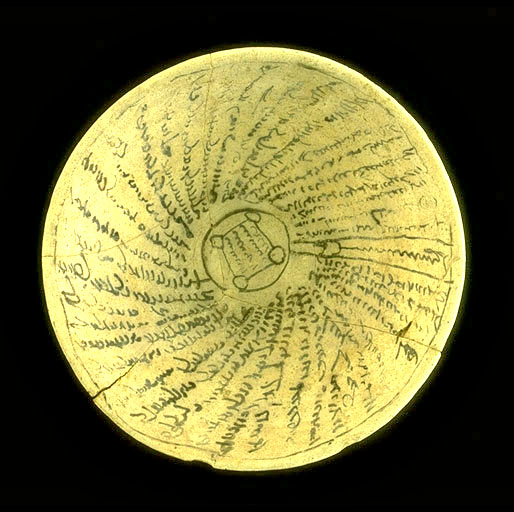
About the time the Talmud was completed, people living in the Jewish colony of Nippur, Babylonia, also knew of Lilith. Her image has been unearthed on numerous ceramic bowls known as incantation bowls for the Aramaic spells inscribed on them. If the Talmud demonstrates what scholars thought about Lilith, the incantation bowls, dating from approximately 600 C.E., show what average citizens believed. One bowl now on display at Harvard University’s Semitic Museum reads, “Thou Lilith. . .Hag and Snatcher, I adjure you by the Strong One of Abraham, by the Rock of Isaac, by the Shaddai of Jacob. . .to turn away from this Rashnoi. . .and from Geyonai her husband. . .Your divorce and writ and letter of separation. . .sent through holy angels. . .Amen, Amen, Selah, Halleluyah!”9 The inscription is meant to offer a woman named Rashnoi protection from Lilith. According to popular folklore, demons not only killed human infants, they would also produce depraved offspring by attaching themselves to human beings and copulating at night. Therefore, on this particular bowl a Jewish writ of divorce expels the demons from the home of Rashnoi.
Until the seventh century C.E., Lilith was known as a dangerous embodiment of dark, feminine powers. In the Middle Ages, however, the Babylonian she-demon took on new and even more sinister characteristics. Sometime prior to the year 1000, The Alphabet of Ben Sira was introduced to medieval Jewry. The Alphabet, an anonymous text, contains 22 episodes, corresponding to the 22 letters of the Hebrew alphabet. The fifth episode includes a Lilith who was to tantalize and terrify the population for generations to come. To some extent, The Alphabet of Ben Sira shows a familiar Lilith: She is destructive, she can fly and she has a penchant for sex. Yet this tale adds a new twist: She is Adam’s first wife, before Eve, who boldly leaves Eden because she is treated as man’s inferior.
The Alphabet’s narrative about Lilith is framed within a tale of King Nebuchadnezzar of Babylon. The king’s young son is ill, and a courtier named Ben Sira is commanded to cure the boy. Invoking the name of God, Ben Sira inscribes an amulet with the names of three healing angels. Then he relates a story of how these angels travel around the world to subdue evil spirits, such as Lilith, who cause illness and death. Ben Sira cites the Bible passage indicating that after creating Adam, God realizes that it is not good for man to be alone (Genesis 2:18). In Ben Sira’s fanciful additions to the biblical tale, the Almighty then fashions another person from the earth, a female called Lilith. Soon the human couple begins to fight, but neither one really hears the other. Lilith refuses to lie underneath Adam during sex, but he insists that the bottom is her rightful place. He apparently believes that Lilith should submissively perform wifely duties. Lilith, on the other hand, is attempting to rule over no one. She is simply asserting her personal freedom. Lilith states, “We are equal because we are both created from the earth.”10
The validity of Lilith’s argument is more apparent in Hebrew, where the words for man (Adam) and “earth” come from the same root, adm (nst) (adam [nst] = Adam; adamah [vnst] = earth). Since Lilith and Adam are formed of the same substance, they are alike in importance.

The struggle continues until Lilith becomes so frustrated with Adam’s
stubbornness and arrogance that she brazenly pronounces the
Tetragrammaton, the ineffable name of the Lord. God’s name (YHWH),
translated as “Lord God” in most Bibles and roughly equivalent to the
term “Yahweh,” has long been considered so holy that it is unspeakable.
During the days of the Jerusalem Temple, only the High Priest said the
word out loud, and then only once a year, on the Day of Atonement. In
Jewish theology and practice, there is still mystery and majesty
attached to God’s special name. The Tetragrammaton is considered “the
name that comprises all” (Zohar 19a).11
In the Bible’s burning bush episode of Exodus 3, God explains the
meaning of the divine name as “I am what I am,” or “I will be what I
will be,” a kind of formula for YHWH (vuvh), associated with the Hebrew root “to be.” The whole of the Torah is thought to be contained within the holy name. In The Alphabet,
Lilith sins by impudently uttering the sacred syllables, thereby
demonstrating to a medieval audience her unworthiness to reside in
Paradise. So Lilith flies away, having gained power to do so by
pronouncing God’s avowed name. Though made of the earth, she is not
earthbound. Her dramatic departure reestablishes for a new generation
Lilith’s supernatural character as a winged devil.
In the Gilgamesh and Isaiah episodes, Lilith flees to desert spaces. In The Alphabet of Ben Sira her destination is the Red Sea, site of historic and symbolic importance to the Jewish people. Just as the ancient Israelites achieve freedom from Pharaoh at the Red Sea, so Lilith gains independence from Adam by going there. But even though Lilith is the one who leaves, it is she who feels rejected and angry.
The Almighty tells Adam that if Lilith fails to return, 100 of her children must die each day. Apparently, Lilith is not only a child-murdering witch but also an amazingly fertile mother. In this way, she helps maintain the world’s balance between good and evil.
Three angels are sent in search of Lilith. When they find her at the Red Sea, she refuses to return to Eden, claiming that she was created to devour children. Ben Sira’s story suggests that Lilith is driven to kill babies in retaliation for Adam’s mistreatment and God’s insistence on slaying 100 of her progeny daily.

To prevent the three angels from drowning her in the Red Sea, Lilith
swears in the name of God that she will not harm any infant who wears an
amulet bearing her name. Ironically, by forging an agreement with God
and the angels, Lilith demonstrates that she is not totally separated
from the divine.
Lilith’s relationship with Adam is a different matter. Their conflict is one of patriarchal authority versus matriarchal desire for emancipation, and the warring couple cannot reconcile. They represent the archetypal battle of the sexes. Neither attempts to solve their dispute or to reach some kind of compromise where they take turns being on top (literally and figuratively). Man cannot cope with woman’s desire for freedom, and woman will settle for nothing less. In the end, they both lose.
Why did the The Alphabet’s unnamed author produce this tragedy? What compelled the author to theorize that Adam had a mate before Eve? The answer may be found in the Bible’s two Creation stories. In Genesis 1 living things appear in a specific order; plants, then animals, then finally man and woman are made simultaneously on the sixth day: “Male and female He created them” (Genesis 1:27). In this version of human origins, man and woman (“humankind” in the New Revised Standard Version) are created together and appear to be equal. In Genesis 2, however, man is created first, followed by plants, then animals and finally woman. She comes last because in the array of wild beasts and birds that God had created, “no fitting helper was found” (Genesis 2:20). The Lord therefore casts a deep sleep upon Adam and returns to work, forming woman from Adam’s rib. God presents woman to Adam, who approves of her and names her Eve. One traditional interpretation of this second Creation story (which scholars identify as the older of the two accounts) is that woman is made to please man and is subordinate to him.b
Considering every word of the Bible to be accurate and sacred, commentators needed a midrash or story to explain the disparity in the Creation narratives of Genesis 1 and 2. God creates woman twice—once with man, once from man’s rib—so there must have been two women. The Bible names the second woman Eve; Lilith was identified as the first in order to complete the story.
Another plausible theory about the creation of this Lilith story, however, is that Ben Sira’s tale is in its entirety a deliberately satiric piece that mocks the Bible, the Talmud and other rabbinic exegeses. Indeed, The Alphabet’s language is often coarse and its tone irreverent, exposing the hypocrisies of biblical heroes such as Jeremiah and offering “serious” discussions of vulgar matters such as masturbation, flatulence and copulation by animals.12 In this context, the story of Lilith might have been parody that never represented true rabbinic thought. It may have served as lewd entertainment for rabbinic students and the public, but it was largely unacknowledged by serious scholars of the time.
Whether the writer of The Alphabet intended to produce earnest midrash or irreligious burlesque, the treatise proclaims Lilith unfit to serve as Adam’s helper. While medieval readers might have laughed at the story’s bawdiness, at the end of this risqué tale, Lilith’s desire for liberation is thwarted by male-dominated society. For this reason, of all the Lilith myths, her portrayal in The Alphabet of Ben Sira is today the most trumpeted, despite the distinct possibility that its author was spoofing sacred texts all along.

The next milestone in Lilith’s journey lies in the Zohar, which elaborates on the earlier account of Lilith’s birth in Eden. The Zohar
(meaning “Splendor”) is the Hebrew title for a fundamental kabbalistic
tome, first compiled in Spain by Moses de Leon (1250–1305), using
earlier sources. To the Kabbalists (members of the late medieval school
of mystical thought), the Zohar’s mystical and allegorical interpretations of the Torah are considered sacred. The Lilith of the Zohar
depends on a rereading of Genesis 1:27 (“And God created man in His
image, in the image of God He created him; male and female He created
them”), and the interpretation of this passage in the Talmud. Based on
the shift of pronouns from “He created him” to the plural “He created
them,” in Genesis 1:27, the Talmud suggests that the first human being
was a single, androgynous creature, with two distinct halves: “At first
it was the intention that two [male and female] should be created but
ultimately only one was created” (Erubin 18a). Centuries later the Zohar
elaborates that the male and female were soon separated. The female
portion of the human being was attached on the side, so God placed Adam
in a deep slumber and “sawed her off from him and adorned her like a
bride and brought her to him.” This detached portion is “the original
Lilith, who was with him [Adam] and who conceived from him” (Zohar 34b).
Another passage indicates that as soon as Eve is created and Lilith
sees her rival clinging to Adam, Lilith flies away.
The Zohar, like the earlier treatments of Lilith, sees her as a temptress of innocent men, breeder of evil spirits and carrier of disease: “She wanders about at night time, vexing the sons of men and causing them to defile themselves [emit seed]” (Zohar 19b). The passage goes on to say that she hovers over her unsuspecting victims, inspires their lust, conceives their children and then infects them with disease. Adam is one of her victims, for he fathers “many spirits and demons, through the force of the impurity which he had absorbed” from Lilith. The promiscuity of Lilith will continue until the day God destroys all evil spirits. Lilith even attempts to seduce King Solomon. She comes in the guise of the Queen of Sheba, but when the Israelite king spies her hairy legs, he realizes she is a beastly impostor.
At several points, the Zohar breaks away from the traditional presentation of the divine personality as exclusively male and discusses a female side to God, called the Shekhinah. (The Shekhinah, whose name means “the Divine Presence” in Hebrew, also appears in the Talmud.) In the Zohar, the lust that Lilith instills in men sends the Shekhinah into exile. If the Shekhinah is Israel’s mother, then Lilith is the mother of Israel’s apostasy. Lilith is even accused of tearing apart the Tetragrammaton, the sacred name of the Lord (YHWH).
The Zohar’s final innovation concerning the Lilith myth is to partner her with the male personification of evil, named either Samael or Asmodeus. He is associated with Satan, the serpent and the leader of fallen angels. Lilith and Samael form an unholy alliance (Zohar 23b, 55a) and embody the dark, negative sphere of the depraved. In one of the many stories of Samael and Lilith, God is concerned that the couple will produce a huge demonic brood and overwhelm the earth with evil. Samael is therefore castrated, and Lilith satisfies her passions by dallying with other men and causing their nocturnal emissions, which she then uses to become pregnant.13
While Lilith appears in the Zohar and many anonymous folktales throughout Europe, over the centuries she has attracted the attention of some of Europe’s best-known artists and writers. Germany’s Johann Goethe (1749–1832) refers to Lilith in Faust, and English Victorian poet Robert Browning (1812–1889) penned “Adam, Lilith and Eve,” another testament to the she-demon’s enduring power. The Pre-Raphaelite poet and painter Dante Gabriel Rossetti (1828–1882) imaginatively describes a pact between Lilith and the Bible’s serpent. A scheming and spiteful Lilith convinces her former lover, the snake, to loan her a reptilian shape. Disguised as a snake Lilith returns to Eden, convinces Eve and Adam to sin by eating the forbidden fruit, and causes God great sorrow.14 Rossetti maintains that “not a drop of her blood was human” but that Lilith nevertheless had the form of a beautiful woman, as can be seen in his painting entitled “Lady Lilith,” begun in 1864 (see the sidebar to this article).
In the 1950s C.S. Lewis invoked Lilith’s image in The Chronicles of Narnia by creating the White Witch, one of the most sinister characters in this imaginary world. As the daughter of Lilith, the White Witch is determined to kill the sons of Adam and the daughters of Eve. She imposes a perpetual freeze on Narnia so that it is always winter but never Christmas. In an apocalyptic tale of good overcoming evil, Aslan—creator and king of Narnia—kills the White Witch and ends her cruel reign.
Today the tradition of Lilith has enjoyed a resurgence, due mainly to the feminist movement of the late 20th century. Renewed interest in Lilith has led modern writers to invent ever more stories. Ignoring or explaining away Lilith’s unsavory traits, feminists have focused instead upon Lilith’s independence and desire for autonomy.
A feminist parable by Judith Plaskow Goldenberg typifies the new view of Lilith. At first Goldenberg’s fanciful tale follows the basic Ben Sira plot line: Lilith dislikes being subservient to Adam, so she flees Paradise and her absence inspires God to create Eve. But in Goldenberg’s retelling, the exiled Lilith is lonely and tries to re-enter the garden. Adam does everything he can to keep her out, inventing wildly untrue stories about how Lilith threatens pregnant women and newborns. One day Eve sees Lilith on the other side of the garden wall and realizes that Lilith is a woman like herself. Swinging on the branch of an apple tree, a curious Eve catapults herself over Eden’s walls where she finds Lilith waiting. As the two women talk, they realize they have much in common, “till the bond of sisterhood grew between them.”15 The budding friendship between Lilith and Eve puzzles and frightens both man and deity.
Soon after Goldenberg’s prose piece, Pamela Hadas produced a 12-part poem that examines Lilith’s dilemma from the female vantage point (see the sidebar to this article). Titled “The Passion of Lilith,” the poem explores the she-demon’s feelings in the first person by beginning with the question “What had the likes of me / to do with the likes of Adam?”16 The first two people are cast as opposites who do not understand one another and cannot learn to appreciate each other’s strengths. Lilith regards herself as an example of God’s “after-whim / or black humor.”
Hadas’s Lilith complains that she feels superfluous because she cannot yield to the dull, artless and monotonous restrictions of Paradise. The female misfit flees the scene and tries to satisfy her maternal instincts by approaching women in childbirth and newborn babies, to their detriment, of course. Hadas’s feminist perspective is most apparent at the poem’s conclusion, however, when Lilith sees her life of pain as qualifying her for sainthood. Having been created from God’s breath, Lilith asks “old bald God” to marry her, to breathe her in again. When the Lord refuses, she is hurt, angry and left with few options, except to travel the world alone.
Lilith’s peregrinations continue today. This winged night creature is, in effect, the only “surviving” she-demon from the Babylonian empire, for she is reborn each time her character is reinterpreted. The retellings of the myth of Lilith reflect each generation’s views of the feminine role. As we grow and change with the millennia, Lilith survives because she is the archetype for the changing role of woman.
Janet Howe Gaines teaches English at the University of New Mexico, where she specializes in the Bible as literature. Her article “How Bad Was Jezebel?” appeared in BR 16:05.
In the Renaissance, Michelangelo portrayed Lilith as a half-woman, half-serpent, coiled around the Tree of Knowledge. Later, her beauty would captivate the English poet Dante Gabriel Rossetti. “Her enchanted hair,” he wrote, “was the first gold.”1 Irish novelist James Joyce cast her as the “patron of abortions.”2 Modern feminists celebrate her bold struggle for independence from Adam. Her name appears as the title of a Jewish women’s magazine and a national literacy program. An annual music festival that donates its profits to battered women’s shelters and breast cancer research institutes is called the Lilith Fair.
In most manifestations of her myth, Lilith represents chaos, seduction and ungodliness. Yet, in her every guise, Lilith has cast a spell on humankind.
The ancient name “Lilith” derives from a Sumerian word for female demons or wind spirits—the lilītu and the related ardat lilǐ. The lilītu dwells in desert lands and open country spaces and is especially dangerous to pregnant women and infants. Her breasts are filled with poison, not milk. The ardat lilī is a sexually frustrated and infertile female who behaves aggressively toward young men.
The earliest surviving mention of Lilith’s name appears in Gilgamesh and the Huluppu-Tree, a Sumerian epic poem found on a tablet at Ur and dating from approximately 2000 B.C.E. The mighty ruler Gilgamesh is the world’s first literary hero; he boldly slays monsters and vainly searches for the secret to eternal life.a In one episode, “after heaven and earth had separated and man had been created,”3 Gilgamesh rushes to assist Inanna, goddess of erotic love and war. In her garden near the Euphrates River, Inanna lovingly tends a willow (huluppu) tree, the wood of which she hopes to fashion into a throne and bed for herself. Inanna’s plans are nearly thwarted, however, when a dastardly triumvirate possesses the tree. One of the villains is Lilith: “Inanna, to her chagrin, found herself unable to realize her hopes. For in the meantime a dragon had set up its nest at the base of the tree, the Zu-bird had placed his young in its crown, and in its midst the demoness Lilith had built her house.” Wearing heavy armor, brave Gilgamesh kills the dragon, causing the Zu-bird to fly to the mountains and a terrified Lilith to flee “to the desert.”
Lilith?
In the 1930s, scholars identified the voluptuous woman on this
terracotta plaque (called the Burney Relief) as the Babylonian demoness
Lilith. Today, the figure is generally identified as the goddess of love
and war, known as Inanna to the Sumerians and Ishtar to the later
Akkadians. (Both characters are featured in the poem Gilgamesh and the
Huluppu-Tree, quoted on this page.) The woman wears a horned crown and
has the wings and feet of a bird. She is flanked by owls (associated
with Lilith) and stands on the backs of two lions (symbols of Inanna).
According to Mesopotamian myths, the demoness Lilith (lilītu or ardat
lilǐ) flew at night, seducing men and killing pregnant women and babies.
This night creature makes one appearance in the Bible, in Isaiah 34,
which enumerates the fierce denizens of the desert wilderness: hyenas,
goat-demons and “the lilith” (Isaiah 34:14). (In the King James Version,
“lilith” is translated “screech owl”—apparently alluding to the demon’s
night flights in search of prey.) From The Great Mother
In early incantations against Lilith, she travels on demon wings, a conventional mode of transportation for underworld residents. Dating from the seventh or eighth century B.C.E. is a limestone wall plaque, discovered in Arslan Tash, Syria, in 1933, which contains a horrific mention of Lilith. The tablet probably hung in the house of a pregnant woman and served as an amulet against Lilith, who was believed to be lurking at the door and figuratively blocking the light. One translation reads: “O you who fly in (the) darkened room(s), / Be off with you this instant, this instant, Lilith. / Thief, breaker of bones.”4 Presumably, if Lilith saw her name written on the plaque, she would fear recognition and quickly depart. The plaque thus offered protection from Lilith’s evil intentions toward a mother or child. At critical junctures in a woman’s life—such as menarche, marriage, the loss of virginity or childbirth—ancient peoples thought supernatural forces were at work. To explain the high rate of infant mortality, for example, a demon goddess was held responsible. Lilith stories and amulets probably helped generations of people cope with their fear.
Over time, people throughout the Near East became increasingly familiar with the myth of Lilith. In the Bible, she is mentioned only once, in Isaiah 34. The Book of Isaiah is a compendium of Hebrew prophecy spanning many years; the book’s first 39 chapters, frequently referred to as “First Isaiah,” can be assigned to the time when the prophet lived (approximately 742–701 B.C.E.). Throughout the Book of Isaiah, the prophet encourages God’s people to avoid entanglements with foreigners who worship alien deities. In Chapter 34, a sword-wielding Yahweh seeks vengeance on the infidel Edomites, perennial outsiders and foes of the ancient Israelites. According to this powerful apocalyptic poem, Edom will become a chaotic, desert land where the soil is infertile and wild animals roam: “Wildcats shall meet hyenas, / Goat-demons shall greet each other; / There too the lilith shall repose / And find herself a resting place” (Isaiah 34:14).5 The Lilith demon was apparently so well known to Isaiah’s audience that no explanation of her identity was necessary.
The
evil Lilith is depicted on this ceramic bowl from Mesopotamia. The
Aramaic incantation inscribed on the bowl was intended to protect a man
named Quqai and his family from assorted demons. The spell begins:
“Removed and chased are the curses and incantations from Quqai son of
Gushnai, and Abi daughter of Nanai and from their children.” Although
Lilith’s name does not appear, she may be identified by comparison with
images of her on other bowls, where she is shown with her arms raised
aggressively and her skin spotted like a leopard’s. Dating to about 600
C.E., this bowl from Harvard University’s Semitic Museum attests to the
longevity of Lilith’s reputation in Mesopotamia as a seducer of men and
murderer of children. Courtesy of the Semitic Musuem, Harvard University
English translators of Isaiah 34:14 sometimes lack confidence in their readers’ knowledge of Babylonian demonology. The King James Bible’s prose rendition of the poem translates “the lilith” as “the screech owl,” recalling the ominous bird-like qualities of the Babylonian she-demon. The Revised Standard Version picks up on her nocturnal habits and tags her “the night hag” instead of “the lilith,” while the 1917 Jewish Publication Society’s Holy Scriptures calls her “the night-monster.”6 The Hebrew text and its best translations employ the word “lilith” in the Isaiah passage, but other versions are true to her ancient image as a bird, night creature and beldam (hag).
While Lilith is not mentioned again in the Bible, she does resurface in the Dead Sea Scrolls found at Qumran. The Qumran sect was engrossed with demonology, and Lilith appears in the Song for a Sage, a hymn possibly used in exorcisms: “And I, the Sage, sound the majesty of His beauty to terrify and confound all the spirits of destroying angels and the bastard spirits, the demons, Lilith. . ., and those that strike suddenly, to lead astray the spirit of understanding, and to make desolate their heart.”7 The Qumran community was surely familiar with the Isaiah passage, and the Bible’s sketchy characterization of Lilith is echoed by this liturgical Dead Sea Scroll. (Lilith may also appear in a second Dead Sea Scroll. See the following article in this issue.)
Centuries after the Dead Sea Scrolls were written, learned rabbis completed the Babylonian Talmud (final editing circa 500 to 600 C.E.), and female demons journeyed into scholarly Jewish inquiries. The Talmud (the name comes from a Hebrew word meaning “study”) is a compendium of legal discussions, tales of great rabbis and meditations on Bible passages. Talmudic references to Lilith are few, but they provide a glimpse of what intellectuals thought about her. The Talmud’s Lilith recalls older Babylonian images, for she has “long hair” (Erubin 100b) and wings (Niddah 24b).8 The Talmud’s image of Lilith also reinforces older impressions of her as a succubus, a demon in female form who had sex with men while the men were sleeping. Unwholesome sexual practices are linked to Lilith as she powerfully embodies the demon-lover myth.
One talmudic reference claims that people should not sleep alone at night, lest Lilith slay them (Shabbath 151b). During the 130-year period between the death of Abel and the birth of Seth, the Talmud reports, a distraught Adam separates himself from Eve. During this time he becomes the father of “ghosts and male demons and female [or night] demons” (Erubin 18b). And those who try to construct the Tower of Babel are turned into “apes, spirits, devils and night-demons” (Sanhedrin 109a). The female night demon is Lilith.
About the time the Talmud was completed, people living in the Jewish colony of Nippur, Babylonia, also knew of Lilith. Her image has been unearthed on numerous ceramic bowls known as incantation bowls for the Aramaic spells inscribed on them. If the Talmud demonstrates what scholars thought about Lilith, the incantation bowls, dating from approximately 600 C.E., show what average citizens believed. One bowl now on display at Harvard University’s Semitic Museum reads, “Thou Lilith. . .Hag and Snatcher, I adjure you by the Strong One of Abraham, by the Rock of Isaac, by the Shaddai of Jacob. . .to turn away from this Rashnoi. . .and from Geyonai her husband. . .Your divorce and writ and letter of separation. . .sent through holy angels. . .Amen, Amen, Selah, Halleluyah!”9 The inscription is meant to offer a woman named Rashnoi protection from Lilith. According to popular folklore, demons not only killed human infants, they would also produce depraved offspring by attaching themselves to human beings and copulating at night. Therefore, on this particular bowl a Jewish writ of divorce expels the demons from the home of Rashnoi.
Until the seventh century C.E., Lilith was known as a dangerous embodiment of dark, feminine powers. In the Middle Ages, however, the Babylonian she-demon took on new and even more sinister characteristics. Sometime prior to the year 1000, The Alphabet of Ben Sira was introduced to medieval Jewry. The Alphabet, an anonymous text, contains 22 episodes, corresponding to the 22 letters of the Hebrew alphabet. The fifth episode includes a Lilith who was to tantalize and terrify the population for generations to come. To some extent, The Alphabet of Ben Sira shows a familiar Lilith: She is destructive, she can fly and she has a penchant for sex. Yet this tale adds a new twist: She is Adam’s first wife, before Eve, who boldly leaves Eden because she is treated as man’s inferior.
The Alphabet’s narrative about Lilith is framed within a tale of King Nebuchadnezzar of Babylon. The king’s young son is ill, and a courtier named Ben Sira is commanded to cure the boy. Invoking the name of God, Ben Sira inscribes an amulet with the names of three healing angels. Then he relates a story of how these angels travel around the world to subdue evil spirits, such as Lilith, who cause illness and death. Ben Sira cites the Bible passage indicating that after creating Adam, God realizes that it is not good for man to be alone (Genesis 2:18). In Ben Sira’s fanciful additions to the biblical tale, the Almighty then fashions another person from the earth, a female called Lilith. Soon the human couple begins to fight, but neither one really hears the other. Lilith refuses to lie underneath Adam during sex, but he insists that the bottom is her rightful place. He apparently believes that Lilith should submissively perform wifely duties. Lilith, on the other hand, is attempting to rule over no one. She is simply asserting her personal freedom. Lilith states, “We are equal because we are both created from the earth.”10
The validity of Lilith’s argument is more apparent in Hebrew, where the words for man (Adam) and “earth” come from the same root, adm (nst) (adam [nst] = Adam; adamah [vnst] = earth). Since Lilith and Adam are formed of the same substance, they are alike in importance.
Eve,
meet Lilith. Lilith—depicted with a woman’s face and a serpentine
body—assaults Adam and Eve beneath the Tree of Knowledge in Hugo van der
Goes’s “Fall of Adam and Eve” (c. 1470), from the Kunsthistorisches
Museum, in Vienna. According to medieval Jewish apocryphal tradition,
which attempts to reconcile the two Creation stories presented in
Genesis, Lilith was Adam’s first wife. In Genesis 1:27, God creates man
and woman simultaneously from the earth. In Genesis 2:7, however, Adam
is created by himself from the earth; Eve is produced later, from Adam’s
rib (Genesis 2:21–22). In Jewish legend, the name Lilith was attached
to the woman who was created at the same time as Adam. Erich Lessing/Art Resource, NY
In the Gilgamesh and Isaiah episodes, Lilith flees to desert spaces. In The Alphabet of Ben Sira her destination is the Red Sea, site of historic and symbolic importance to the Jewish people. Just as the ancient Israelites achieve freedom from Pharaoh at the Red Sea, so Lilith gains independence from Adam by going there. But even though Lilith is the one who leaves, it is she who feels rejected and angry.
The Almighty tells Adam that if Lilith fails to return, 100 of her children must die each day. Apparently, Lilith is not only a child-murdering witch but also an amazingly fertile mother. In this way, she helps maintain the world’s balance between good and evil.
Three angels are sent in search of Lilith. When they find her at the Red Sea, she refuses to return to Eden, claiming that she was created to devour children. Ben Sira’s story suggests that Lilith is driven to kill babies in retaliation for Adam’s mistreatment and God’s insistence on slaying 100 of her progeny daily.
“Bind
Lilith in chains!” reads a warning in Hebrew on this 18th- or
19th-century C.E. amulet from the Israel Museum intended to protect an
infant from the demoness. The image of Lilith appears at center. The
small circles that outline her body represent a chain. The divine name
is written in code (called atbash) down her chest. (The letters yhwh appear instead as mzpz.)
Beneath this is a prayer: “Protect this boy who is a newborn from all
harm and evil. Amen.” Surrounding the central image are abbreviated
quotations from Numbers 6:22–27 (“The Lord bless you and keep you. . .”)
and Psalm 121 (“I lift up my eyes to the hills. . .”). According to
the apocryphal Alphabet of Ben Sira, Lilith herself promised she would harm no child who wore an amulet bearing her name. Israel Museum, Jerusalem
Lilith’s relationship with Adam is a different matter. Their conflict is one of patriarchal authority versus matriarchal desire for emancipation, and the warring couple cannot reconcile. They represent the archetypal battle of the sexes. Neither attempts to solve their dispute or to reach some kind of compromise where they take turns being on top (literally and figuratively). Man cannot cope with woman’s desire for freedom, and woman will settle for nothing less. In the end, they both lose.
Why did the The Alphabet’s unnamed author produce this tragedy? What compelled the author to theorize that Adam had a mate before Eve? The answer may be found in the Bible’s two Creation stories. In Genesis 1 living things appear in a specific order; plants, then animals, then finally man and woman are made simultaneously on the sixth day: “Male and female He created them” (Genesis 1:27). In this version of human origins, man and woman (“humankind” in the New Revised Standard Version) are created together and appear to be equal. In Genesis 2, however, man is created first, followed by plants, then animals and finally woman. She comes last because in the array of wild beasts and birds that God had created, “no fitting helper was found” (Genesis 2:20). The Lord therefore casts a deep sleep upon Adam and returns to work, forming woman from Adam’s rib. God presents woman to Adam, who approves of her and names her Eve. One traditional interpretation of this second Creation story (which scholars identify as the older of the two accounts) is that woman is made to please man and is subordinate to him.b
Considering every word of the Bible to be accurate and sacred, commentators needed a midrash or story to explain the disparity in the Creation narratives of Genesis 1 and 2. God creates woman twice—once with man, once from man’s rib—so there must have been two women. The Bible names the second woman Eve; Lilith was identified as the first in order to complete the story.
Another plausible theory about the creation of this Lilith story, however, is that Ben Sira’s tale is in its entirety a deliberately satiric piece that mocks the Bible, the Talmud and other rabbinic exegeses. Indeed, The Alphabet’s language is often coarse and its tone irreverent, exposing the hypocrisies of biblical heroes such as Jeremiah and offering “serious” discussions of vulgar matters such as masturbation, flatulence and copulation by animals.12 In this context, the story of Lilith might have been parody that never represented true rabbinic thought. It may have served as lewd entertainment for rabbinic students and the public, but it was largely unacknowledged by serious scholars of the time.
Whether the writer of The Alphabet intended to produce earnest midrash or irreligious burlesque, the treatise proclaims Lilith unfit to serve as Adam’s helper. While medieval readers might have laughed at the story’s bawdiness, at the end of this risqué tale, Lilith’s desire for liberation is thwarted by male-dominated society. For this reason, of all the Lilith myths, her portrayal in The Alphabet of Ben Sira is today the most trumpeted, despite the distinct possibility that its author was spoofing sacred texts all along.
Dressed
in a polka-dot bikini and high-heeled pumps, Lilith hurls lightning
bolts at Adam, in Texas artist Allison Merriweather’s colorful “Lilith”
(1999), from the artist’s collection. Today, feminists celebrate Lilith
for insisting on being treated as Adam’s equal. In repicturing Lilith as
a modern woman, they draw heavily on the medieval Alphabet of Ben Sira,
where Lilith tells Adam: “We are equal because we are both created from
the earth.” But the author of The Alphabet might actually have intended
his tale to be interpreted as satire. Indeed, the book is rife with
dirty jokes, praise for hypocrites and biting sarcasm. And the pious
character Ben Sira, who retells Lilith’s story in The Alphabet, is
identified as the product of an incestuous relationship between the
prophet Jeremiah and his daughter. Courtesy of Allison Merriweather
The Zohar, like the earlier treatments of Lilith, sees her as a temptress of innocent men, breeder of evil spirits and carrier of disease: “She wanders about at night time, vexing the sons of men and causing them to defile themselves [emit seed]” (Zohar 19b). The passage goes on to say that she hovers over her unsuspecting victims, inspires their lust, conceives their children and then infects them with disease. Adam is one of her victims, for he fathers “many spirits and demons, through the force of the impurity which he had absorbed” from Lilith. The promiscuity of Lilith will continue until the day God destroys all evil spirits. Lilith even attempts to seduce King Solomon. She comes in the guise of the Queen of Sheba, but when the Israelite king spies her hairy legs, he realizes she is a beastly impostor.
At several points, the Zohar breaks away from the traditional presentation of the divine personality as exclusively male and discusses a female side to God, called the Shekhinah. (The Shekhinah, whose name means “the Divine Presence” in Hebrew, also appears in the Talmud.) In the Zohar, the lust that Lilith instills in men sends the Shekhinah into exile. If the Shekhinah is Israel’s mother, then Lilith is the mother of Israel’s apostasy. Lilith is even accused of tearing apart the Tetragrammaton, the sacred name of the Lord (YHWH).
The Zohar’s final innovation concerning the Lilith myth is to partner her with the male personification of evil, named either Samael or Asmodeus. He is associated with Satan, the serpent and the leader of fallen angels. Lilith and Samael form an unholy alliance (Zohar 23b, 55a) and embody the dark, negative sphere of the depraved. In one of the many stories of Samael and Lilith, God is concerned that the couple will produce a huge demonic brood and overwhelm the earth with evil. Samael is therefore castrated, and Lilith satisfies her passions by dallying with other men and causing their nocturnal emissions, which she then uses to become pregnant.13
While Lilith appears in the Zohar and many anonymous folktales throughout Europe, over the centuries she has attracted the attention of some of Europe’s best-known artists and writers. Germany’s Johann Goethe (1749–1832) refers to Lilith in Faust, and English Victorian poet Robert Browning (1812–1889) penned “Adam, Lilith and Eve,” another testament to the she-demon’s enduring power. The Pre-Raphaelite poet and painter Dante Gabriel Rossetti (1828–1882) imaginatively describes a pact between Lilith and the Bible’s serpent. A scheming and spiteful Lilith convinces her former lover, the snake, to loan her a reptilian shape. Disguised as a snake Lilith returns to Eden, convinces Eve and Adam to sin by eating the forbidden fruit, and causes God great sorrow.14 Rossetti maintains that “not a drop of her blood was human” but that Lilith nevertheless had the form of a beautiful woman, as can be seen in his painting entitled “Lady Lilith,” begun in 1864 (see the sidebar to this article).
In the 1950s C.S. Lewis invoked Lilith’s image in The Chronicles of Narnia by creating the White Witch, one of the most sinister characters in this imaginary world. As the daughter of Lilith, the White Witch is determined to kill the sons of Adam and the daughters of Eve. She imposes a perpetual freeze on Narnia so that it is always winter but never Christmas. In an apocalyptic tale of good overcoming evil, Aslan—creator and king of Narnia—kills the White Witch and ends her cruel reign.
Today the tradition of Lilith has enjoyed a resurgence, due mainly to the feminist movement of the late 20th century. Renewed interest in Lilith has led modern writers to invent ever more stories. Ignoring or explaining away Lilith’s unsavory traits, feminists have focused instead upon Lilith’s independence and desire for autonomy.
A feminist parable by Judith Plaskow Goldenberg typifies the new view of Lilith. At first Goldenberg’s fanciful tale follows the basic Ben Sira plot line: Lilith dislikes being subservient to Adam, so she flees Paradise and her absence inspires God to create Eve. But in Goldenberg’s retelling, the exiled Lilith is lonely and tries to re-enter the garden. Adam does everything he can to keep her out, inventing wildly untrue stories about how Lilith threatens pregnant women and newborns. One day Eve sees Lilith on the other side of the garden wall and realizes that Lilith is a woman like herself. Swinging on the branch of an apple tree, a curious Eve catapults herself over Eden’s walls where she finds Lilith waiting. As the two women talk, they realize they have much in common, “till the bond of sisterhood grew between them.”15 The budding friendship between Lilith and Eve puzzles and frightens both man and deity.
Soon after Goldenberg’s prose piece, Pamela Hadas produced a 12-part poem that examines Lilith’s dilemma from the female vantage point (see the sidebar to this article). Titled “The Passion of Lilith,” the poem explores the she-demon’s feelings in the first person by beginning with the question “What had the likes of me / to do with the likes of Adam?”16 The first two people are cast as opposites who do not understand one another and cannot learn to appreciate each other’s strengths. Lilith regards herself as an example of God’s “after-whim / or black humor.”
Hadas’s Lilith complains that she feels superfluous because she cannot yield to the dull, artless and monotonous restrictions of Paradise. The female misfit flees the scene and tries to satisfy her maternal instincts by approaching women in childbirth and newborn babies, to their detriment, of course. Hadas’s feminist perspective is most apparent at the poem’s conclusion, however, when Lilith sees her life of pain as qualifying her for sainthood. Having been created from God’s breath, Lilith asks “old bald God” to marry her, to breathe her in again. When the Lord refuses, she is hurt, angry and left with few options, except to travel the world alone.
Lilith’s peregrinations continue today. This winged night creature is, in effect, the only “surviving” she-demon from the Babylonian empire, for she is reborn each time her character is reinterpreted. The retellings of the myth of Lilith reflect each generation’s views of the feminine role. As we grow and change with the millennia, Lilith survives because she is the archetype for the changing role of woman.
Janet Howe Gaines teaches English at the University of New Mexico, where she specializes in the Bible as literature. Her article “How Bad Was Jezebel?” appeared in BR 16:05.
Permalink: http://www.biblicalarchaeology.org/daily/people-cultures-in-the-bible/people-in-the-bible/lilith/
http://www.biblicalarchaeology.org/daily/people-cultures-in-the-bible/people-in-the-bible/lilith/

 Quoting Zohar 1:19b -