Σύμπαν και άνθρωπος

Όλα στο σύμπαν αφορούν τη μεταμόρφωση.Η ζωή μας μοιάζει με τις σκέψεις που τη διαμορφώνουν.

Μάρκος Αυρήλιος
Εμφάνιση αναρτήσεων με ετικέτα Life. Εμφάνιση όλων των αναρτήσεων

Σάββατο 15 Δεκεμβρίου 2012

The Gratitude Tutorial ~ How Thankfulness Can Improve Your Life


We spend just one day a year giving thanks, but we have reasons to be thankful every single day. Unfortunately, bad things tend to grab our attention and allow the good things to slip by, unnoticed. Even when we notice something good, we tend to forget about it more quickly than we do the bad things.
That's the inspiration behind this tutorial. Using the tips below, you'll not only develop an attitude of gratitude for Thanksgiving, but you'll be well on your way to making gratefulness a habit. Why would you want to do that? Simple. Gratitude is a powerful tool for focusing the mind on the positive, and positive people draw positive outcomes.
Begin by keeping a gratitude journal. Don't write down negative things; only positive ones. For example:
"I'm grateful that I made it through rush hour safely."
"I'm grateful that I got to see a beautiful sunset."
"I'm grateful that I have a class at school that I really like."
Think of all the good things that happened because something bad happened first. For example:
"If that slow driver hadn't pulled in front of me, I'd have gotten a speeding ticket."
"If I hadn't tripped on the playground, I would never have met such a nice person."
"If I hadn't been laid off, I would never have gotten a better job."
Don't focus on what you don't have. Focus on what you do have. For example:
"I'm so fortunate to have a warm place to sleep."
"I'm so fortunate to live in a safe neighborhood."
"I'm so fortunate to have time to relax."
Think about people you've known that have made you thankful for their existence. They can be family, friends or simply people who have created things that you enjoy. Imagine how many other people there are who might be equally as wonderful. You just haven't met them yet!
Think about people who have made life hard for you. Now think about the things you accomplished because of them. Did you finish something because they said that you couldn't? Did you get better at something because they made fun of you when you did it badly? Did their cruel actions make you vow never to treat others that way? Even the negative forces in your life can be hidden blessings, worthy of thankfulness.
Think about the animals that have given you joy: Dogs that love you with every inch of their hearts, cats that think your lap is the best place to nap in the whole world, birds whose songs uplift your spirit, squirrels whose antics put a grin on your face and so on.
Think about the places that make you smile: A favorite hangout, a wooded trail, an exciting city, a great spot from which to view the sky, a hill that you once rolled down. Give thanks for all these things.
Create your own opportunities for gratitude. Do you know someone who never seems happy? Be ready with a smile and a kind word each time you see them. It may require patience, but eventually, they'll smile first when they see you. Your interactions with them will be much more pleasant. Guess what? You'll have a new reason to be thankful!
Let others know when they've done something that you're thankful for. For example:
"I'll never forget how you stuck up for me. It meant a lot."
"That email you sent really made my day."
"You make shopping here a pleasure."
An attitude of gratitude spreads like ripples from a tossed pebble, benefiting all that it touches.
Remember that hard times make good times sweeter. Obstacles and challenges not only make you stronger, but force you to explore outside of your comfort zone. Without challenges, there can be no progress. Without obstacles, there can be no achievement. Be thankful for the opportunities that they provide.
Now pass it on. True gratitude leads to action. Lend a hand. Pitch in. Listen. Even small things like a friendly greeting can make a difference. And in the process of paying it forward, you'll discover more reasons to give thanks!
http://knowledgehound.com/khhow2s/giving_thanks.htm

http://www.templeilluminatus.com/

Κυριακή 25 Νοεμβρίου 2012

“Living The Dream”

“Reality is that which, when you stop believing in it, doesn’t go away”

- How To Build A Universe That Doesn’t Fall Apart Two Days Later, Philip K. Dick
Part 2, Essays for the Discordian occultist: inducing a magickal state of consciousness
Magick is a highly subjective skill. According to the occultist, Ramsey Dukes, as a discipline it lies somewhere alongside ‘art’, ‘science’ and ‘religion’ [1]. All of these pursuits require a certain state of mind. The magick user who entirely excludes the possibility of magick from his worldview is like a cleric who knows no God, an artist with no appreciation for art or a scientist who refuses to accept the laws of mathematics. It’s not necessarily the case that you will be unsuccessful but it’s significantly less likely. So, for as long as is comfortable[2], it’s time to allow magick to be part of your reality.
This essay includes two exercises, the first will involve noticing magick and the second will involve using it. The first exercise is outlined below in three easy steps:
Step one: Resolve to notice the number 23.
The particular number is not relevant at this stage. Some observe the number 11 or 13 or 7 but as we’re Discordians the number 23 will tune us into the right state of mind for this series of thought exercises. People who are inexperienced in the ways of numerology are advised to watch Eric Cartmen’s explanation of the causes of 9/11 [Mystery of the Urinal Deuce (Season 10, Episode 9)]. A good numerologist can easily spot the 23’s in the numbers 203, 2003, or, at a push, 5.
Step two: Get your dream diary and record what 23 means to you each time you see it.
This diary will now be re-named a “spellbook”. Spells can take years to manifest and there’s no way of checking your effectiveness if you can’t remember which ones you have cast.
Step three: Learn not to freak out too much when the number 23 does actually seem to take on some sort of significance.
I suggest you apply maximum fluidity to the meanings you start to notice here. The number 23 doesn’t usually acquire one meaning and the more you pay attention the more you should realise it’s neither always lucky or unlucky. All we are noticing is it carries a certain significance.
Step four: Toward the end of the week (usually by the fifth day) you’ll be able to explore a world where other random details can also be viewed as significant.
In his occult masterpiece “The Secret History of The World” Jonathan Black nails a description of the sort of mindset we’re trying to invoke here:
“In this history the universe is anthropocentric, every single particle of it straining, directed towards humankind. […In] the mind-before-matter universe that this book describes, the connection between mind and matter is much more intimate. It is a living, dynamic connection. Everything in this universe is alive and conscious to some degree, responding sensitively and intelligently to our deepest, subtlest needs.”
[my italics]
The Secret History of The World, Jonathan Black. P33-34
While dreaming one’s thoughts manifest almost instantly and if you’re lucid at the time this process is easily observed. Now you have entered a more magickal state of mind we’re going to see how long it takes to replicate this process in waking life. This next exercise is similar to one suggested by Pope Bob in the first chapter of “Prometheus Rising”[3]. The only difference is we’re adjusting things slightly to account for inflation and we are not searching for any explanation other than a magickal one. Once again it is a three step process:
Step one: Resolve to evoke a nice shiny fifty cent piece.
Step two: Keep an eye out for the fruits of your evocation.
Step three: Learn not to freak out when you finally do find it. It will be found by you easily and the moment you’ve got it in your hand you will be ready for part three of this five part series where we will finally get cracking on some real high grade Discordian nonsense.
Step four: Wonder why it is that each of these three step plans has had a fourth step?
23
Footnotes:
[1]
His essay on this topic is excellent but far beyond the realms of this short practical guide for today’s busy Discordian occultist. The serious student will return to these essays once they’ve achieved incredible results with the techniques outlined in Chapters #3 and #4. These initiates will of course want to purchase a copy of all the books outlined in the further reading sections.
[2]
Occultism’s not for everyone. If you feel out of your depth at any point it’s important for the uninitiated wanderer to remember that Discordianism is of course a joke.
[3]
Pope Bob is to Discordianism what St Paul was to Christianity. His work “Prometheus Rising” was included in part one’s further reading section. International readers (anyone outside ‘the land of the free and home of the brave’) will have to work out what sort of coin suits their circumstances. The local currency tends to be more practical so something equivalent in the UK, for example, would be a 5p.
FURTHER READING:
The Secret History Of The World by Jonathan Black
SSOTBME Revised – an essay on magic by Ramsey Dukes
And of course the always essential Disinfo comments section…
Note to commenters – I intend to use your words in a little podcast I’m making, if you don’t mind? This article is to be featured (with your improvements) in a later episode of: http://thecultofnick.libsyn.com/
 http://www.disinfo.com/

“Life is But a Dream”

“As sunlight obscures the stars by day so too does wakefullness blind us to the fact that we are still dreaming.”
- Liber Kaos, Peter J Carroll.
Part 1, Essays for the Discordian occultist: introducing the lucid dream.
Everything you experience of the outside world has to pass via your senses into your brain. Your body acts as an instrument through which reality is filtered. Ignorance allows you to focus. You always exclude more than you are taking in. If this article has your full attention it will necessarily be at the expense of other things.  If you’re reading it on your mobile in a pub some people will see your focus as ignorant, for example.
It is with your memory and imagination that you decode meaning from the chaos of the external world. You’ve been around in some form or other since the dawn of time. In my experience it’s only recently that any of it has made any sort of “sense” thanks in the main to my memory and imagination.
However, that “sense” and meaning is ultimately decided by you. You get the final call as regards what is or is not “real”. This is the case with everything you have ever experienced.
Sleep is a good expression of this truth. While enveloped in sleep the brain invents scenarios by ignoring most sense data. This act of invention is usually a result of your subconscious mind combining memories and imagination. This video posted on Disinfo recently about lucid dreaming allows you to investigate the dream state further by learning to use your conscious mind to create dreams. There’s plenty of information online elsewhere about the process but a simple three step guide for the busy Discordian would run something like this:
Step one: Resolve to perform frequent ‘reality checks’.
Reality checking techniques vary from person to person but I find pulling my hands up into my line of vision is enough. This is tricky for me to do while dreaming as they usually appear a little slow moving or blurred. Other people switch electric lights off and on or try reading words, in short perform any simple activity you find is usually difficult in a dream.
Do these checks every hour or so until it’s an instinctive habit. The point of them is to trigger the realisation that you are dreaming.
Step two: Keep a dream diary and fill it in every morning.
This principally aids your memory and ability to recall any dreams from the previous night. No point in lucid dreaming if you forget about it the next day.
Step three: Learn not to freak out when you do finally feel lucid within the dream state.
I fell into the trap of waking up each time I realised I was dreaming for a while. This was mainly because I’d get so excited when a reality check revealed I was dreaming that I’d also trigger a ‘fully conscious wake up in the middle of the night situation’.
Step four: Explore the world of lucid dreaming where anything you think is true becomes the case instantly.
Magick is the art of manipulating reality both internally and externally. Lucid dreaming is an interesting preparatory first step. Further magickal exercises will build upon principles you’ll discover as your mind becomes more able to consciously manipulate the dream state. Most so-called low magick is principally concerned with projecting dreams outward into our external reality. There’s little point in doing this if you can’t dream properly.
The phrase “living the dream” owes more than a little to magickal thinking. However, our aim is to live this dream we call reality in a fully conscious ‘awakened’ state.
FURTHER READING:
Robert Anton Wilson: Prometheus Rising
Peter J Carrol: Liber Kaos
And of course this article’s invaluable comments section…
Note to commenters – I intend to use your words in a little podcast I’m making, if you don’t mind? This article is to be featured (with your improvements) in a later episode of http://thecultofnick.libsyn.com/
 http://www.disinfo.com/
Related Posts with Thumbnails

Πέμπτη 22 Νοεμβρίου 2012

Goldilocks, and other Habitable Zones for Life


Heard of the Goldilocks zone?
It’s the idea that an area of space around a star will be at the right temperature for life to exist. Not too hot, not too cold, hence Goldilocks.
It’s a bit like standing around a campfire on a very cold night. Stand too far away and you freeze, stand too close and you catch on fire and burn to death.
It’s the same with planets orbiting stars too, if they’re too far away then water freezes and life can’t emerge, and if they orbit too close the planet is roasting hot and nothing can live.
It gets a bit more complex than this though, but complex in a fun way. Oh and its also got some pretty big implications for the search for extraterrestrial life…

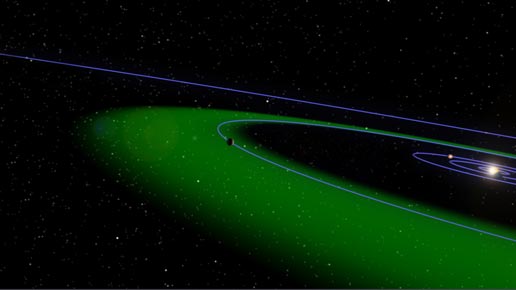
This Goldilocks zone is more usually called a habitable zone (HZ for short). It’s the distance around a star at which a planet can maintain surface liquid water.
Scientists care about liquid water, as all life on Earth needs liquid water to survive (life on Earth is basically bags of water with a few other ingredients thrown in). Scientists’ care about the idea of a HZ as it guides our thinking as to where in our Solar System life could potentially be found, and where it could be found in other solar systems too. And we all care about finding alien life, right?
Earth is in the HZ of our star, obviously, whereas Venus is too close to the Sun, as it’s surface is almost hot enough to glow, and Mars is probably right at the outer edge of the habitable zone, as its surface is too cold for water to remain liquid for long.
A simplified representation of our Sun’s habitable zone
A habitable zone is therefore defined as the region around a star between the distance at which water would evaporate and the distance at which surface water begins to freeze. (Sometimes the outer edge is set at the distance at which carbon dioxide would freeze out of an atmosphere, as CO2 is a greenhouse gas that can heat a planet, meaning that planets rich in CO2 could be warm enough to enjoy liquid water at a distance a bit further out than we would normally expect to find it).
The HZ doesn’t just depend on the distance from a star though; it also depends upon the features of the planet. If Mars had been slightly bigger it would have been able to maintain an atmosphere (it lost most of it’s initial atmosphere to space as its gravity isn’t strong enough to capture it permanently, more here) and if this atmosphere contained enough greenhouse gassed Mars could have a warm and wet surface today. Thus a HZ is typically defined as the region around a star in which an Earth-like planet could maintain surface liquid water.
A HZ also depends upon the star too. Larger stars emit much more heat, thus the zone in which an Earth-like planet could maintain surface liquid water would be much further out than for our Sun, and much closer in for stars smaller than ours.
Like this (click to enlarge)
Habitable zones are also affected by time. Over their lifetimes the heat output of stars changes. Our Sun has increased in luminosity since it first formed and is roughly 30% hotter today than it was 4.6 billion years ago. This means that the habitable zone must have moved outwards throughout the life of our star. Astronomers and astrobiologists believe that Earth has always been inside our Sun’s habitable zone, but it inspired a scientist called Michael Hart to come up with the idea of the Continuously Habitable Zone (CHZ). This is the region around a star in which an Earth-like planet can sustain surface liquid water for most of the lifetime of its star.
The idea of a CHZ is important, as the fossil record indicates that it took a long time for complex life to evolve on Earth. Palaeontologists have discovered that single-celled life emerged early in Earth’s history, possibly as far back as 4 billion years ago, but that it took more than 3.5 billion years for this bacterial life to evolve into the first animals. If the Earth had formed 5% closer to the Sun, or 15% further away, its likely that it would have been outside of this CHZ and thus animal life would not have been able to evolve on Earth (yes, that includes us).
This leads to a really cool habitable zone idea, that there may be different HZs for different types of life, an Animal Habitable Zone (AHZ) and a Microbial Habitable Zone (MHZ).
It’s likely that the AHZ would be very narrow, and would be confined to a star’s CHZ, as the planet would need to have surface liquid water for billions of years to allow animals time to evolve.
The animal habitable zone, narrow
The MHZ will likely be much wider, as microbial life may well take a mere few hundred millions years or so to emerge, thus can live on planets that may only spend a short time in a star’s HZ. Venus and Mars may well have had their own microbial life early in their histories, and thus may have been inside our Sun’s MHZ for a time.
Two other discoveries have also expanded the possible boundaries of a MHZ. The first of these was the discovery of extremophiles in the 1970s. Extremophiles are single-celled life forms that thrive in extreme conditions such as boiling water, sulphuric acid or inside rocks deep within the Earth’s crust. Extremophiles expanded the range of conditions in which life can be found and thus expand the range of the MHZ.
The second discovery is that liquid water can exist below the surface of planetary bodies that orbit way outside of a star’s HZ. Evidence suggests that some of the moons orbiting gas giant planets in our Solar System, such as Europa and Enceladus, may have vast subsurface oceans that could support life. I won’t go into the details here (if you want to know more than please see these posts; Europa, Enceladus) but it’s possible that these moons may have their own biospheres in underground oceans, but its more likely that these biospheres are microbial rather than animal. The existence of these moons suggests that the MHZ may be huge, and could potentially span between the orbits of Venus and Saturn in our Solar System.
Europa, within our Sun’s microbial habitable zone?
So what does this mean for the search for alien life?
Firstly, it means that if we hunt for advanced alien life, such as alien civilisations with radio technology, then we need to confine our searches to exoplanets that orbit in a very narrow CHZ around their stars.
Secondly, it suggests that microbial life may be relatively common in our Galaxy, as the MHZ is potentially so wide, but that complex life may be extremely rare, as it likely requires a planet of the right size and composition to orbit stars with a stable temperature at a precise distance. This means that planets that can support animal life in our Galaxy may be rare.
So maybe we aren’t alone in our Galaxy, but maybe most of our alien cousins are simple bacteria.
 http://astrobioloblog.wordpress.com/

Πέμπτη 18 Οκτωβρίου 2012

Swedish Stonehenge? Stone Structure Spurs Debate

A series of 59 boulders placed at a seaside cliff in Sweden might represent Stonehenge's "sister" site.

THE GIST
  • An ancient stone structure in Sweden may be 1,500 years older than previously thought.
  • New analysis suggests the stones represent an ancient astronomical calendar.
  • Some researchers argue the stones were placed with the same underlying geometry of Stonehenge.
swedish stone hengeGetty Images

Could this megalithic structure, known as Ales Stenar, be much older than we thought?


Ancient Scandinavians dragged 59 boulders to a seaside cliff near what is now the Swedish fishing village of Kåseberga. They carefully arranged the massive stones -- each weighing up to 4,000 pounds (1,800 kilograms) -- in the outline of a 220-foot-long (67-meter) ship overlooking the Baltic Sea.
Archaeologists generally agree this megalithic structure, known as Ales Stenar ("Ale's Stones"), was assembled about 1,000 years ago, near the end of the Iron Age, as a burial monument. But a team of researchers now argues it's really 2,500 years old, dating from the Scandinavian Bronze Age, and was built as an astronomical calendar with the same underlying geometry as England's Stonehenge.
"We can now say Stonehenge has a younger sister, but she's so much more beautiful," said Nils-Axel Mörner, a retired geologist from Stockholm University who co-authored the paper on the interpretation, published in March in the International Journal of Astronomy and Astrophysics.
Other researchers familiar with the site are skeptical. Among other arguments, they cite the results of carbon dating to reject Mörner's interpretation.
Inspired by Stonehenge?
Mörner says his team observed that the sun rises and sets at specific points around Ales Stenar at the summer and winter solstices, hinting that an ancient culture could have built it as an astronomical calendar to time things like annual religious ceremonies or planting and harvesting crops. [Stunning Photos of Summer Solstice]
They also observed that certain aspects of the stone ship's geometry matched those of Stonehenge, a Bronze Age monument that some enthusiasts believe was used as a calendar. (Those claims are contentious, and there are many other theories of Stonehenge's original purpose.)
The similarities led Mörner to propose the mysterious stone structure of Sweden was a Stonehenge-inspired astronomical calendar constructed by a Bronze Age Scandinavian community that regularly traveled and traded throughout Europe and the Mediterranean.
"The first thing is to see that, yes, it's a calendar," Mörner told LiveScience. "But Ale's Stones also tells us a lot more than we knew before about trading and travel in the Bronze Age among Scandinavia, England and Greece."
Beowulf, not the Bronze Age
Other researchers are not convinced.
"The idea that the stone ship might have been an astronomical calendar has no supporters among academic archaeologists," said Swedish archaeologist Martin Rundkvist, managing editor of the archaeology journal Fornvännen.
Rather, Ales Stenar was probably an ornate grave marker, he said.
The Swedish countryside is home to many similar megalithic structures, which are generally known as stone ships. Most of them date back to Sweden's Late Iron Age (approximately A.D. 500-1000), and they serve as burial monuments, Rundkvist said.
Archaeologists using radiocarbon dating have calculated that Ales Stenar was built about 1,400 years ago, near the end of Scandinavia's Iron Age -- long after the construction date estimated by Mörner's team. [Photos: Mysterious Stone Structures]
Ales Stenar was built by members of a war-like community of seafarers who used oxen, slaves, rope, sleds, wooden spades and simple steel tools to collect and raise the huge boulders, Rundkvist said.
"This was the world of Beowulf," Rundkvist said, referring to the epic poem set in Iron Age Scandinavia.
Ships were an important part of life in this nautical culture, which may have inspired communities to mark the graves of important people with stone ships, some scholars say.
Rundkvist believes there's no evidence for anything beyond that -- including Mörner's Stonehenge theory.
"New Age mystics like standing stones," Rundkvist told LiveScience.

 http://news.discovery.com/